
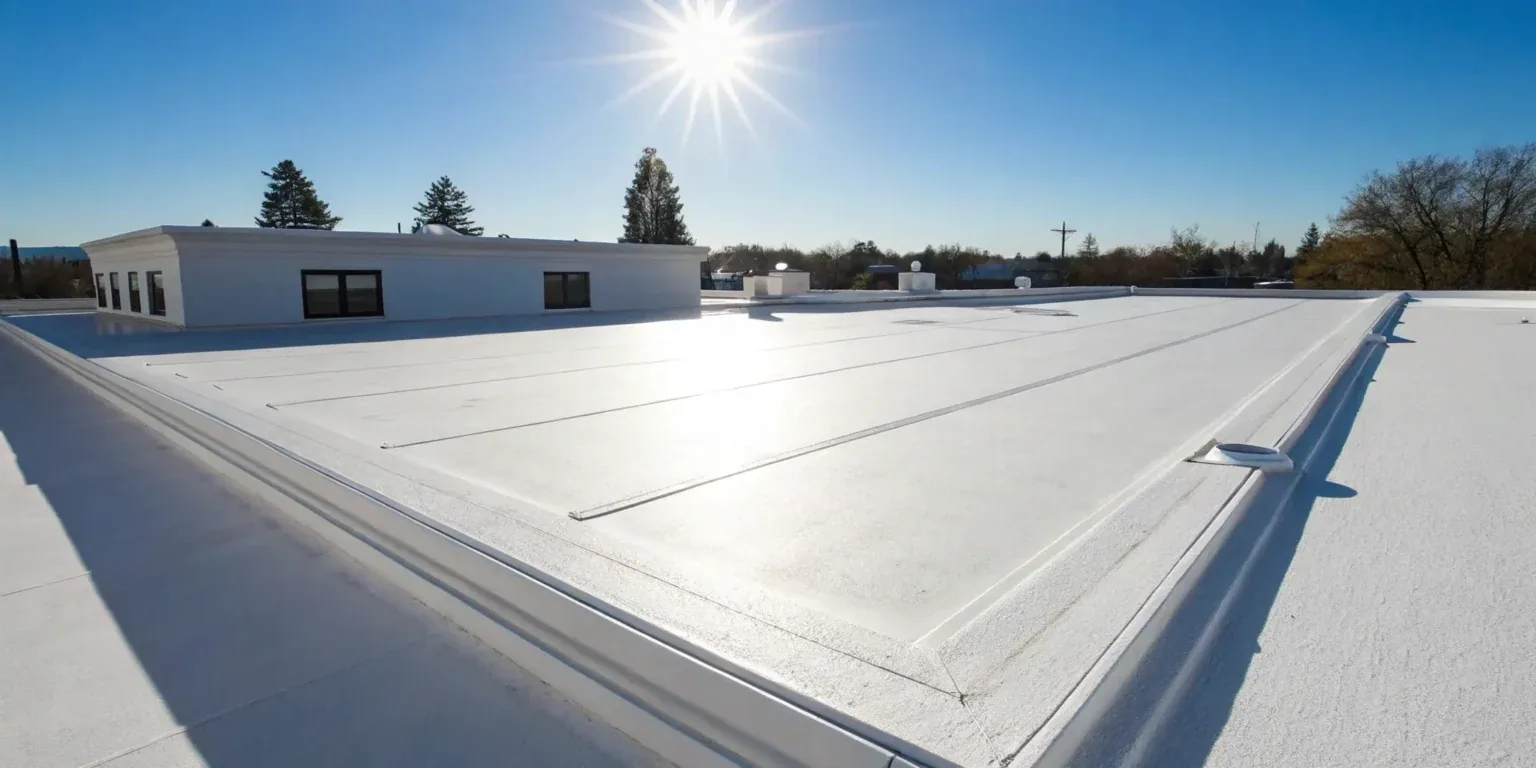
Cold air finds the dew point. In Flagstaff, AZ the first cold comes in late September, and the record is minus 30 degrees F. A warm, humid room under a cold roof deck makes water on the underside of the assembly with no leak at all. That is the first thing to understand about Johns Manville roofs, which pair membranes with a thick layer of insulation board. Johns Manville makes built-up, modified bitumen and single-ply membranes, plus the insulation beneath them. Roofs on these systems come to us for repair and upkeep. Half of the roof is the insulation.
A built-up roof stacks plies of felt, set in hot or cold asphalt, under a surface of gravel or a coating. Modified bitumen is a factory-made sheet with rubber or plastic added to the asphalt, applied by torch, adhesive or mop. Single-ply sheets such as TPO, PVC and EPDM are rolled out and joined at the seams. All three sit on rigid insulation, often polyiso, which gives high R-value per inch. A cover board sits between board and membrane on many roofs. Each part carries a job. The membrane sheds water. The board holds heat. The cover board protects the board. The deck carries the load.
Fasteners and adhesives tie the layers. Board can be mechanically fastened, adhered or set in hot asphalt. Each method resists wind in its own way and each fails in its own way. Fasteners back out in thaw cycles. Adhesive loses grip when the board is wet. Hot asphalt can embrittle with age. We read which method the roof uses before we plan repairs.
Warm interior air carries moisture. Where it meets a cold surface, it turns to water. If the vapor retarder leaks or the insulation is thin, that happens inside the roof. Insulation gets wet from below. The stain looks like a leak, and a patch on top does nothing. Flagstaff's long cold season makes this a real risk in buildings with high interior humidity. We check the vapor retarder, the insulation thickness and the air sealing at walls and penetrations. A moisture scan shows wet board. A core sample shows whether the water came from above or below.
Ventilation and air sealing matter as much as the board. A roof that leaks warm air at the wall top or around a pipe sends moisture straight to the cold deck. We seal gaps at penetrations, check the air barrier at parapets and look at exhaust fans that discharge into the space under the roof. Fixing the air path is cheaper than replacing the board it ruins.
In some areas the February 28, 2023 storm had stacked 24.5 inches of snow by March 2. Collapsed roofs were reported, and the city pointed owners to sagging ceilings, bowing trusses and severe leaks. Insulation board does not carry snow load. The deck does. Crushed or wet board, though, lets the membrane sag into low spots where water ponds, and snow drifts deepen behind parapets and mechanical wells. We mark drift lines and check the deck beneath them. We look from below first and call a structural engineer if the framing shows stress.
On a built-up roof, look for blisters, alligatoring, bare felts and gravel loss. On modified bitumen, look for open laps, granule loss and cracked flashings. On single-ply, probe the seams. On any of them, clear the drains, check the base flashing at every wall and curb, and press the surface near the drains for soft spots. Cut a core in a doubtful area and read the layers. A core tells you how many plies, how thick the board is and where the water sits. Photograph each core and patch the hole the same day. An infrared moisture survey narrows where to core.
Look at the edges too. Edge metal on a roof with thick insulation sits higher than on a thin one. Wind finds a loose joint there. We tighten fasteners, reseal laps and replace sections that have bent. Gutters and downspouts get the same check, because ice backs up at a clogged outlet and works under the edge metal.
A built-up repair uses compatible felts and asphalt, laid to lap the old plies. A modified bitumen repair uses a patch of the same type, torched or adhered to a sound base. A single-ply repair uses a welded or glued patch to match the sheet. Wet board is cut out and replaced with dry board of the same thickness, then the membrane is rebuilt over it. Flashings get the most attention. A built-up roof and a modified bitumen roof both rely on tight flashing at walls. A cover board and insulation upgrade is often the best value in a replacement.
Order of work matters in winter. Stop the water first with a temporary patch. Dry the area. Schedule the permanent repair for a dry stretch above freezing, since torches, adhesives and welds all need workable weather. We record each temporary repair on the roof sketch with the date and the permanent work it waits for. That keeps the stop-gap from turning into the roof.
Northern Arizona University ran 21,550 students through its Flagstaff campus in fall 2023, and its buildings include a 111,000 square foot business college complex and the Walkup Skydome. The campus sits near Butler Avenue and Lone Tree Road in a large ponderosa pine forest at 6,950 feet. Needles and cones fill drains in a forest setting. Downtown Flagstaff holds older masonry buildings, where parapets, drains and old flashing need a close look. The roof type on any one building comes from the walk. The college roof class adds a calendar and quiet hours.
Core the roof before you price a coating, a recover or a replacement. Wet board changes every number. Book the fall walk and the drain clear before October. Write the shoveling plan before the first storm, with plastic tools and no ice chipping at drains. Insulation levels on a replacement follow the 2018 energy code as Flagstaff amended it in 2019. For bitumen and liquid-applied systems, Soprema is the nearer match, and GAF covers the single-ply range.
Put the vapor path in the budget too. If the interior is humid, a better vapor retarder or air seal may do more than a thicker board. We run the dew point calculation on any replacement. It costs little and prevents a wet assembly from the day it goes in.
Look at the timing. A leak follows rain or melt. Condensation follows cold mornings, along beams and fixtures. A moisture scan and a core sample tell the two apart, and the fix differs.
Rarely. Wet board loses R-value and feeds rot in the deck. Cut it out, replace it with dry board and rebuild the membrane over it.
It can be, where the deck is sound and the owner wants redundancy. Multiple plies add protection against punctures. Weight and installation method matter, so check the structure first.
A small hole, patched the same day. The information is worth far more than the patch. We seal each core with matching material.
When the old board tests dry, the deck is sound and the code permits a second layer. If insulation is wet across wide areas, replacement is the better route.
Browse the services, roof systems and building types we work with across Flagstaff and nearby Arizona communities.
A walk of the roof with photos, findings and a written scope.
Active leaks, storm damage and blocked drains get a fast response.
Roofing across Flagstaff and nearby Arizona communities.