
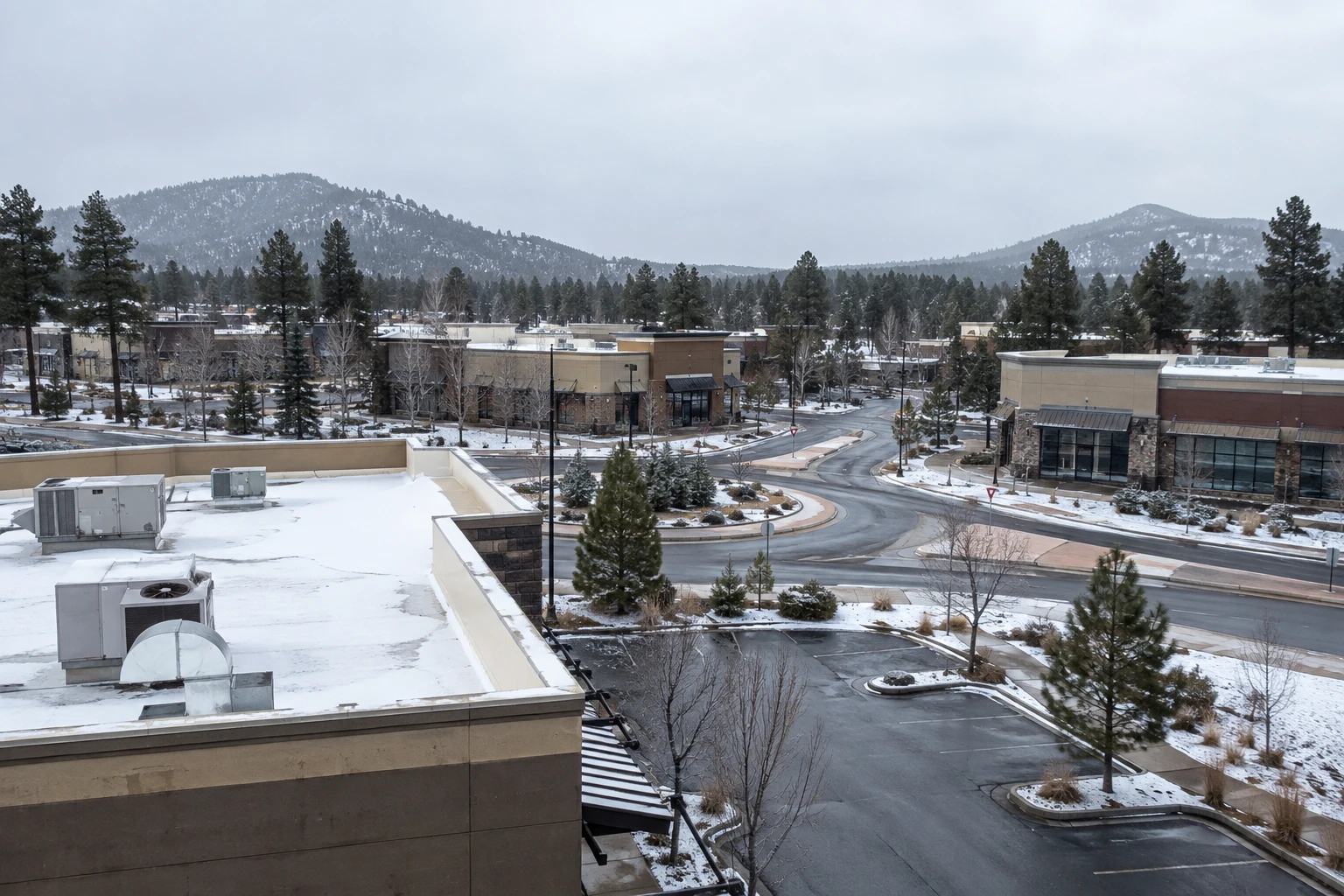
Pine needles clog drains. Snow turns the clog into a pond. Along Butler Avenue and Lone Tree Road in Flagstaff, AZ, the commercial roofs sit near Northern Arizona University, whose main campus lies at 6,950 feet in the middle of a large ponderosa pine forest. Needles, cones and bark can land on any flat roof near the trees, and Flagstaff's snowfall of 90 to 97 inches a year turns a half-blocked drain into a standing pool. We clear the drains first. Then we walk the seams, the flashings and the rooftop units.
I-40 exit 198 serves Butler Avenue, which gained an additional interchange in 1969. Aspen Place at the Sawmill sits where Butler Avenue meets Lone Tree Road near the university, with Whole Foods as the main tenant and others including REI and Wildflower Bread Company as of 2014. That points to a mix of grocery, outdoor retail and restaurant roofs near the university. The age and system of any one roof come from the walk, and the retail class gets the same short list of checks: drains, rooftop units, flashings and edges.
Retail roofs on a strip like this often finish in parapets and long runs of edge metal. Wind lifts loose caps and trim at corners. We check each joint along the run, reseal what has moved and note the footage that needs replacement. Gutters and downspouts get cleared of needles and checked for ice-related sag.
Ponderosa needles are small and sharp, and they pack into strainers like felt. Cones lodge in scupper openings. Bark flakes settle in valleys. A drain that was clear in September can be blocked by December, and snow-melt arrives in February to find it shut. We clear every drain, scupper and gutter on the fall walk and again after leaf and needle drop. We recommend domed strainers where debris is heavy. Overflow scuppers get the same attention, since they are the only path when the primary drain freezes. A drain and scupper review belongs in every plan on this corridor.
Needles hold water. A mat of them on a membrane keeps the surface wet, grows algae and speeds wear. We sweep the field, not just the drains, and look for staining and soft spots under the heaviest cover. Trees near the roof edge also drop limbs in a storm, so we check for punctures and scrapes after wind. A membrane puncture repair is cheaper the day after than the spring after.
Retail roofs carry many rooftop units. Grocery adds refrigeration condensers and exhaust. Each unit sits on a curb with flashing, and each curb is a place for water to enter. Units also build drift. Snow piles on the lee side of each one and sits on the deck for weeks. We map the units on the roof sketch, check every curb and support for flashing and sealant, and mark the drift lines. A walk pad along the service path saves the membrane from daily wear. A grocery store roof adds grease and condensate lines to the list. A leak over a cooler or a produce floor costs product as well as drywall, so those bays rank first.
Refrigeration and exhaust units put heat and moisture on the roof. Condensate lines that drain onto the membrane leave stains and, over time, wear. We route them to drains or splash pads and replace cracked lines. Exhaust discharge can soften some membranes, so we check the area around each fan for blistering. A short written rule set for HVAC and refrigeration vendors keeps one trade from undoing another's repair.
Heat tape helps where a drain freezes every year. We list those drains in the plan. Needles in a gutter also hold ice, and a full gutter of ice can pull away from the fascia.
Between February 28 and March 2, 2023, some Flagstaff neighborhoods collected 24.5 inches, and roofs gave way. City officials tied several collapses to snow load and named the warning signs: dipping ceilings, bowed trusses and heavy leaks. Where a retail bay spans wide, a lot of snow sits on one set of members. Look for dips in the ceiling grid, bowed trusses and doors that stick. Those are structural flags, not leak complaints. Call a structural engineer first. Every walk starts with the sag check from inside the space. The membrane comes second in the written report.
Drift ignores the drawings, and it shifts with each storm. Snow slips from a high roof onto a low one and stacks against the wall between them. A low roof next to a tall wall can take a load far above the open field. We note every step in roof height and check the lower roof's deck. After a big storm, the first walk looks at where the snow actually landed.
The university's main campus, near this corridor, held 21,550 students in the fall of 2023. A university brings a school-year rhythm: busy in term, quiet in summer. Roof work on neighboring properties can follow the same calendar. We schedule noisy steps for hours when classes and events are out, and we plan big jobs for the summer window. A college roof follows the academic calendar, and the retail roofs beside it follow the same traffic.
Access matters near a campus. Foot traffic and deliveries share the streets near a campus, and lifts and hoists need a clear staging area. We plan routes and hours with the property manager so crews do not block fire lanes or loading zones. Debris goes into covered containers and the lot is swept at the end of each day.
Walk the roof in September. The first hard freeze comes right after. Clear the drains, check the curbs and write a shoveling plan with plastic tools. Walk again after the heavy needle drop. A preventive roof maintenance plan puts both walks on the calendar. Hand us the address, the roof material and the last walk date, and the sag and drain checks go on the calendar. Wide retail roofs in East Flagstaff face the same drift questions, and the brick buildings of Downtown Flagstaff face them behind parapets. Roofs with unsound decks need a structural fix before any new membrane.
Spend in this order. Roofs that fail the sag check come first. Roofs with blocked drains or open curb flashings come second. Old but sound roofs get a yearly walk. The order puts the money where the risk sits.
At least twice a year, in early fall and again after the heavy needle drop. Roofs under dense trees may need a third visit before snow-melt season.
They keep needles off the drain opening and let water pass around them. They need a quick clear after storms, but they stop the felt-like mat that blocks flat strainers.
Clear drains, tight curb flashings, sound edges and a snow plan. A sag check from below tells you whether the deck is carrying its load.
Small repairs, yes. We schedule noisy steps after hours and protect entrances. Large replacements fit best in the summer window.
A structural engineer. A dip can come from snow load or from a member that has failed. Roofing work follows their findings.
Browse the services, roof systems and building types we work with across Flagstaff and nearby Arizona communities.
A walk of the roof with photos, findings and a written scope.
Active leaks, storm damage and blocked drains get a fast response.
Roofing across Flagstaff and nearby Arizona communities.