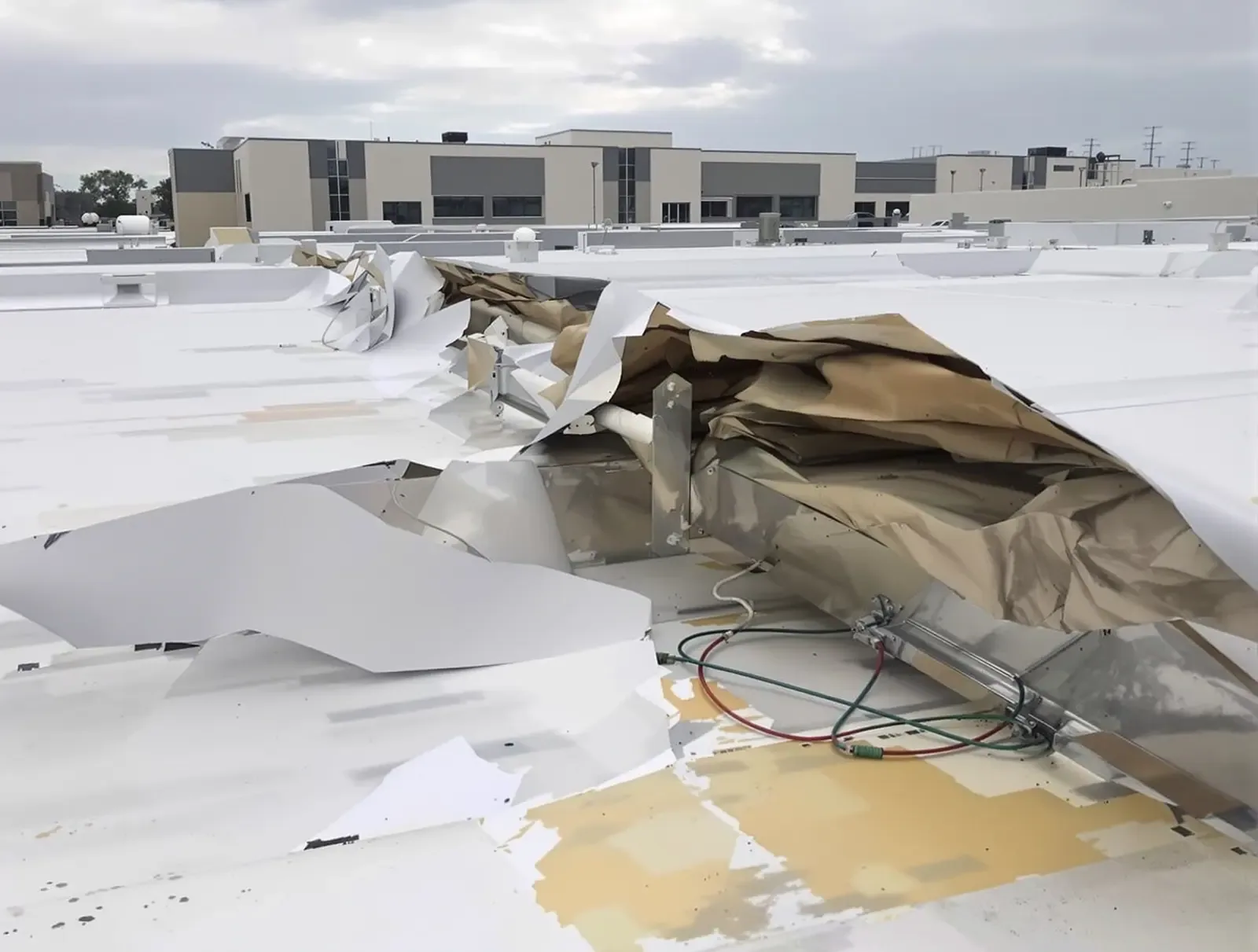
Call from a safe spot, not from the roof. In Flagstaff, AZ the emergencies that matter most are the ones that change how much a building can carry: a sagging ceiling, a bowing truss, a roof edge that has dropped. Those come before leaks. That late February 2023 storm piled 24.5 inches in places, and several roofs came down under it. Commercial Roofing Flagstaff answers every hour of every day, holidays included, and the first job is always to judge whether the building is safe to enter.
Leaks come second. Structure comes first.
The first call tells us which kind of emergency we have. Water coming in through a ceiling is one problem. A ceiling that sags, doors that stick, cracks in the wall or a roof that creaks under snow is another. City officials pointed to sagging ceilings, bowing trusses and severe leaks after the 2023 storm. Stuck doors and new wall cracks are worth reporting alongside them.
If you see structural signs, get people out and call us. We do not recommend that anyone shovel or walk a roof that looks overloaded. We recommend a structural engineer look at the building before anyone goes back in. The city and Coconino County staff a shared phone line for owners who spot structural trouble after heavy snow.
When the problem is water alone, the work shifts to dry-in. The goal is to stop the water within hours and keep the interior safe.
Dry-in is temporary and fast. We locate the opening, cut away wet material where needed and cover it with a membrane patch, sealant, tarp or a combination. On a snow-covered roof, we clear the work area carefully and look for the drift line that created the damage.
We protect the interior in parallel. Buckets and plastic sheeting go up. Ceiling tiles come down before they fall. Electrical gear gets covered. Where water has reached insulation, we mark the wet area so a moisture survey can follow.
A temporary seal in cold weather does not always cure. Sealants need warmth and dry surfaces. We use cold-rated products where we can, and mechanical fastening and temporary membrane where we cannot. Dry-in is a bridge. It holds until the roof is dry enough and warm enough for the permanent repair.
Four kinds of event send us calls. Heavy snow, with its load and the drift against parapets. The thaw that follows, which sends meltwater into every weak spot. The July and August monsoon, which dumps about a third of the yearly moisture in short, hard storms. And wildfire, which has shaped the area since the Tunnel Fire burned 19,088 acres and the Pipeline Fire burned 26,532 acres north of Flagstaff in 2022.
After those fires, monsoon storms caused flash flooding. Neighborhoods along Highway 180 near Schultz Creek face new flood risk from the burn scar. Owners in Fort Valley, Doney Park and Timberline-Fernwood should know the difference between a roof leak and runoff entering at grade. We check both and tell you which is which. Twenty-six homes in Timberline were lost in the Tunnel Fire, which is a reminder of how fast conditions change.
Once the building is dry, storm damage roof repair restores the system.
Winter can slow a response, since storm travel on I-40 and I-17 is slower. From Munds Park, about 21 miles south off I-17 exit 322, and from Bellemont, about 11 miles west on I-40, travel time depends on conditions. We tell you plainly when the road is the limit.
On arrival we look for roof access, power and lighting, and we ask for a person who knows the building. A security guard, a facilities manager or a tenant with a key can save an hour. At night, we bring our own lighting and fall protection.
Have the building address, the roof hatch or ladder location and a contact number ready before you call. Tell us if the roof carries rooftop units, solar equipment or skylights, because each one changes where a crew can stand and where water is likely to enter. Frozen surfaces change what we can do. We clear ice before we step. If it is not safe, we protect from the inside and wait for daylight.
Snow removal can cause the damage it is meant to prevent. A rake or shovel cuts membrane. A pile pushed against a parapet adds load in one spot. Dumping snow off one side of a roof unbalances it. We ask owners to leave heavy removal to people who know the structure.
Where removal is needed, we clear in even strips, leave a few inches of snow on the membrane, and keep piles away from edges and rooftop units. Falling snow and icicles also hurt people, so we close the ground below and use a spotter. A raked slab can slide without warning, and icicles hanging at an eave can hurt a person standing under them.
After removal, we look at the membrane for cuts and at the drains for blockage. Snow cleared this way leaves the building with fewer repairs to make.
A dry-in is not a repair. Within days we return to inspect the whole roof, not just the opening. Storms expose weak details elsewhere: a lifted seam, a loose coping run, a drain that backed up. We check them all.
Then we give you a written scope with photos, the cause, and the permanent repair. If the damage is large, we explain the options, including a commercial roof replacement. We help you document the loss for an insurer. Take photos, keep receipts for temporary work and note the date and weather. That record supports a claim.
Get people out of the area and call us, then call your building engineer. Do not climb onto the roof to shovel. The county and city share a phone line for structural reports after heavy snow. Sagging, bowing and cracks mean the structure is stressed, and that matters more than any leak.
Dry-in work is priced by the crew hours, the materials and the access. The hour of the call, the access to the roof and the size of the opening drive the figure. We give you a number before we start, and we keep a record of what we used. The permanent repair is priced separately after we inspect the roof.
We can stabilize an opening, but we cannot weld, torch or cure most sealants on a frozen, wet surface. We make the roof safe, protect the interior and return when conditions allow. Late spring through early fall, and the dry days between storms, are the best times for permanent work.
Photograph the damage from the inside and the outside before anyone cleans up. Note the date, the weather and the storm. Save receipts for temporary work. We provide a written report with photos and the cause of loss. The insurer decides coverage, but good records move a claim faster.
Yes, along the I-40 and I-17 corridors and into Coconino County. Bellemont, Parks, Williams, Munds Park and Doney Park are all within reach. Response time depends on road conditions, which in winter can change within an hour.
Browse the services, roof systems and building types we work with across Flagstaff and nearby Arizona communities.
A walk of the roof with photos, findings and a written scope.
Active leaks, storm damage and blocked drains get a fast response.
Roofing across Flagstaff and nearby Arizona communities.