
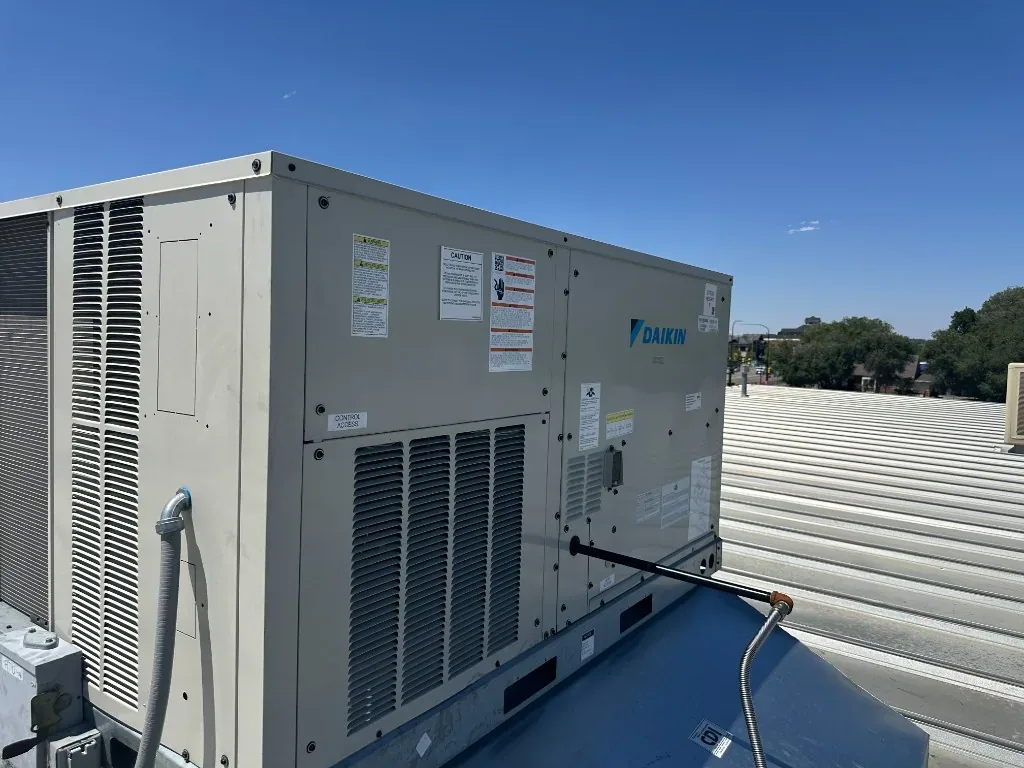
A rooftop unit is a snow trap. It sits up in the wind, and the drift builds on its lee side. In Flagstaff, AZ that drift packs against the curb and can stay frozen for weeks. The curb flashing sits under it the whole time. Commercial Roofing Flagstaff checks curbs, supports and pipe stands before the snow, not after the leak.
Curbs are small. The damage they cause is not. A split flashing at a curb lets meltwater into the deck right under the mechanical room. We look at the curb, the unit, the support and the roof around them as one system.
Wind drops snow behind anything tall. A unit on a roof does that. So does a parapet. A mechanical well, with units set low inside a parapet, does both at once. Drift tends to settle in the same lee spots from one storm to the next.
We mark drift lines on the roof plan. Then we compare them to curb height and flashing height. A curb that is too short lets drifted snow sit against the unit. Meltwater then runs behind the flashing. A short curb that works in a mild climate fails at 7,000 feet, where snow stacks up for months.
Height solves most of this. We raise the curb or add a cricket upslope of it. A cricket is a small peaked section that sheds water around the curb, not into it.
Drainage ties in. A curb on a flat roof sits across the line water wants to take. Water has to go around it. Without a cricket, water ponds upslope of the curb and sits against the flashing. We trace the flow to the nearest outlet and check that the roof drains and scuppers are clear. A frozen drain turns every curb on the roof into a dam.
Curb flashing is where roofs leak. The membrane runs up the curb side. It is held at the top by a counterflashing or a termination bar. Sealant covers the top edge. Thermal movement works on all of it every day.
Freeze-thaw is hard on that sealant. Water gets in a hairline gap. It freezes. The ice pries the gap wider. By spring the flashing has pulled away. We press-test the sealant, lift the edge of the flashing and look for water tracks behind it.
Repairs follow a short order. Clean the surface. Replace failed flashing. Reset the termination bar. Reseal the top. A commercial roof leak repair at a curb ends with a water test where the weather allows.
Gaskets and caps matter too. Many curbs have a cap or a lid over the top. The cap has a gasket. Gaskets dry out. Sun hits them for about 3,475 hours a year here, since Flagstaff averages roughly 78 percent of possible sunshine. We replace gaskets that have gone hard or flat.
Pipes, conduit and gas lines cross the roof on stands. Each stand has a foot. Each foot sits on the membrane. Foot traffic and thermal movement wear the membrane under those feet.
We check every stand for a wear pad. We check that feet are fixed to structure, not just to the membrane. We look for stands that have slid from their layout. A pipe that drags across the roof will wear through it in a few seasons.
Equipment rails carry heavier units. Rails settle. A settled rail makes a low spot, and low spots hold water. We shim and re-level where the structure allows. If the deck under a rail has softened, we flag it. That is a structural note, not a roofing one.
Condensate and refrigerant lines add small penetrations. Each one has a boot. Rubber boots crack in strong sun and cold. We replace boots in groups. A set of cracked boots costs little to fix and a lot to ignore.
Units are heavy. Snow adds more. A roof near a heavy unit carries both. After the February 2023 storm, the city told owners to watch for ceilings that sag, trusses that bow and leaks that worsen, and a heavy unit is a place to look first.
Around each heavy unit we run a sag check. We look at the ceiling below. We look at how the deck deflects. We look for new cracks in walls and doors that stick. If we see a flag, we tell the owner to call a structural engineer. Roof repairs do not fix a framing problem.
If a flag shows, the number to call is the joint city and county line for structural roof trouble after heavy snow. We hand owners that number along with our findings.
Technicians cross the roof to reach units. Every trip wears the membrane. A walk pad path fixes that. We lay pads from the hatch to each unit and around it. We replace pads that have worn thin.
Snow changes the route. A drift can hide a curb. A technician can step into a gap. We mark curbs with tall flags before winter, so they show above the snowpack. The shoveling plan keeps clear paths to each unit.
Frozen condensate is the other winter problem. A drain line that dumps on the roof makes an ice patch. The patch grows. It lifts membrane and blocks the path. We route condensate to a drain or heat-trace the line where the unit allows.
Shoveling plans need care. Crews that clear a roof should work away from curbs, not against them, and use plastic shovels near flashing. A metal blade can cut membrane at a curb base. We write the shoveling plan with the curb locations marked, so clearing stays safe for the roof and the crew.
Different buildings hold different equipment. Downtown brick buildings in the Railroad Addition Historic District, listed in 1983, call for a careful look at what each deck can carry. On Mike's Pike, the mostly industrial half-mile of old Route 66, any unit set on rails needs its settling checked. Retail roofs along Butler Avenue, near I-40 exit 198, collect units like any others. Each one needs its own check.
Owners with several roofs can get a curb log for each. Owners in Southside and Mike's Pike or along Butler Avenue and Lone Tree can have units mapped across every roof they hold. A big-box retail roof with many units should have a curb log. A preventive roof maintenance plan keeps that log current.
Taller than the drift line. Check last winter's snow depth against the curb. If snow reached the top, the curb is too short. We raise it or add a cricket upslope. Measure at the lee side, where the drift sits.
Yes. The leak can sit behind the flashing. Water tracks down the curb side and into the deck. We lift the flashing edge and check behind it. A water test confirms the fix.
Before the first freeze. Press the bead with a probe. If it is hard, cracked or pulled back, cut it out and reseal. Do it in early fall, when the roof is dry and the weather is mild.
The ceiling below, the deck deflection, wall cracks and sticking doors near each heavy unit. Any flag goes to the owner as a structural note. Call a structural engineer for framing problems.
They need to be fixed to structure, with a wear pad under each foot. A stand that sits only on membrane will drag and wear it. We check layout, fasteners and pads each visit.
Browse the services, roof systems and building types we work with across Flagstaff and nearby Arizona communities.
A walk of the roof with photos, findings and a written scope.
Active leaks, storm damage and blocked drains get a fast response.
Roofing across Flagstaff and nearby Arizona communities.