
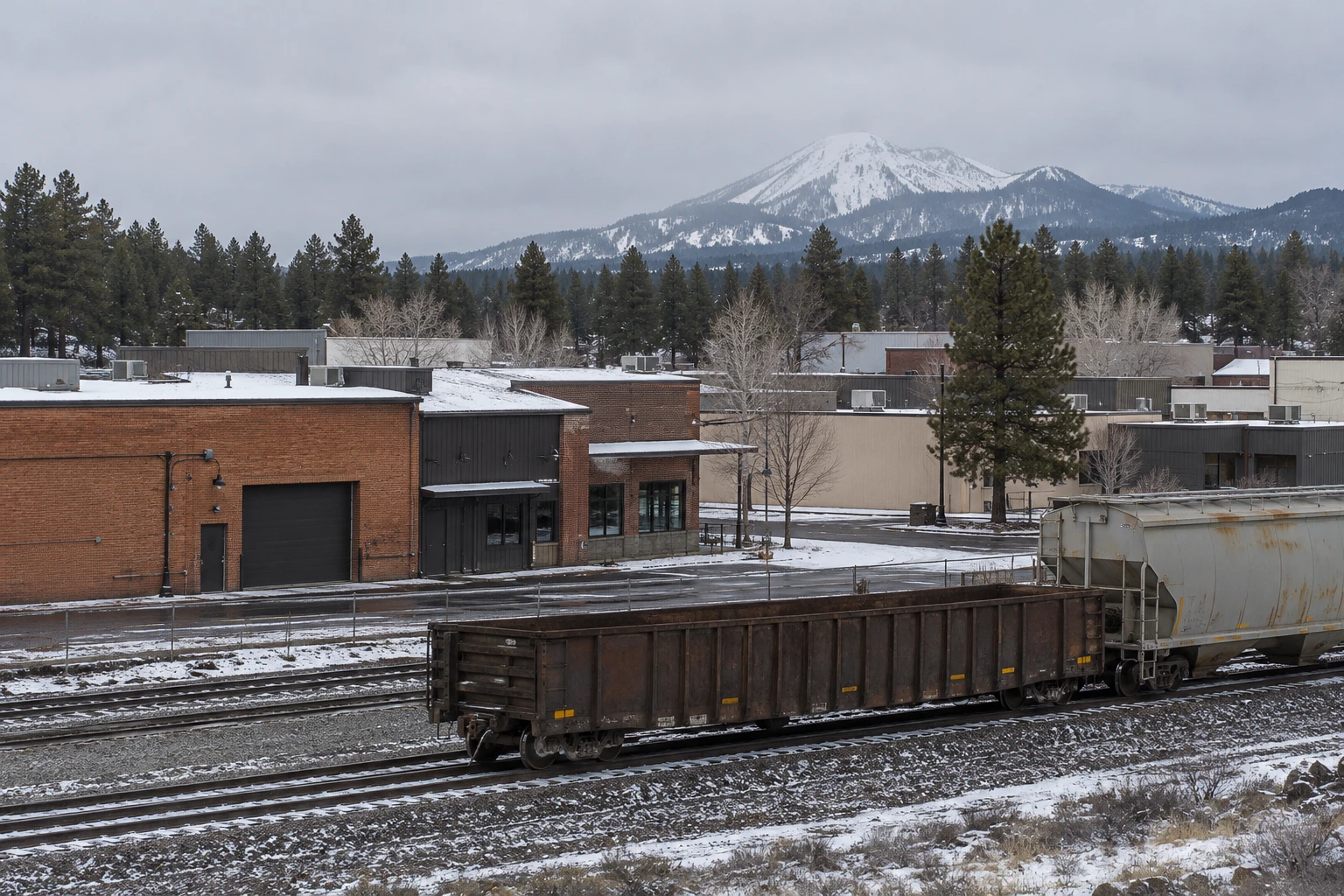
A metal roof slides. Snow on a smooth panel lets go all at once, and what lands below is a sheet of ice weighing tons. Mike's Pike runs half a mile along a pre-1934 alignment of Route 66 in Flagstaff, AZ, and its buildings are mostly industrial: boxy, in metal, wood or concrete. Each of those roofs takes Flagstaff's yearly snow, which runs 90 to 97 inches. We start with the load and the slide path. Then we walk the fasteners, the seams and the drains. Southside as a whole is a National Register historic district, which adds approval questions to some jobs.
The BNSF Southern Transcon runs alongside Route 66 and Santa Fe Avenue, so Mike's Pike roofs sit in a rail and industrial setting. City officials expected the area to revitalize after sidewalk repairs, new street lights and completion of the Rio de Flag drainage project. Revitalization can bring tenant changes, and tenant changes can bring roof work: new units, new penetrations and new loads. Mike's Pike mixes metal, wooden and concrete buildings, and each one gets its own walk.
Industrial roofs elsewhere in Flagstaff get the same checks. An owner with a building in the airport technology park area near I-17 and SR 89A as well can have both roofs walked in one visit. Newer roofs need a baseline, older ones need a moisture scan, and both need the sag check before the first storm.
Metal panels expand in heat and shrink in cold. Flagstaff's record low is minus 30 degrees F, and freezing returns in late September. Through-fastened panels ride on screws that work loose with every cycle. The rubber washer cracks, the hole widens and water follows the screw. We check fastener heads, laps, ridge caps and end closures. We look at rust at cut edges and at the lowest panel run. A standing seam metal roof hides the fasteners under clips and lets the panels float. It still needs clean seams and sound flashing at every penetration.
Condensation can mimic a leak under a metal roof. Warm, humid air inside meets a cold panel and drips. The stain shows after cold mornings, not after rain. We check insulation facing, air sealing at the eaves and vent paths before we cut into a roof that may be sound. If condensation is the cause, a patch on the roof does nothing, and the fix lives in the assembly below.
Snow on a metal roof slides without warning. A slide can crush a car, block a door or hurt a person. Snow guards or a snow fence hold the pack on the roof so it melts in place. We check where each slope sheds: over a walkway, a dock door, a gas meter or a neighbor's lot. If the slope sheds somewhere it should not, we add guards or change the plan. A snow and ice damage repair call often starts with a slide that tore off a gutter or bent an eave.
Gutters take the first hit. A slide tears them off or crushes them, and a clogged gutter holds ice that works under the eave panel. We check hangers, outlets and downspouts on the fall walk. Heated cable can help at chronic problem spots. Where a slide path crosses a dock door, we add guards above it and mark the area for staff.
Flagstaff's storm of late February 2023 left 24.5 inches in some areas, and snow load brought roofs down. Officials gave owners three signs to watch: a sagging ceiling, a bowing truss, a severe leak. In a boxy building, the framing carries everything the roof collects. A sag can mean the roof has more weight than it was built to carry. If a ceiling dips, a truss bows or an overhead door sticks, call a structural engineer first. We run the sag check from below on every walk and report it before we talk about membranes or panels.
Rooftop equipment adds load. A new unit set near the middle of a span loads the framing in a way the original design may not have counted. We record each unit and its position on the sketch and flag any addition that looks heavy for the span.
Not every roof is metal. Concrete and wooden buildings often carry low-slope roofs behind parapets or walls. The checks shift. Drains, scuppers and base flashings come first. Drift lines pile behind walls and rooftop equipment. Wooden decks hold moisture longer than steel, so a slow leak can rot a board before anyone sees a stain. A moisture scan and a core show what the roof has absorbed. A warehouse roof and a flex building roof both follow this pattern.
Rail vibration and heavy trucks shake walls and edges. A low-slope roof near a track or a loading lane can show cracked sealant at parapets and loose edge metal sooner than a quiet one. We press the cap joints, check the fasteners and reseal what has moved. Overhead door tracks also tie into walls near the roof line, and a bent track can open a leak at the wall top.
Fix the water first. Clear drains, reset fasteners, reseal laps and patch openings. A sound steel roof with a chalked finish may take a roof coating. A roof with rusted-through panels may suit a metal roof retrofit over the old deck. A low-slope roof with wet insulation needs a section replacement or a full replacement. We cut a sample, measure the steel and read the layers before we recommend. The scope lists the cost drivers: area, panel gauge, access, deck condition and the number of penetrations.
Timing helps cost. Coatings and retrofits need dry weather and moderate temperatures, so they wait for late spring through early fall. Booking early lets the owner pick the window before it fills. Temporary repairs hold the building through winter, and the file marks each one so none turns into the roof.
Walk the roof in September. Reset loose fasteners, clear gutters and check the slide paths. Write a shoveling plan with who goes up and which tools are allowed. Send the address and roof type with the last walk date, and we book the sag check and the drain check. An owner with property in both Downtown Flagstaff and Southside can have the two walks done together. Any replacement has to meet Flagstaff's 2019 local amendments to the 2018 building and energy codes.
Yes, if the slope sheds over a door, walkway, vehicle or neighbor. Guards hold the pack so it melts in place. We check each slide path on the fall walk.
Heat and cold move the panels, and each cycle works the screws loose. Washers crack and holes widen. We reset or replace fasteners and reseal laps.
Light surface rust can be cleaned and coated. Rusted-through panels cannot. We cut a sample and measure the steel before deciding.
Keep people out of the bay and bring in a structural engineer. The dip may trace to snow weight or to a framing member that has given way. Roof work starts only after the engineer reports.
When the deck and framing are sound and the old panels are failing. A retrofit goes over the old roof and avoids tear-off. A structural check comes first.
Browse the services, roof systems and building types we work with across Flagstaff and nearby Arizona communities.
A walk of the roof with photos, findings and a written scope.
Active leaks, storm damage and blocked drains get a fast response.
Roofing across Flagstaff and nearby Arizona communities.