
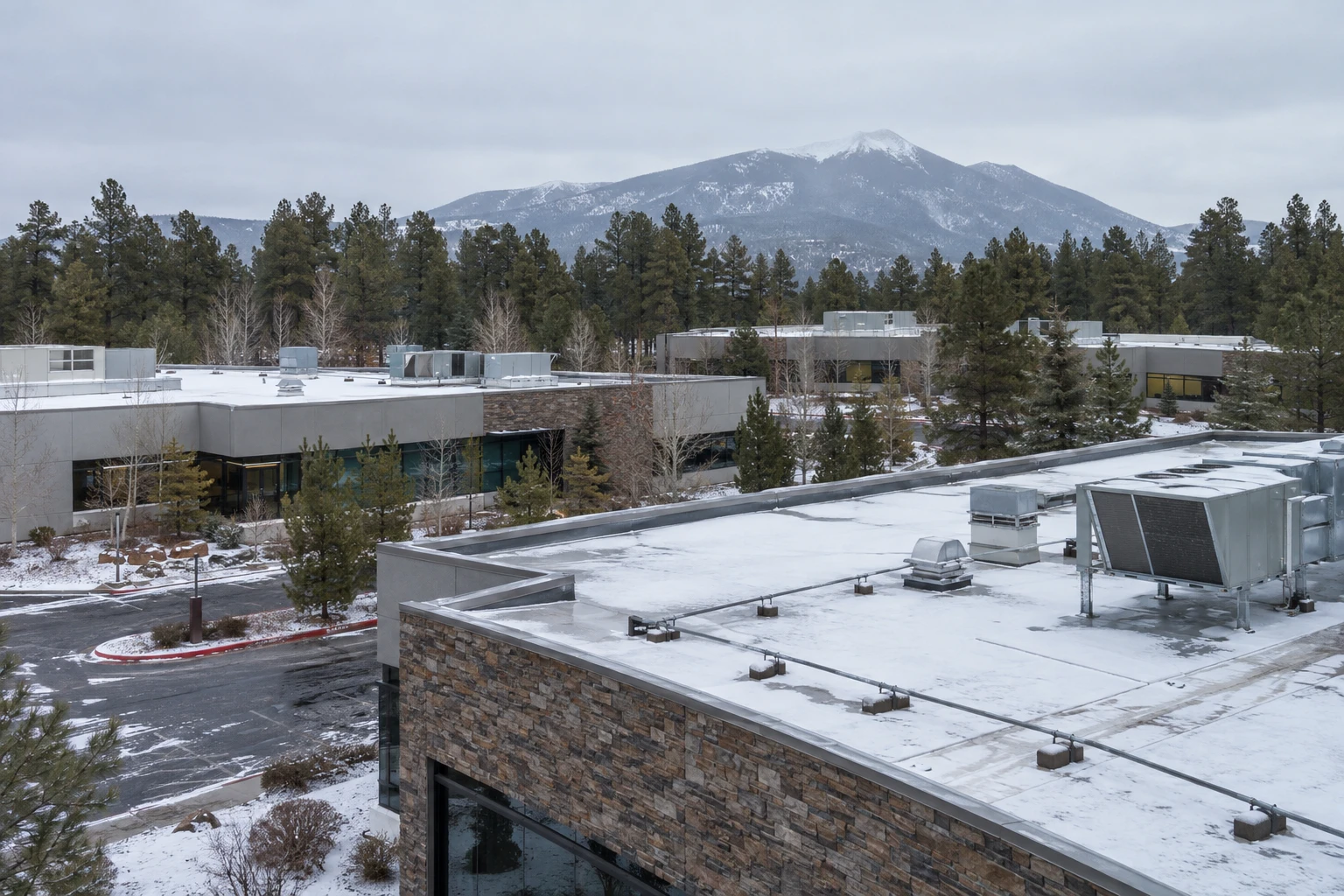
New roofs fail small, then fail fast. A fastener set high, a lap rushed in the cold or a drain installed an inch proud looks like nothing in year one. By year three it is a leak. The Northern Arizona Technology Park is about 31 acres of city-owned airport land south of Flagstaff, AZ, aimed at bioscience, advanced manufacturing, aerospace and technology. Roofs in the park and along the I-17 and SR 89A corridor around it carry Flagstaff's 90 to 97 inches of snow a year. We baseline new roofs early, then keep the file current. The year-one record is what the year-ten walk gets measured against.
I-17 exit 337 on SR 89A, John Wesley Powell Boulevard, serves the district. The park has direct access to I-17, I-40 and SR 89A. That sets the haul route for crews and materials. The first phase brings a hotel, a restaurant and the first office and research buildings. The park is built on airport land the city owns, with the airport itself about 5 miles south of downtown. That is the setting. The roofs in question are the offices, research buildings, shells and hotel in the business district around it.
The district is a business park, not a single tenant, and we read it that way. Each building gets its own walk, and the roof type comes from the walk. Low-slope membranes and metal panels are the usual choices for offices, labs and larger shells.
Access follows the land. Access rules come from whoever manages the parcel, and on city-owned land the city is part of that answer, so gates, staging areas and the height and position of a lift or crane are confirmed first. We confirm those rules before the crew arrives, so the first day does not become a waiting day.
Walk a new roof within the first year. Scan for moisture where the system allows. Probe the seams. Check the fasteners and plates. Press the surface near each drain. Look at the flashing at every wall, curb and pipe. Check the edge metal and the cap. Look for construction debris, sealant that never cured and walk paths that are already wearing. Write a punch list. Photograph everything. The file fixes the starting point for warranty questions. A due diligence roof survey gives a buyer or lender the same facts in their format.
Records from the builder help. Gather what was installed, when and with what attachment. Keep the as-built drawings, the product data and the warranty paperwork in one folder. When the roof is walked, compare the as-built with what is actually there. Differences show where a field change was made, and field changes are where early problems tend to start.
In the three days after February 28, 2023, parts of Flagstaff took 24.5 inches of snow, and city officials counted roof collapses. Its warning list ran from ceilings that sag to trusses that bow to leaks that turn severe. A new building is designed for a snow load, and it should carry it. Still, drifts form where design assumptions miss: behind a rooftop unit added late, against a taller wing or beside a parapet. We mark drift lines on the roof sketch and check the deck beneath them. If a ceiling dips in any building, call a structural engineer first.
Drainage on a new roof must be proved. Water-test each drain before the first storm, and watch the first thaw. If a pond lingers, the fix is easy in year one and costly in year ten, when the membrane at the pond edge has aged. Overflow scuppers get the same test. Snow-melt finds the weakness the design drawing missed.
A hotel roof sits over guest rooms, and a restaurant roof sits over a kitchen. Both mean exhaust, rooftop units, vents and many penetrations. Each is a seal to check. We map the penetrations, probe the flashings and look for grease staining near fans. A stain over a guest room shows below before it shows on the roof, so the walk includes the ceilings. Work near an occupied hotel follows quiet-hour rules, with noisy steps early and intakes protected. Cold-applied and welded systems cut odor near open windows.
Exhaust and make-up air units are the big penetrations on a hotel and kitchen roof. Their curbs take vibration, heat and grease. We check the curb corners, the sealant under each unit and the membrane around each discharge. Walk pads protect the sheet along service paths. A short list of rules for the mechanical contractor keeps repairs from being undone.
A business park on open ground catches wind from every side. Few tall neighbors block it, so edge metal, coping and the first rows of membrane take the load. Corners see the strongest uplift, so we check fasteners and plates there before the field. A new office building roof is only as good as its perimeter attachment.
Buildings of mixed heights share a park like this one. Where a taller wing meets a lower roof, snow slides off the high side and packs against the wall. The tie-in between the two roofs gets a close look on the first-year walk, along with the deck below it.
Fix early items now: reset fasteners, reseal flashings, correct drains. Tapered insulation and cover board fix ponding and add impact resistance, so roof insulation and cover board belong on the first-year punch list when a pond lingers. Owners planning solar can lay out the roof for solar-ready roofing, which keeps arrays off drains and drift lines. Any new roof work in the city follows the 2018 building and energy codes as amended in 2019, which sets the starting point for insulation depth and attachment. Cost drivers are area, access, insulation, attachment and the number of penetrations.
Research and lab space adds its own sensitivity. Instruments, clean rooms and stored materials do not tolerate water, so a leak over such space costs far more than the repair. We scan the roof over those rooms first and set a tighter inspection cycle for them. Where exhaust from lab equipment reaches the roof, we check the membrane around each discharge for chemical staining or softening.
Baseline the roof this year. Walk it in early fall, ahead of the first hard freeze in late September. Clear the drains and check the curbs. Write a shoveling plan with plastic tools. Fall and spring give workable windows.
Newer shells look nothing like the retail roofs near the university on Butler Avenue and Lone Tree Road or the boxy industrial ones in Southside and Mike's Pike, which is why each building here gets its own file.
Budget by risk. Roofs over sensitive space come first. Roofs with punch-list items come second. Sound new roofs go on a yearly walk. That order keeps the first leak from landing on the most expensive floor.
Within the first year, before the first full winter. Early fixes are cheap and the baseline settles later arguments about what was already wrong.
A sketch with drains and penetrations, dated photographs, a moisture scan where possible, a punch list and the warranty paperwork.
Design assumes simple wind and snow patterns. Added units, taller wings and nearby buildings change them. We walk after the first big storm to see where snow landed.
In phases, yes. We schedule noisy steps early, protect air intakes and close in each section daily. The manager gets a daily note.
Whoever manages the parcel, with the city involved since the park sits on city-owned airport land. We get their height and position limits before the equipment is set.
Browse the services, roof systems and building types we work with across Flagstaff and nearby Arizona communities.
A walk of the roof with photos, findings and a written scope.
Active leaks, storm damage and blocked drains get a fast response.
Roofing across Flagstaff and nearby Arizona communities.