
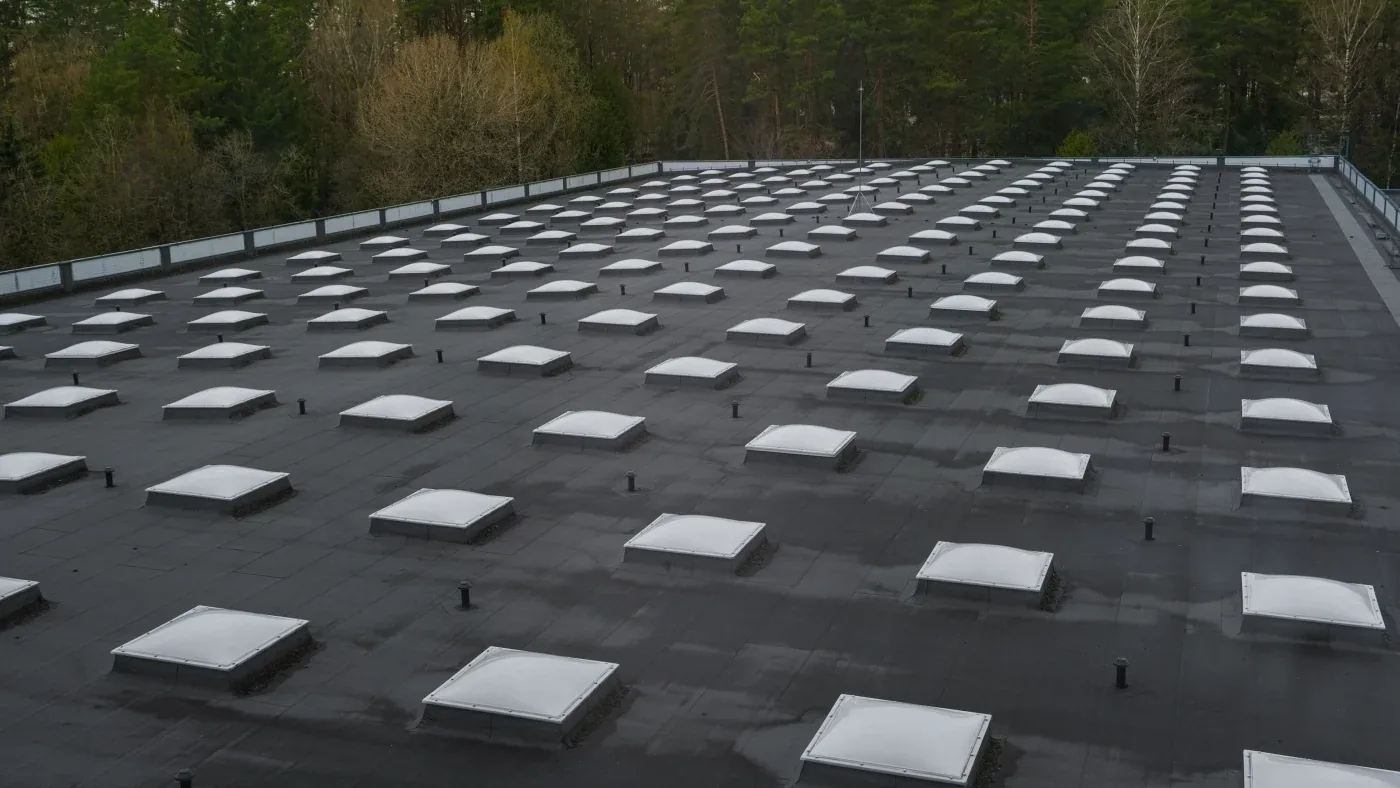
The insulation does two jobs here. It keeps heat in the building, and it carries the snow. A soft or wet board fails at both. Flagstaff, AZ sits near 7,000 feet, takes about 90 to 97 inches of snow in a year and has seen a record low of minus 30 degrees F. A roof that holds its heat and its shape through that is a roof with the right layers under the membrane.
We design and repair those layers. Insulation, tapered sections and cover board decide how the roof drains, how it carries load and how long the membrane lasts.
Snow is weight. A deep drift behind a parapet or a mechanical well loads one patch of roof far more than the rest. Insulation sits between that weight and the deck, so it must resist crushing.
Boards differ in compressive strength. Soft board dents under foot traffic and under a heavy drift. Over time the dent holds water and the membrane stretches over it. Dense board and a cover board spread the load.
We check the roof for crushed areas, soft spots and ridges. Where we find them, we cut out the damaged board and replace it with one rated for the load. We tell the owner where drifts form and recommend firmer board there.
The late February 2023 storm stacked up to 24.5 inches on parts of Flagstaff, and several roof collapses followed. Structure decides collapse, not insulation. But a compressed board is a sign that the roof is working hard.
Fasteners and adhesives play a part. Mechanical fasteners hold boards to the deck, and rusted or backed-out fasteners let boards shift. Adhered boards rely on the bond. We check both during a core review, and we replace what is loose before a new membrane goes on.
Warm, humid air from inside rises toward the roof. In deep cold, the deck is far colder than the room, and the air condenses where the two meet. Water collects in the insulation or on the underside of the deck. The ceiling stains, and no one finds a hole.
The fix is a vapor retarder in the right place and an air seal at the deck, walls and penetrations. We find the pattern with a moisture scan and cores. If the board is wet at the bottom, vapor is the likely cause. If it is wet at the top, water is entering from above.
Wet insulation loses its value and freezes. Freeze-thaw cycles crush wet board and split seams above it. We cut out wet sections and replace them. We seal the air leaks that fed them. An infrared moisture survey shows where the wetness runs.
Air leaks do as much harm as vapor diffusion. Gaps at the deck edge, around penetrations and at wall transitions let warm air move straight up. Foam, tape and sealant at those spots stop it. The cost is small. The saved insulation is large.
A flat roof is never flat. It should slope toward drains. Tapered insulation builds that slope into the board. Each piece is cut at a small angle, and the set pushes water toward an outlet. Crickets do the same behind curbs and walls.
Slope matters on a Flagstaff roof because ponded water freezes. Monsoon rain in summer and snowmelt in winter both need a clear fall to an outlet. Water that sits on a roof freezes in winter and cracks seams.
We lay out tapers from a plan of the drains and the low spots. We confirm with a level after install. A taper costs more than flat board, and it earns the difference in drainage. Our roof drains and scuppers work starts from the same slope measurements.
A cover board sits between the insulation and the membrane. It resists foot traffic, dropped tools and ice. It gives the membrane a firm, flat base. It also separates the insulation from the heat of some adhesives.
Cover boards earn their place on roofs with heavy traffic, many units or a history of punctures. They also help where snow removal tools may touch the roof. A board spreads a point load and lowers the odds of a tear.
We pick the board for the membrane and the attachment. Some boards suit adhered sheets. Others suit mechanically attached ones. We check manufacturer compatibility before we order. A roof recover overlay often adds a cover board over dry existing insulation, which improves the base without tear-off.
Fire and wind ratings can depend on the cover board. Some assemblies get their rating from a specific board. We check the assembly listing before we swap a board, because a substitute can void the rating.
Flagstaff enforces the 2018 building and energy codes, with 2019 local amendments in City Code Title 4. A replacement that opens the roof can trigger current insulation requirements. The amount depends on the project and the edition.
We confirm the requirements with the permit office before we price a job. We also confirm structural limits. More insulation means more thickness and sometimes more weight. A tapered layer and a cover board add dead load. The deck and framing must carry it plus the snow.
When the structure is in question, an engineer decides. We design the layers to the allowed load and tell the owner what the limit is. A commercial roof replacement plan includes that check from the start.
Industrial parks cluster along I-40 and I-17, and Phase I of the Northern Arizona Technology Park near Pulliam Airport calls for a hotel, a restaurant and office and research space. A new roof on any of them should get a baseline moisture scan at turnover. A roof in East Flagstaff or the airport technology park area that has been patched more than once deserves a layer-by-layer review. Cores show what is under the membrane.
Along Mike's Pike in Southside, the old Route 66 stretch, the buildings run industrial. Any warehouse roof in that kind of district gets the same review: cores for the layers, a scan for wet board and a look at the drift lines at walls.
The adopted energy code sets the minimum, and the City of Flagstaff uses the 2018 edition with local amendments. Go above the minimum only if the deck and framing can carry the added weight with snow on top. We confirm both with the permit office and an engineer where needed.
Condensation, in many cases. Warm, humid air rises, meets the cold deck and turns to water. A moisture scan and cores show whether the board is wet at the bottom, which points to vapor, or at the top, which points to a leak.
On roofs with foot traffic, many units or past punctures, yes. It protects the insulation and gives the membrane a firm base. On a quiet roof with dense insulation, it may be optional. We price both and show the tradeoff.
Yes, when the cause is slope. It builds a fall toward drains. If the cause is a clogged drain or a sagging deck, tapered board will not help, so we measure first.
No. Wet board holds water, freezes and crushes. Cut it out and replace it. A coating or a new membrane over wet board hides the problem and speeds the failure.
Browse the services, roof systems and building types we work with across Flagstaff and nearby Arizona communities.
A walk of the roof with photos, findings and a written scope.
Active leaks, storm damage and blocked drains get a fast response.
Roofing across Flagstaff and nearby Arizona communities.