
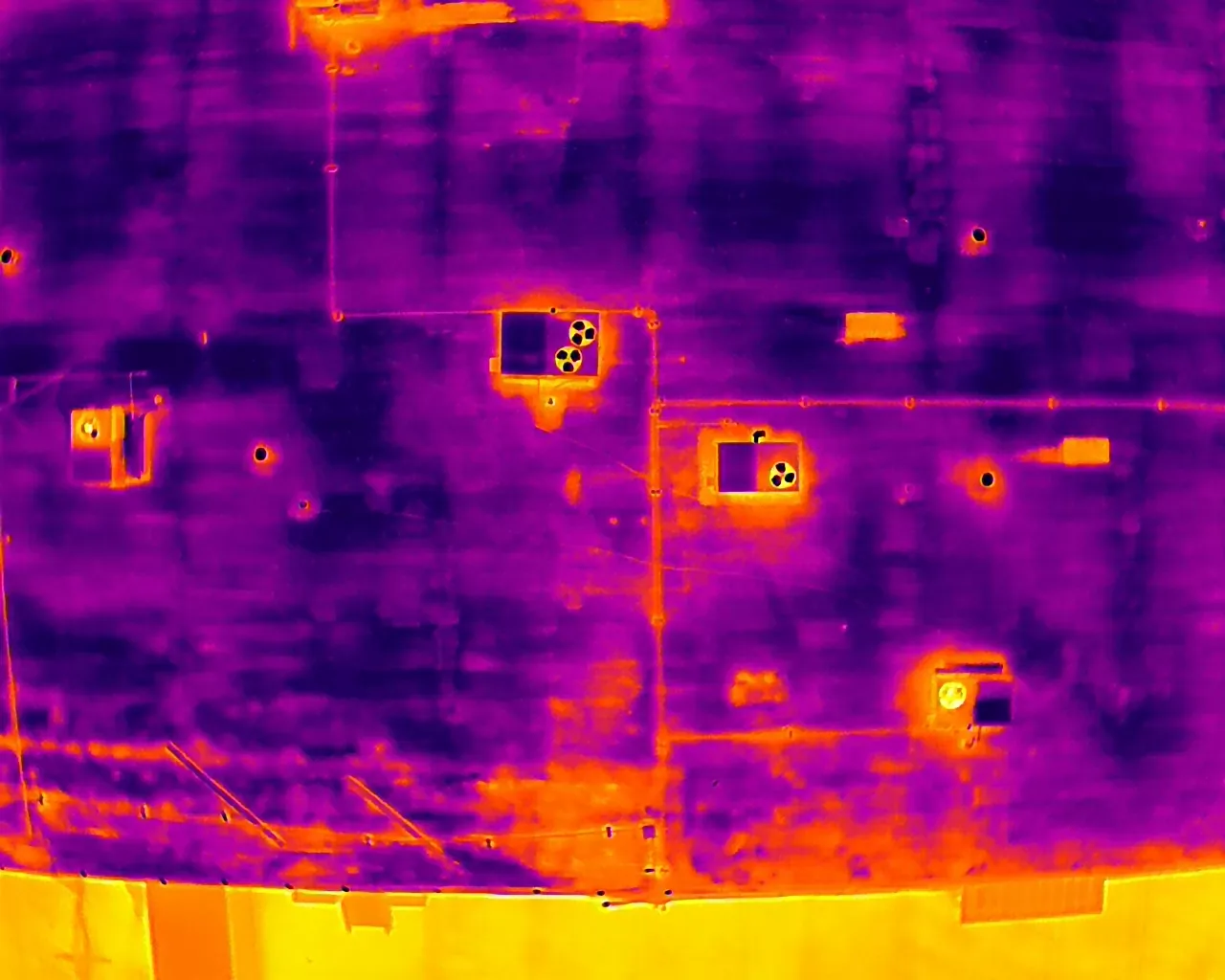
Water under a roof does not stay quiet in Flagstaff, AZ. It freezes, expands and pushes layers apart, then thaws and spreads. A leak you can see on a ceiling is the last stage of a problem that began months earlier in the insulation. Commercial Roofing Flagstaff finds that water early. We scan the roof with an infrared camera, confirm with moisture meters and core cuts, and hand you a map of what is wet and what is dry. That map decides whether you patch, recover or replace.
Without the map, a repair budget follows the stain on the ceiling. With it, the money goes to the wet insulation. Send us the roof age, the system type and every leak report you have. The history tells us where to look first and which patches to test.
Wet insulation holds heat longer than dry insulation. After a sunny day, the sun-warmed roof cools in the evening, and wet areas stay warmer than the dry ones around them. An infrared camera sees that difference as a bright patch.
We scan at dusk or in the first hours after sunset on a clear, dry day, with the roof surface dry. Then we walk the roof, mark the anomalies with paint and confirm each with a moisture meter. Where the readings are unclear, we cut a core, look at the layers and measure the moisture directly.
A scan that skips the confirmation step produces false positives. A shadow, a patch of old tar or a different insulation type can look like water. The meter and the core settle the question.
Scanning depends on weather. The roof must be dry, the sky mostly clear and the temperature gradient strong enough to show differences. Snow or frost hides the signal. A roof under a winter snowpack cannot be scanned at all, and the cold season starts in late September, so the good scanning season runs from late spring through early fall.
Afternoon thunderstorms in July and August break up the summer calendar and push scans to clear evenings. Evening scans after a dry day work best. We watch the forecast and book around it.
Winter is not a dead season. If a roof leaks in February, we can use core cuts and meters to find the wet area, and then confirm with infrared once the roof clears. Plan the full survey for spring, before capital decisions are made.
A core cut is a small round sample taken through the roof down to the deck. It shows the membrane type, the insulation thickness, the condition of the layers and whether moisture is present. We patch every core the same day with a matched repair.
Cores answer questions the camera cannot. How many layers are there? Is there an old roof under the current one? Is the insulation polyiso, perlite or something else? Is the deck steel, concrete or wood? That information shapes the repair, the recover option and the replacement scope. It also tells us whether the existing assembly meets current energy code. Flagstaff works under the 2018 International Energy Conservation Code with local amendments, and insulation depth is one of the items that can change in a replacement.
The survey ends with a roof plan. Wet areas are outlined, labeled and tied to photos. We estimate the share of the roof affected and give a recommendation.
The decision rule is simple. If wet areas are small and local, we cut them out and handle it as commercial roof repair. If they are scattered across the field, a recover is not an option, because a second membrane would trap the water. If they cover a large share of the roof, replacement costs less than repairs that keep coming back. When the insulation tests dry, a roof recover becomes a real option.
The map also guides drainage. Wet areas often sit near drains, curbs and low spots, which tells us where water enters.
The city tied several roof collapses to the storm that closed February 2023, and snow of that depth sits on the membrane for days. Roofs that held through it may still have taken in water at seams and flashings. A scan in the first dry stretch after the melt shows whether the insulation took on moisture, before the next freeze locks it in.
The same applies to monsoon damage. A roof that took a heavy July cloudburst can hold water under the membrane for weeks. A scan within a few weeks, on a clear evening, finds it while repair is still small. Owners in Doney Park and Timberline-Fernwood, where flash flooding followed the 2022 Tunnel Fire, should put any building with a past leak on a repeat scan schedule.
On a wide roof, a drone roof inspection can pick the scan zones before the infrared and meter work starts on foot. A commercial roof inspection fills in the seam and flashing detail around the wet areas.
Property managers use the survey to rank buildings. Buyers use it in due diligence, since wet insulation is a hidden cost. A lender may ask for it before a loan, and an insurer may ask after a storm. Owners use it to plan capital spending.
It matters most where the building matters most. In the downtown Railroad Addition, historic commercial buildings carry the age of their construction and the cost of a surprise is high. Along Mike's Pike, industrial buildings of metal, wood and concrete have a roof that has to keep working, so knowing where water sits matters.
A baseline survey on a new roof is worth doing too. It records the dry state, so future scans have something to compare.
Yes, but it is harder. Ballast and gravel hide the membrane and mask heat patterns. We use meters and cores more heavily on those roofs and pull back ballast in sample areas. The result is less like a picture and more like a grid of readings, which still tells us where water sits.
A survey costs a fraction of a replacement. A wrong decision, like recovering over wet insulation, can cost the full replacement later and possibly a second tear-off. We scope the survey to the roof size and the number of cores needed, and we give you the number before we start.
Often, yes. A leak is the visible end of a wet path. The insulation around the opening may be saturated for dozens of feet. Cutting out only the stain leaves wet material in place. A scan shows how far the water has spread.
Wind, rain, snow cover and heavy cloud all weaken the signal. A hot, clear day followed by a calm, dry evening gives the best result. In Flagstaff, that usually means late spring and early fall, with care around the afternoon thunderstorms of July and August.
The scan does not. Cores make small holes that we seal the same day. We choose core locations to answer specific questions, and we avoid areas that already look suspect. A properly patched core is sealed and flashed the same day it is cut.
Browse the services, roof systems and building types we work with across Flagstaff and nearby Arizona communities.
A walk of the roof with photos, findings and a written scope.
Active leaks, storm damage and blocked drains get a fast response.
Roofing across Flagstaff and nearby Arizona communities.