
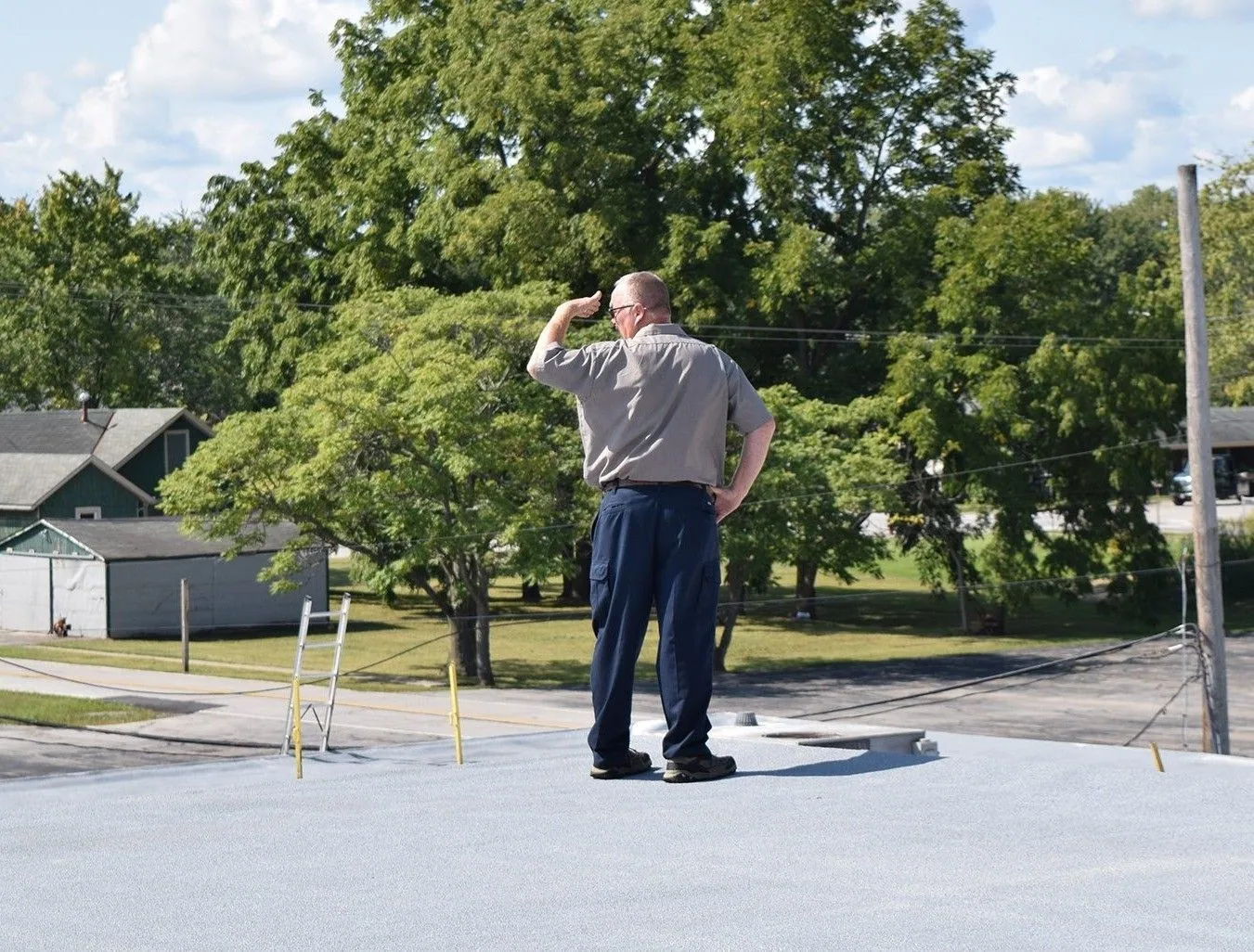
A buyer in Flagstaff, AZ who skips the roof is buying the winter's decision. Commercial Roofing Flagstaff runs roof surveys for acquisitions, refinancing and lender reviews, and the product is a short, hard document: what the roof is, what shape it is in, what it will need and when. The timeline is tight, because closings do not wait for thaw. The survey is built to fit inside the window the deal allows.
Snow makes this different from a warm-climate survey. A roof can look clean in July and carry a sagging deck, a frozen drain line or a wet insulation layer that only winter reveals. The survey has to see through the season.
Every survey follows a fixed scope so reports compare cleanly across buildings.
The survey is read-only. We do not fix anything during the visit.
Access gets recorded too. We log how crews reach the roof, where lifts or cranes could set up, and whether tenants or rooftop equipment limit repair work. Those details change the price of every future repair, and a buyer who sees them early can plan for them.
A typical due diligence window is short, and a Flagstaff winter can cut into it. A roof under snow cannot be inspected the usual way. The survey schedule has to account for weather, access and the data we need.
When the roof is clear, the walk and moisture mapping can happen in a day or two for most single buildings. When snow covers the surface, we do an interim survey: interior observations, drain checks, structure signs and records review, with the limits written down. The full roof survey follows in the first dry window, and we tell the buyer what could change.
Drone imagery can speed up large roofs. Our drone inspection gives a quick overall view, and the infrared moisture survey picks up wet insulation at the right time of day. Core samples confirm anything the scan suggests.
Freezing returns in late September, so a deal that closes in the cold months should start the roof work early, before snow covers the one thing the survey needs to see.
Buyers and lenders want a number. We give them a range tied to what we found, not a guess. Remaining life depends on the membrane, the attachment, the moisture and the deck. A sound sheet over dry insulation has a long road. Wet insulation and open seams shorten it.
We separate the findings into three buckets. Immediate repairs are the items that should be done within the year. Near-term work includes recovers, drain upgrades and edge replacement over the next few years. Replacement is the large item, and we state which roofs are likely to need it inside the hold period.
Cost drivers sit next to each item: tear-off depth, insulation thickness, drain count, crane or lift access, rooftop equipment, and the season. The buyer can use the numbers to price the deal, ask for a credit or plan the capital budget.
One more figure matters to a lender: the age and condition of insulation. Insulation holds heat and moisture. Dry board under a worn membrane is a recover candidate. Wet board is a tear-off. The core samples that settle this question are inexpensive compared with a surprise replacement in the first year of ownership.
Flagstaff deals come in several shapes. Downtown, the Railroad Addition holds historic commercial buildings listed on the National Register in 1983, and a buyer there needs to know how the roof meets masonry walls and how drainage works behind the parapets. Retail is another type: Flagstaff Mall, in East Flagstaff, opened in 1979 as a single-story center of 347,000 square feet, and whoever buys a center of that kind inherits tenant rooftop equipment, lease-limited access and a drainage layout to verify.
On the industrial side, a buyer sizes up buildings in the five parks along I-40 and I-17 and the metal and concrete boxes on Mike's Pike. For these, the survey stresses roof drainage, wet insulation and attachment, the places where a low-slope roof hides trouble. Shopping center roofs add tenant equipment and lease access.
For a buyer planning a hold period, we pair the survey with the capital plan, so the findings turn into a year-by-year budget.
The report arrives as a document with photographs, a roof plan, moisture maps, measured quantities and the ranked list. It follows the layout of our condition reports with added sections for remaining life and hold-period costs.
For lenders, the report states the basis of each finding and the limits of each method. For owners refinancing, the same document supports a discussion of capital reserves. For a general partner or investment group, a one-page summary rolls the roofs into a table sorted by priority.
If the survey finds an urgent safety issue, such as signs of structural movement, we report it by phone the same day and recommend an engineer. After heavy snow, the city and Coconino County keep a shared information line open for people who spot structural roof trouble, and we send owners to it when a survey finds such signs.
For a single clear roof, the field work is typically a day or two, and the report follows in a few working days. Multi-building portfolios take longer. If snow covers the roof, we issue an interim report and complete the survey when the surface is clear. Tell us the closing date and we plan backward from it.
Partly. We can review drains, interior signs, records and structure indicators, and we write down what the snow prevents us from seeing. The full membrane survey needs a clear, dry roof. For a tight deal, we give the buyer an interim opinion with the unknowns spelled out so the contract can reflect them.
It gives a ranked view: sound, repairable or near the end of its life. Moisture and core samples decide most of that. If the roof is likely to need replacing inside the hold period, we state the likely timing and the cost drivers so the buyer can price the deal accordingly.
They help. Warranty paperwork, past invoices, installation dates and earlier reports save time and sharpen the opinion. If the seller has none, we work from the roof itself with test cuts and core samples, and we mark the age and warranty status as unconfirmed.
The survey stands on its own. We do not fix anything during it, and the findings are the same whether or not the buyer hires us for repairs afterward. Lenders and buyers get the same report format used for owners, with the basis of each finding listed.
Browse the services, roof systems and building types we work with across Flagstaff and nearby Arizona communities.
A walk of the roof with photos, findings and a written scope.
Active leaks, storm damage and blocked drains get a fast response.
Roofing across Flagstaff and nearby Arizona communities.