
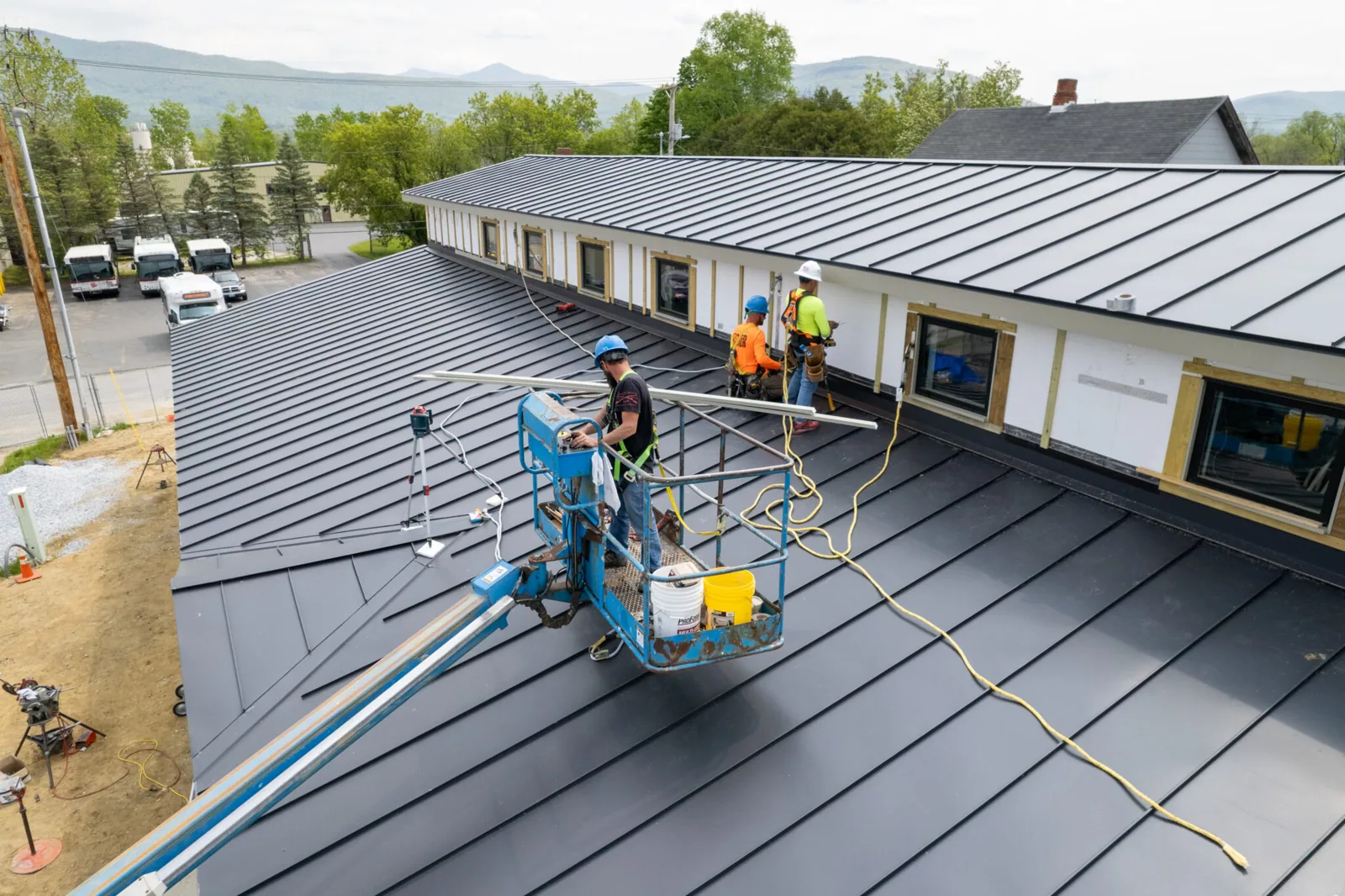
A standing seam roof sheds snow. That is its strength and its hazard. Panels are slick, and snow slides off in sheets. In Flagstaff, AZ, with a winter snowpack near 90 inches, one slide off a metal roof can land on a walkway, a car or a door. Snow retention is not an extra here. It is part of the roof.
Commercial Roofing Flagstaff installs, inspects and repairs standing seam metal roofs. We look at the clips, the seams and the snow plan together.
Snow does more than slide. It loads the roof and drifts against walls and units. A metal roof is light, so it often has margin for snow. That margin is not unlimited, and the structure sets the limit. We do a sag check before any change that adds weight or alters how snow sits.
A standing seam roof is a run of metal panels. Each panel has raised ribs along its edges. Adjacent ribs lock or fold together into a seam. Hidden clips under the seam hold the panels to the structure. No screws go through the face of the panel in the field.
That design lets the panels expand and contract with temperature. Clips slide. The panel moves. Thermal movement is large here. Nights have dropped to minus 30 degrees F, and sun at altitude heats metal fast.
The panels may be steel or aluminum, with a painted finish. They sit over a deck with underlayment, or on purlins with insulation below. Slope matters. Standing seam works on low slopes if the seams are the right type and sealed.
Seam type matters. Mechanically seamed panels are folded shut with a machine and resist water well on low slopes. Snap-lock panels are quicker to install and suit steeper slopes. We confirm the type before we repair, since a seam cap for one will not fit the other.
Snow guards hold snow on the roof and let it melt in place. Without them, snow slides at once. Guards are bars, fences or small pads attached to the seams. They go in rows across the slope and are spaced by roof pitch, length and expected load.
Guard attachment matters. Some clamp to the seam and do not pierce the panel. Others fasten to the structure. Poorly attached guards tear off under a heavy slide or damage the seam. We check each guard by hand on every walk.
Storm loads can exceed plans. Late February 2023 put 24.5 inches on parts of town in a few days. The city tied several collapsed roofs to the weight. A sag check comes before any retrofit that adds guards, since guards add load transfer to the structure.
Where roofs shed onto lower roofs, the lower membrane takes the hit. A sheet of snow landing on a membrane can tear it or crush a drain. We add guards upslope, or fit a protective strip on the lower roof. Walkways below get a canopy or a fence.
Metal grows and shrinks. Over a long panel, the change is visible. Clips must be free to slide. Trim must allow movement. A panel pinned at both ends will buckle or tear its clips.
We check clips at eaves and ridges. We look at oil-canning, which is waviness in the flat of the panel, and at fastener points at the edges. Trim that is fixed too tightly leaves marks and gaps. We reset trim and clips where needed and seal the ends.
The daily swing is wide. A clear winter day can swing between a sunlit afternoon and a cold night. Freeze-thaw also works at the seams, where water can enter and expand. We look at seam laps for damage each spring.
Fastener points still exist at the eave, the ridge and penetrations. Those are exposed fasteners with washers. They wear like any exposed fastener. We replace failing washers and reset loose screws with oversize fasteners. Penetrations get boots that match the panel profile.
Heat from the building melts snow on the roof. Meltwater runs to the cold eave and freezes. The ice ridge backs more water up under the panels. On a low-slope seam, water can run past the seam cap into the deck.
Detailing at the eave cuts that risk. Insulation and air sealing keep heat inside. Eave ice protection under the panels adds a barrier. Open drainage lets meltwater leave. We check the eave on every fall walk and clear gutters before the first storm.
Condensation can pass for a leak under metal. Warm interior air meets a cold panel and drips. We compare stain patterns to rain events. The fix for condensation is ventilation, insulation or a vapor layer.
Gutters need care on metal roofs. Sliding snow can tear them off. Heated cable can keep a gutter open, but only where the building can feed it and the cable is set properly. We inspect hangers, slope and downspouts each fall, and we replace sections that have pulled away.
Most standing seam trouble is at the details. A seam cap lifts. A trim fastener backs out. A sealant joint splits. A boot cracks. We find the opening, clean it and seal it with a product made for metal.
A seam failure repair reseals or re-seams the panel. A wind damage roof repair checks for lifted panels and bent trim. A flashing failure repair replaces failed flashing at walls and curbs. We photograph each repair and log it.
For worn exposed-fastener roofs, a metal roof retrofit can add a standing seam layer. That is a separate scope with its own structure check.
Scratches in the finish matter. Paint protects the metal. A deep scratch exposes the base and starts rust or corrosion. We touch up small marks and flag panels with widespread paint loss. A walkway of pads protects the finish where crews cross.
Standing seam suits pitched roofs, long spans and buildings where appearance counts. It lasts, sheds snow and resists wind. It costs more than most membranes. On a low-slope roof, a TPO roofing or PVC roofing system may cost less.
A metal-roofed shop in Bellemont sits at roughly 7,100 feet on I-40, so its snow plan gets the same weight as any Flagstaff roof. Whatever the choice, the sag check and snow plan come first.
Above any walkway, door, car park or neighboring roof, yes. Smooth panels let snow slide in sheets. Guards hold it in place to melt. Spacing follows pitch, length and load.
Usually the details: a lifted seam cap, a split sealant joint, a cracked boot or a backed-out trim fastener. Ice at the eave can also back water in. We find the opening and seal it.
Yes. Warm interior air condenses on cold panels and drips. We compare the stain with rain events. The fix is ventilation, insulation or a vapor layer.
Often yes. Many clamp to the seam. We check the seam type, the structure and the load before we add them.
A panel pinned at both ends buckles or tears clips. Clips and trim must slide. We reset them where they bind and seal the ends.
Browse the services, roof systems and building types we work with across Flagstaff and nearby Arizona communities.
A walk of the roof with photos, findings and a written scope.
Active leaks, storm damage and blocked drains get a fast response.
Roofing across Flagstaff and nearby Arizona communities.