
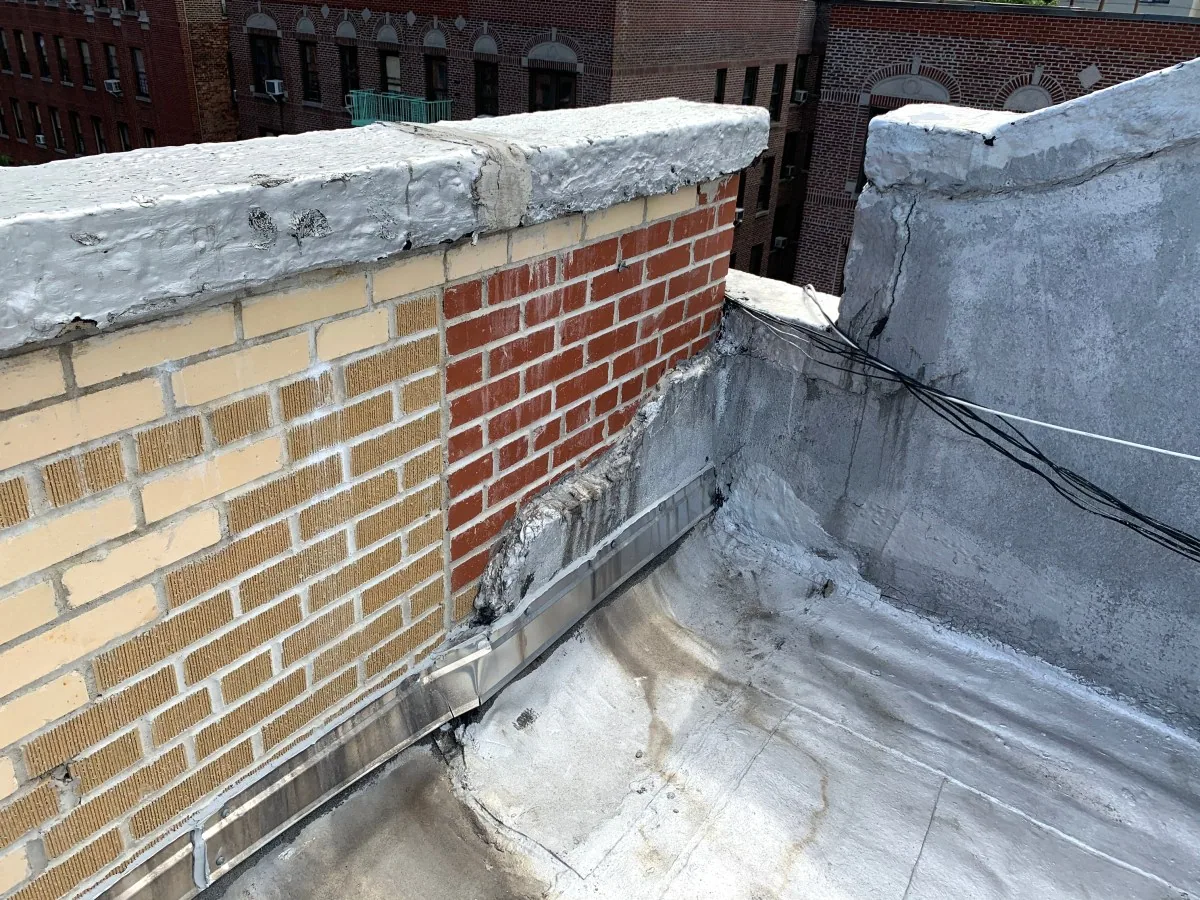
Flashing is where the roof meets everything else, and everything else moves. Parapets shift, curbs settle, pipes flex and snow slides. Commercial Roofing Flagstaff repairs failed flashing on commercial roofs in Flagstaff, AZ, and in a climate with this much snow and this many thaw cycles, flashing fails before the field membrane does. The sheet in the middle of the roof can be fine for years while the base of a wall is already open.
On a flat roof, a leak more often ends at a detail than at a seam in the field. The fix is not more sealant. The fix is finding why the detail opened and rebuilding it so it can move without tearing.
Flashing fails in predictable places, and we check them in the same order on every roof.
Each one has a different failure. A boot cracks from sun. A termination bar loses its seal when the wall behind it moves. A counterflashing pulls out of a mortar joint. We open the detail, look behind the sealant, and see which part has actually failed.
Age matters less than movement. A ten-year-old flashing on a stable wall can outlast a new one on a wall that is still settling, so the first question on every detail is whether the surface behind it holds still.
Water gets behind a flashing joint in autumn. It freezes. Ice expands in the gap and pushes the metal or membrane away from the wall. When it thaws, the gap stays. The next freeze widens it further. Freezing returns here in late September and has reached minus 30 degrees F, so the cycle repeats through a long season.
Snow adds weight and slide. A drift line behind a parapet or mechanical well presses on the flashing and, as it settles, drags the base of the wall flashing downward. Sliding snow off an upper roof can shear a roof-edge flashing clean off. Ice that builds up along a wall base can lift the membrane an inch before anyone sees it.
That is why a detail that looked tight in October can leak in March. We check flashing again after the first thaw, because the winter has already shown which details were weak.
The monsoon tests the same details from the other side. A July downpour on a roof with a cracked boot sends water straight down the pipe into a ceiling, and the stain looks like a fresh storm leak. It is a winter injury that waited for rain.
Flashing has to match the wall it meets. Downtown, the Railroad Addition holds historic commercial buildings, and an 1897 ordinance after fires required brick, stone or iron construction in the business area. A parapet on a masonry wall wants a reglet cut into the mortar and counterflashing set into it. If the mortar is soft, new flashing cannot hold. We repoint the joint before anything else goes in. Throughout downtown Flagstaff, that masonry-first sequence applies.
On Mike's Pike, the mostly industrial stretch of Route 66, the buildings are boxy metal, wooden and concrete. A metal wall panel needs a different termination from brick, with a sealed closure at the profile. Along Butler Avenue, any retail roof with rooftop equipment needs curb flashing that stays watertight through every temperature swing. Each wall type gets its own detail, and a generic caulk line across all of them is how leaks come back.
A bead of sealant over a failed detail is a bandage. We remove old mastic, strip loose membrane, clean the substrate and inspect the wall or curb behind it. Then we rebuild the flashing in a system compatible with the roof: a heat-welded membrane flashing on single-ply roofs, a reinforced liquid-applied flashing resin on irregular shapes, or a modified bitumen flashing ply on bituminous roofs.
Corners are the weak points, so we use preformed corner pieces where the system allows. Pipes get new boots or properly built pitch pans. Terminations get a continuous bar, fasteners at the right spacing and a sealant that stays flexible in the cold. Counterflashing is reset or replaced, and any bent metal is pulled and straightened or swapped.
A flashing repair next to a wet field needs a test for trapped moisture before it is closed. If the insulation behind a wall base is soaked, the fix includes replacing it. A new flashing over wet board will fail again.
A failed flashing often travels with other defects. Seams near a wall base open because the sheet is pulling on them, which is why a seam failure next to a detail rarely happens alone. Foot traffic around curbs punctures the field, so we check for membrane punctures on the same walk.
Skylights and rooftop penetrations deserve their own attention. Our work on skylight and penetration flashing covers frames, domes, vent pipes and conduit, and our edge-metal repairs handle coping, gutters and drip edge where a roof edge needs to shed water. Where a pattern shows up across the whole roof, we say so and price the broader fix in writing.
Caulk alone buys a season at most. If the substrate is sound and the metal or membrane is intact, we reseal with a compatible sealant that stays flexible in the cold. If the membrane is cracked, the metal is bent or the wall is loose, the detail gets rebuilt. We decide after opening the joint and checking what sits behind it.
Snow melts and the water runs down the wall face, finds the gap at the termination and refreezes inside it overnight. By day two the ice has pushed the opening wider. A flashing that is tight in dry weather can leak every thaw until the termination is rebuilt, so the repair targets the joint itself.
We check the mortar first. A reglet is cut into a sound joint, counterflashing is set in and sealed, and the base flashing is welded or adhered to the roof side. If the brick is loose or spalling, a mason repoints before roofing starts. The roof detail is only as good as the wall that holds it.
We flash the curb and the roof side of it. If a unit has to be lifted or disconnected to reach the detail, the mechanical contractor handles that part, and we coordinate the day so the roof is not open longer than necessary. Plan on a lift or crane date for larger units.
Movement. A detail repaired over a wall that is still shifting, or over a curb that was never fastened, opens again. We look for the source, whether that is settlement, thermal movement or a loose substrate, and fix it before reflashing. Without that step the second repair fails on the same schedule as the first.
Browse the services, roof systems and building types we work with across Flagstaff and nearby Arizona communities.
A walk of the roof with photos, findings and a written scope.
Active leaks, storm damage and blocked drains get a fast response.
Roofing across Flagstaff and nearby Arizona communities.