
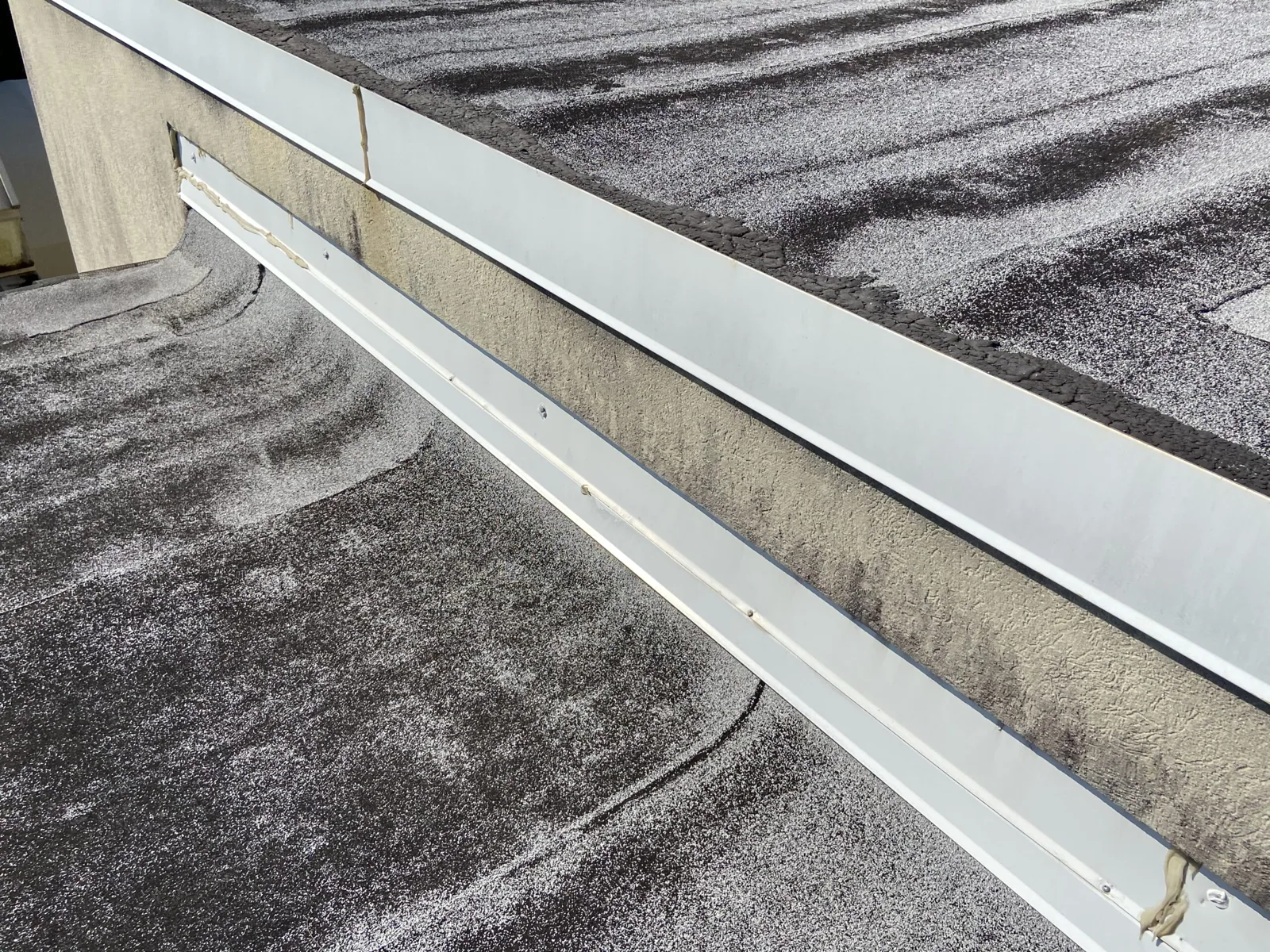
The edge fails first. Snow slides to it, ice builds on it and wind grabs it. In Flagstaff, AZ the edge of a roof carries more than the field does, because everything that melts, slides or blows ends up there. Coping, edge metal, gutters and downspouts are the parts that hold the roof's outer line.
We check them each fall and after each heavy storm. A loose run of coping costs little to fix. A run that peels in a wind costs a lot.
Coping caps the top of a parapet wall. It sheds water off the wall and shields the flashing below. It is made of metal, stone or precast. Any of them can shift, crack or open at the joints.
Downtown Flagstaff has historic brick and stone buildings. Fires led the city to demand brick, stone or iron in its business area in 1897, so the old downtown roofs end at masonry walls. Parapet caps there get hard use from freeze-thaw. Water enters a joint, freezes and widens it. By spring the gap lets water into the wall.
We probe every joint. We check fasteners, end caps and the seal at wall transitions. We reset or replace loose sections and reseal joints. Where masonry is damaged, we note it for a mason. Water in a brick wall will undo any roof repair.
Coping and drainage connect to the roof below. A cap that sheds water onto the field is fine. A cap that sheds water onto a drain-less low spot makes a pond. We check where the water lands and tie our fix to roof drains and scuppers where needed.
Edge metal sits at the roof's perimeter. It holds the membrane edge and directs water into gutters or off the roof. A bent or loose section lets wind under the membrane and lets water behind the fascia.
Wind works at edges first. Uplift pulls on a loose edge, and the membrane can follow. Snow and ice add weight and push. Falling ice from a higher roof can bend a lower edge in one hit.
We check fastener spacing, laps and sealant. We look for gaps between the metal and the roof. We tug the metal by hand. Wind damage usually starts at the edge, so any wind damage roof repair begins with this check.
Repairs are plain. Refasten. Replace sections. Add a continuous cleat where the metal can pull away. Seal the lap. Photograph the result.
Sealant ages fast at 7,000 feet. Sun dries it and cold cracks it. We replace dry sealant on laps and at wall ends during fall visits. A fresh bead in October is cheap insurance against a January leak.
Gutters in a cold climate face ice. Meltwater fills the gutter, then freezes. The ice expands and pulls the gutter off its brackets. A ridge of ice builds at the eave and backs water under the roof edge.
Many commercial buildings use internal drains and scuppers, and others use gutters at eaves and canopies. Where gutters exist, we check slope, brackets and joints, and we clean them before the freeze. We replace worn brackets and add hangers where spacing is wide. We make sure downspouts discharge away from walls and walks.
Leaf and needle debris is the main cause of clogs. Pine needles collect fast. A cover or guard helps, but it needs cleaning too. We include gutters in our preventive maintenance visits.
Downspout outlets need a plan. A downspout that dumps onto a walk freezes into a sheet of ice. We angle outlets away from entrances, add extensions where needed and check that the discharge point drains. Splash pads protect the surface below.
Metal roofs shed snow fast. A sheet of snow can let go all at once and fall on a walk, a car or a lower roof. Snow guards hold it in place until it melts in small amounts.
We look at where snow lands. Entrances, loading areas and parking are first. A lower roof under a higher one takes a hit every time. We recommend guards above those areas, and we fasten them to the panels with the method the panel type calls for. On a standing seam roof, clamp-on guards avoid new holes.
A guard does not stop all snow. It slows the release. The system needs checking each fall, because a bent or missing guard defeats the row.
A winter's snowpack on a slick panel can release in one slab, and the late February 2023 storm showed how much can pile up. Slide risk is real, and guards are cheap next to a damaged car.
Ice dams form when heat leaks from the building into the roof. Snow melts from below. The meltwater runs to the cold eave and refreezes. The ridge grows and holds water against the edge.
The cure is at the source. Seal air leaks at penetrations. Add insulation at the eave. Improve the roof's ventilation if it has an attic or cavity. Heat cable at the edge treats the symptom and helps in a bad winter.
We never chip ice with a hammer. It damages the metal and the membrane. We cut channels for drainage and thaw outlets with warm water. Then we fix the cause so the dam does not return. Flashing that a dam has lifted or torn needs flashing failure repair once the ice is gone.
Heat cable needs care. It must run to a drain or gutter that is clear, or it only melts a path to a frozen end. We test cable each fall, check the thermostat and note any section that fails to warm.
Downtown Flagstaff has masonry buildings with parapets, and Williams has a six-block historic business district on the National Register with a snow season of its own, about 65 inches from November through March. Owners in Downtown Flagstaff and Williams should look at coping before winter. On the half-mile of Mike's Pike, the boxy metal, wooden and concrete industrial buildings leave the perimeter metal as the main thing to inspect.
Every fall before the freeze and every spring after the thaw, plus after any heavy storm or high wind. A tug test and a visual check of joints and fasteners take little time. Catch a loose run early, and it is a small repair.
Ice. Meltwater freezes in the gutter, expands and loads the brackets. If slope is poor or brackets are wide apart, the gutter sags and fills. Clean in fall, add hangers where spacing is wide and fix the heat leak that feeds the ice.
Not when installed the right way. Clamp-on guards on standing seam avoid new holes. Fastened guards on exposed-fastener panels need sealant at each fastener. We pick the method that fits the panel and check the sealant every year.
Coping and flashing, yes. Cracked mortar and damaged brick need a mason. Water in a wall undoes the roof repair, so we flag masonry problems and coordinate the order of work.
Sealing the air leaks and adding insulation at the eave. Heat cable helps in a bad winter but treats the symptom. We trace the heat source first.
Browse the services, roof systems and building types we work with across Flagstaff and nearby Arizona communities.
A walk of the roof with photos, findings and a written scope.
Active leaks, storm damage and blocked drains get a fast response.
Roofing across Flagstaff and nearby Arizona communities.