
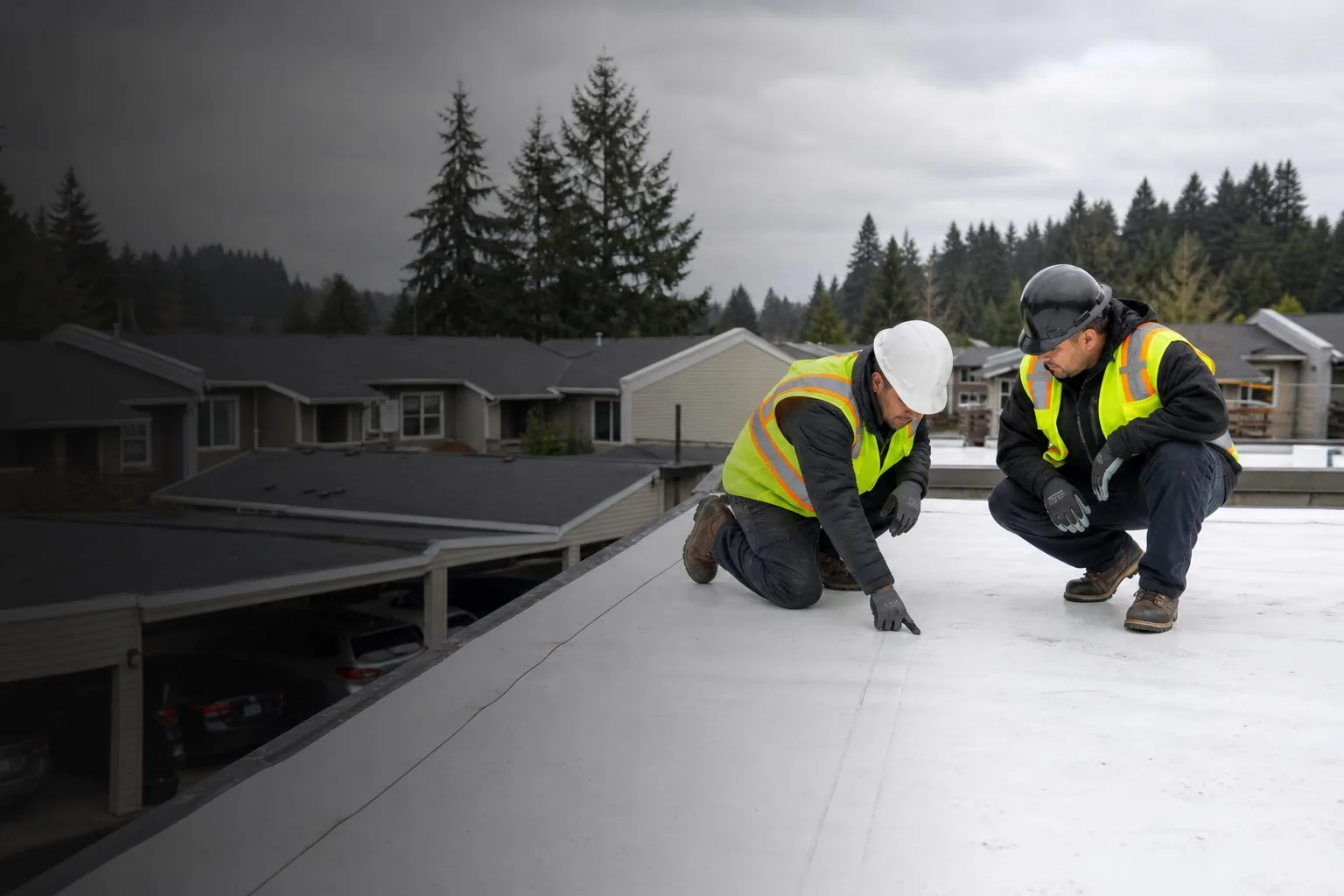
A leak in January is usually a thaw problem. The roof was frozen shut for days, then a warm afternoon sent meltwater looking for a way in. In Flagstaff, AZ the same roof leaks differently in July, when a monsoon cell dumps water faster than the drains can move it. Commercial Roofing Flagstaff traces both kinds. We start from the ceiling, work up through the layers, and stop at the opening. Then we fix the opening and the reason it was there.
Tell us what you see inside. The timing, the weather and the location of the drip narrow the search before anyone climbs a ladder.
Winter leaks cluster on warm days after storms. Each winter's snowpack has to melt somewhere, and on a flat roof that somewhere is a drain, a scupper or a low spot. Meltwater follows the slope down to the first low point it finds. If any of those is frozen or packed, the water backs up and looks for a seam, a curb or a flashing edge.
Ice at the eave and the drain is the usual trigger. Ice dams form where heat leaks from the building into the roof and melts snow from below. That water refreezes at the cold perimeter, and the ridge of ice it leaves dams the next melt behind it. In a commercial building, the cause is often warm air escaping around penetrations or through poorly sealed deck edges.
We thaw drains safely, clear the path and find where the heat is escaping. Then we repair the opening and tell you what to change so it does not repeat.
Summer leaks arrive fast. Thunderstorms peak in July and August, and the monsoon supplies roughly a third of the year's moisture. A drain that handles a steady rain can fail in a cloudburst, and water rises over the flashing. That is when a low parapet or an unsealed curb shows its weakness.
The pattern is easy to read. Leaks that appear only in heavy storms point to drainage or flashing height. Leaks after every rain point to membrane or seam damage. Leaks at the same spot every time point to a penetration. We keep a log of the weather when each leak showed up, because it tells us which type of failure to expect.
We also check overflow. A scupper set at the right height can save a building when the main drain fails.
We map the interior first. Where is the stain, where is the drip, what sits above it. Then we move to the roof and follow a line from that spot upslope. Water runs along the deck and insulation before it falls, so the opening is often higher than the drip.
Infrared scans show wet insulation as a different temperature, and moisture probes confirm it. For stubborn leaks we use a controlled water test: we wet one section at a time, starting low, and have someone inside watch for the first drip. The section that triggers it holds the opening. This method takes patience and saves the cost of tearing up a roof that is sound.
The same logic runs a commercial roof inspection. When the leak is not isolated, a moisture survey maps the full spread of wet insulation.
Once we find the opening, we repair it with materials matched to the roof. A torn single-ply gets a welded patch. A failed pipe boot gets a new boot and a proper seal. A lifted flashing gets re-fastened, sealed and covered with counterflashing. A crack in a built-up roof gets a stripped-in patch over dry material.
Then we look for the cause. Was the drain clogged? Did snow slide off a parapet and shear the flashing? Did a rooftop unit get serviced and the curb flashing left loose? The cause tells us whether the repair will hold.
Wet insulation under the opening comes out. Leaving it in means the leak is stopped on the outside and ongoing on the inside, where the insulation holds water against the deck. We test, cut, dry and patch. If the wet area is large, we price a wider cut-out as planned commercial roof repair next to the quick patch.
Most repeat leaks come from a short list of neglected items. Clogged drains. Loose coping. Pipe boots that have cracked in the sun. Sealant that has dried out at a wall. Curb flashing left open after an equipment service call.
A fall walk catches all of these. Freezing temperatures return in late September, so the weeks before are the best time to clean drains, reseal the details and look at the roof edge. Keep service crews off the roof when it is wet or frozen, and ask them to log any work on penetrations. A record of who opened what is worth more than a guess after a leak.
Plan the snow removal too. Shovels and rakes cut membranes. Tell whoever clears the roof where the drains and seams are, and where not to scrape.
Leaks look different by building. Along Butler Avenue and Lone Tree Road, tenants of retail space such as Aspen Place at the Sawmill notice a drip at once, so speed and interior protection matter as much as the fix. Around Fort Valley, the Museum of Northern Arizona campus spreads over about 200 acres on both sides of US 180, with a lava rock museum building from 1936 and other buildings that each need their own leak path read. Downtown, the Railroad Addition district holds historic commercial buildings where flashing at masonry walls deserves a close look.
The Pipeline Fire in 2022 burned 26,532 acres north of Flagstaff and brought post-fire flooding. Owners along Highway 180 should watch for runoff at grade, which is separate from roof leaks but easy to mistake for one. We note the difference at the site visit.
Active water entry gets a same-day call, and we dry in with a temporary seal or tarp while we trace. Permanent repair waits for dry weather, since adhesives, sealants and welds need a clean surface. A temporary seal buys time. It is not the end of the job.
Because the opening is small and the weather decides when water finds it. A seam might only open when a roof is warm enough to expand. A flashing might only leak when wind drives rain sideways. A leak in a freeze-thaw cycle often shows during the thaw, which is why many leaks seem to appear in late winter.
Yes, where it is saturated. Wet insulation loses insulating value, holds water against the deck and leaks again. Dry areas stay. We cut out the wet section, replace it, and patch the membrane. A moisture survey shows how far the wet area runs.
Photos of the damage and the date of the storm help most. We provide a written leak report with photos, the cause and the repair. If the storm was a named event like the heavy snow of late February 2023, say so in the claim. We put that file together with you as part of roof insurance claim assistance.
Sometimes. Condensation, plumbing and HVAC lines can all drip like a roof leak. We check the roof first and the interior second. If the roof is dry, we say so and point you to the likely source.
Browse the services, roof systems and building types we work with across Flagstaff and nearby Arizona communities.
A walk of the roof with photos, findings and a written scope.
Active leaks, storm damage and blocked drains get a fast response.
Roofing across Flagstaff and nearby Arizona communities.