
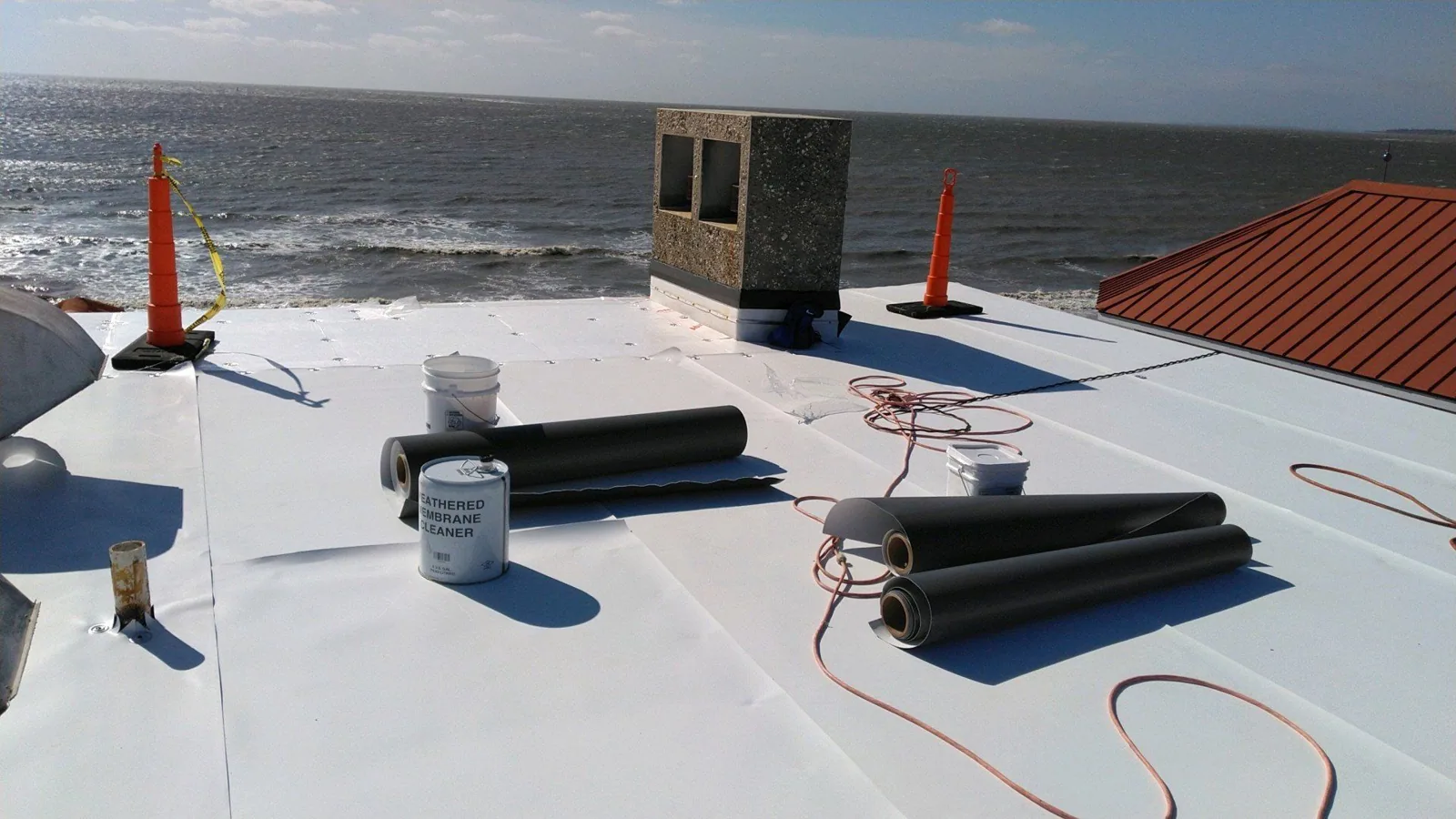
TPO lives or dies at the seam. The sheet itself is a flexible thermoplastic. The seams are heat-welded into one continuous surface. If the weld is good, the roof sheds water. If the weld is cold, the seam opens. Flagstaff, AZ stacks up 90 inches or more of snow and sees its first freeze in late September. That makes the weld the question that matters.
Commercial Roofing Flagstaff installs and repairs TPO. We probe every seam. We tell owners what TPO does well here and where it needs care.
TPO is a single-ply membrane. It comes in wide rolls, often white, sometimes tan or gray. Crews lay the sheet, overlap the edges and weld the overlap with a hot-air machine. The weld fuses the two layers. Reinforcing fabric inside the sheet gives it strength.
The sheet can be mechanically attached with fasteners and plates, fully adhered to the substrate, or ballasted with stone. Each way suits different decks and loads. Insulation sits below the sheet. A cover board often sits between insulation and membrane.
The surface is reflective when white. That matters in a sunny place. Sun shines roughly 3,475 hours a year here.
Thickness varies. A thicker sheet takes more wear and foot traffic. A thinner sheet costs less. We match thickness to the roof's use. A roof with many rooftop units and many service trips gets the thicker sheet and extra walk pads. A quiet roof with few visits can use a lighter one.
Heat welding needs a clean, dry seam. Cold air pulls heat out of the weld. Frost or moisture on the sheet blocks the bond. Crews slow down, raise the machine temperature and wipe each seam. Some cold days are simply too cold to weld.
Roofing season in Flagstaff stretches from late spring into early fall. The first freezing nights return in late September. We schedule TPO work early enough that seams cure and are probed before cold sets in. In shoulder weeks, we weld only in dry, mild hours and stop when conditions slip.
The test is a probe. We run a blunt tool along every seam edge. A seam that lifts is cut and rewelded.
Substrate prep matters in cold work. Insulation and cover board must be dry and tight. Fasteners must be seated. Plates must be spaced to the pattern. A cold morning can leave frost on the board. We wait for it to clear. Laying sheet over frost traps water in the assembly.
A smooth sheet sheds snow well. Sliding snow can be a hazard below. Snow guards or fences go where a sheet of snow could fall onto a path or an entry. Drains matter more than the membrane. A drain choked under deep snow sends the first thaw straight onto the sheet.
Several roofs failed under snow after the late February 2023 storm, which left 24.5 inches in places. The city's list of early signs began with a sagging ceiling. A membrane does not change the structural load. We do a sag check before a reroof and flag any structural concern.
Ice ridges at the eave can back water under the sheet. Good edge details and proper flashing height keep the water out.
Wind piles drifts against parapets and mechanical wells, on any roof from Mike's Pike to Butler Avenue. A drift adds load at one edge. The membrane there needs more fasteners and a taller flashing. We mark the drift lines on the plan and detail those zones with extra attachment.
Flagstaff sits at roughly 7,000 feet. The air is thin. UV is strong. White TPO reflects much of it, but the surface still ages. Over years, the top layer can chalk and thin. Seams and flashing see the same exposure.
Walk pads protect the sheet where crews cross. Dirt reduces reflectivity, and a yearly wash restores much of it. We check thickness at cores where wear shows. A thin sheet cannot take a heavy patch.
For a surface that needs more life, a roof coating restoration may help on a sound sheet. We scan first. Wet insulation under a coating is a bad bet.
Hail can bruise a sheet. A scan after any hail report finds the damage. Cores show whether the fabric cracked.
Most TPO problems are small. A seam opens. A flashing corner splits. A boot cracks. A puncture from a dropped tool. We find the opening, clean the area and weld a patch over it. The patch needs good overlap and a clean weld on all sides.
Aged TPO welds differently. Old sheet can be dirty or contaminated. We scrub it and, in some cases, use a primer or a different method. If the sheet will not take a weld, we use adhesive-based repair or replace the section.
A probe test closes every seam failure repair. A membrane puncture repair ends with a visual and a water test where weather allows.
Flashing is where TPO needs the most hand work. Corners, pipes and curbs use pre-molded pieces or hand-welded patches. A rushed flashing weld is the likely first leak on a new TPO roof. We check each one by probe and mark it on the closeout plan.
TPO suits low-slope roofs with reflective needs and a tight budget. It competes with PVC roofing, which handles grease and chemicals better. It competes with EPDM roofing, a rubber sheet that stays flexible in the cold and joins with tape or adhesive. We compare them on the building.
For roofs near kitchens, labs or exhaust, PVC may fit better. For roofs with heavy snow and little foot traffic, EPDM has a long record. TPO fits the broad middle. A low-slope building in the airport technology park or one of the I-40 industrial parks is a fair fit for a TPO bid.
City code adopts the 2018 IBC and IECC, with 2019 local amendments. Insulation that the code drives is priced on its own lines in a replacement.
Price follows insulation, access and detail count. A simple roof with few penetrations costs less than a busy one. Sheet and detail costs get separate lines.
Only in the right window. Welds need a dry, clean seam and enough heat. Cold and frost cut the bond. We install in late spring to early fall and stop when conditions slip. Every seam is probed.
It reflects UV and heat in a sunny place, about 3,475 hours a year. It also holds snow load as any roof does. The structure decides snow questions. Do a sag check before any reroof.
A good weld can last as long as the sheet. Poor welds fail early. We probe every seam at install and at each inspection. Open seams get rewelded.
Sometimes. It must be dry, and the existing layers must be attached. Infrared scans and cores come first. Wet insulation gets repaired or replaced before anything else goes on.
PVC tolerates grease better. TPO can soften with heavy grease contact. We look at the exhaust, the roof layout and the budget before we recommend one.
Browse the services, roof systems and building types we work with across Flagstaff and nearby Arizona communities.
A walk of the roof with photos, findings and a written scope.
Active leaks, storm damage and blocked drains get a fast response.
Roofing across Flagstaff and nearby Arizona communities.