A coating buys years, not miracles. It works on a sound, dry roof. It fails on a wet one. Flagstaff, AZ logs sun for about 78 percent of the daylight hours, and at 7,000 feet the thin air lets ultraviolet light chew on membranes. Then winter adds snow load, deep cold and repeated thaw.
A coating has to survive both. We test the roof first. If it qualifies, we prep it, coat it and give you a record. If it does not, we tell you plainly and price the alternative.
Three conditions decide. The insulation must be dry. The membrane or panels must be sound. The deck must carry the load. A roof that fails any of the three needs repair or replacement before a coating makes sense.
We test with an infrared moisture survey and cores. The survey maps wet zones. The cores confirm the layers and the wetness. If wet insulation covers a large share of the field, a coating only hides the problem. The water stays, the board rots and the coating blisters.
Roofs that qualify are often middle-aged: sound but worn, with a few failed seams and a chalky surface. A coating seals those, reflects sun and extends service. It also postpones replacement and spreads the cost.
Age is a poor guide. A fifteen-year-old roof with dry insulation can take a coating. A seven-year-old roof with a hidden leak cannot. The scan settles it. We show the owner the map and the cores, then say yes or no.
Sunshine at 7,000 feet is strong. Ultraviolet light breaks down membranes, dries sealants and chalks surfaces. White coatings reflect it and lower surface temperature. That reduces expansion and contraction, which is what opens seams over time.
The effect is real, but it is not the main reason to coat in Flagstaff. The main reason is protection and sealing. A coating gives a worn roof a new wearing surface.
If cooling is the goal, a cool roof installation may fit better. In a cold climate, a reflective surface can also slow snowmelt a little. We discuss the tradeoff before the owner chooses.
Silicone tolerates standing water. It cures to a flexible film and keeps its elasticity in the cold. It is the usual pick where ponding cannot be fully fixed. Acrylic costs less and is easy to apply. It does not like standing water and needs a roof that drains.
Neither is a fix for a roof with bad slope. We look at drainage first. If ponds persist after rain, we correct slope or add drains, or we choose silicone and say why. Our work on ponding water repair starts at the same measurement.
Compatibility matters. Coatings bond differently to metal, built-up roofing, modified bitumen and single-ply membranes. We test adhesion on a small patch before we coat the roof. A coating that peels in the first freeze is a failure we can see coming.
Thickness matters. A coating is measured in mils, and the film must reach the specified build to perform. We measure the coverage rate as we go and check the dry film at random spots. A thin coat looks fine on day one and fails by the second winter.
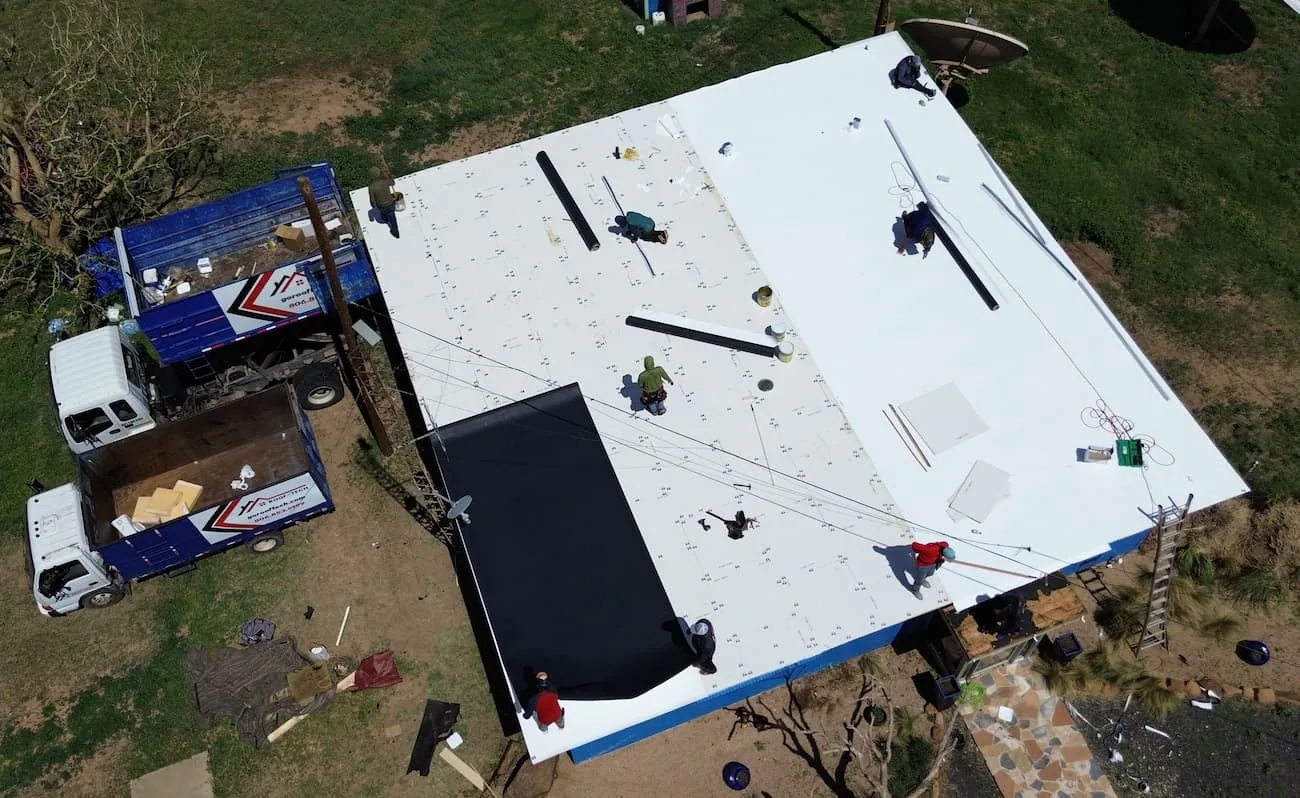
Prep decides the result. We wash the roof. We remove loose material, rust, chalk and blisters. We repair seams, flashings and penetrations. We replace fasteners on metal roofs. We treat rust with the right primer. Then we coat.
Skipping prep is the usual cause of failure. A coating over dirt peels. A coating over a loose seam opens with the seam. A coating over a blister traps moisture. Each step costs time, and each prevents a failure later.
We photograph the roof before, during and after. The record shows the owner what was done and gives a baseline for the next inspection.
Seams get special care. We probe each one. We reinforce open or lifting seams with fabric and coating, not just a dab of sealant. Penetrations get a flashing collar or a liquid flashing. Edges get a sealed termination. A coating is only as sound as the details under it.
Flagstaff gives a short window. Freezes start by late September, and winter nights here can drop far below zero. Coatings need dry surfaces and temperatures that let them cure. Rain, dew and cold nights can ruin a coat.
We schedule from late spring through early fall, and we watch the forecast. The monsoon brings thunderstorms in July and August, so we plan coating days around them. A coating that is rained on before it cures can wash out or blister. We cover and stop work when a cell approaches.
After cure, freeze-thaw tests the coating. A well-applied coat flexes through the cold season. We check it in spring for cracks, peeling and thin spots, and we touch up what needs it.
Surface temperature matters more than air temperature. A dark roof in October sun may be warm at noon and frozen by midnight. We check surface temperature before application and the forecast for the night after. If frost is likely, we hold the job.
Coatings suit low-slope membranes and metal roofs in decent shape. Mike's Pike, the half-mile of old Route 66 in Southside, is mostly industrial, with metal, wooden and concrete buildings. Where a metal roof is sound, fastener work and coating can extend it. East Flagstaff is home to Flagstaff Mall, and any retail roof out there faces the same screening before a coating is priced. We check each roof first.
Owners in Southside and Mike's Pike and East Flagstaff can ask for a coating assessment. We report what the roof can take and what it cannot.
Records close the job. The owner gets before and after photographs, the coverage rate, the product data and a note of the next inspection date. If a leak shows up later, the file helps trace it. If the roof is sold, the file helps the buyer.
No. The insulation must be dry, the membrane or panels sound and the deck able to carry the load. If a survey finds wet insulation across a large area, the right answer is repair or replacement. A coating over wet board only hides the problem, and the board keeps rotting.
Choose silicone if the roof ponds, since it tolerates standing water and stays flexible in the cold. Choose acrylic if the roof drains well and the budget is tight. Either way, fix drainage first. We test adhesion on a patch before committing to the full roof.
Late spring through early fall, on dry days with moderate temperatures. Avoid July and August storm afternoons. We watch the forecast and stop if a monsoon cell approaches. A coat rained on before it cures can blister or wash out.
System, prep and roof condition set the number. We quote a service life after the adhesion test, not before. A coating that is checked each spring and touched up where needed keeps working longer than one that is left alone.
It seals small openings and hairline cracks, and it reinforces seams after repair. It does not stop leaks from open seams, failed flashing or wet insulation. We repair those first, then coat. A moisture scan before and after shows the result.
Browse the services, roof systems and building types we work with across Flagstaff and nearby Arizona communities.
A walk of the roof with photos, findings and a written scope.
Active leaks, storm damage and blocked drains get a fast response.
Roofing across Flagstaff and nearby Arizona communities.