
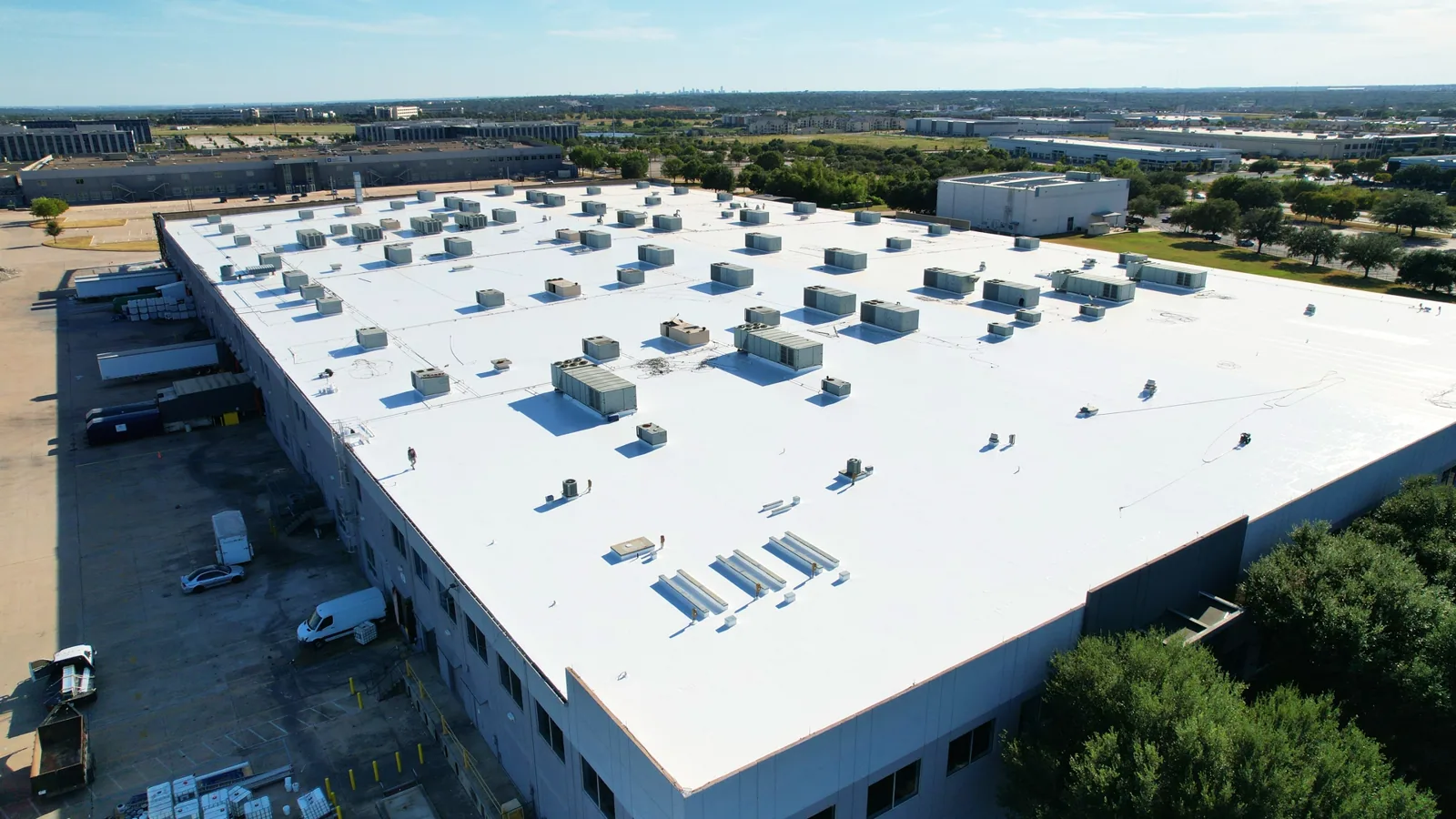
Silicone does not mind standing water. That is the first reason to choose it. Most coatings soften or fail when a pond sits on them. Silicone keeps working. In Flagstaff, AZ a thaw can leave water on a flat roof for days, and the sun at 7,000 feet hits the same surface after the storm. A coating that handles both earns its place.
Silicone cannot rescue a bad roof. It seals a sound one. Commercial Roofing Flagstaff scans and cores the roof first. Then we decide.
Reflectivity is a bonus here, not the main reason. White silicone cuts surface heat in summer and slows the heat cycling that wears seams. It can also hold snow a little longer than a dark roof. The main reasons are sealing and ponding tolerance.
Silicone coating is a liquid that cures into a flexible film. Crews roll or spray it over a cleaned roof. The film bridges small cracks and seals seams, fasteners and flashings. It reflects sunlight when it is white or light gray. It holds its elasticity across a wide range of temperatures.
It goes over many roofs: metal, modified bitumen, built-up, TPO, PVC and spray foam. Each substrate needs its own prep and sometimes its own primer. Adhesion tests decide, not guesses.
Thickness is the quality measure. A thin coat wears fast. We apply in passes, check thickness with a gauge and record it.
Fasteners and seams get special treatment. On metal roofs, each screw head gets a dab of sealant before the field coat. Laps get a reinforcing fabric bedded in coating. On membranes, seams and flashings get the same fabric. Reinforced details carry movement better than plain coating over a gap.
Standing water on a flat roof is common after a thaw or a monsoon cell. Water that sits more than a couple of days is a problem for most coatings. They can soften, blister or wash out. Silicone tolerates it better.
That does not excuse ponding. Water adds weight. Snowpack runs 90 inches or more in a normal winter, and the 24.5 inches that fell in parts of town by March 2, 2023 sat on roofs that were already loaded. The city tied several collapsed roofs to that weight. A pond on top of snow is more load. A ponding water roof repair finds the cause, whether a clogged drain, a high drain or a sagging deck.
Drainage keeps silicone working. A pond that stays for days collects dirt, algae and debris. Those stick to the surface and cut reflectivity. Clear drains and slope fixes cost less than recoating a roof that ponds. We list both in the scope and let the owner choose.
Clean the roof. Wash off dirt, oil and loose debris. Remove loose coating. Repair seams, flashings and penetrations first. Treat rust on metal. Dry everything. Silicone sticks to a clean, dry surface and to little else.
An adhesion test comes next. We apply a patch and pull it after cure. If the coating lifts, we change the primer or the method. Some old coatings, especially acrylic, do not accept silicone well. Silicone is also hard to recoat with anything else, since little sticks to it. That affects every later repair.
A moisture scan and a few cores come before any coating. Wet insulation under a coating is trapped, and heat in summer turns it to vapor that blisters the film.
Compatibility checks save money. Each existing roof type takes a specific primer or none. Old built-up roofs may need a base coat. Single-ply roofs need cleaning with a specific cleaner. Metal needs rust treatment. We follow the coating maker's written prep steps, since skipped steps can cut coating life and affect warranty terms.
Silicone cures with moisture from the air. It needs a dry surface at application and a dry spell after. Rain or heavy dew in the first hours can wash it or leave it blotchy. Freezing temperatures return in late September in Flagstaff, and a coat that has not cured by then can fail the first freeze.
Coating weather is a window from late spring into early fall. July and August thunderstorms cut the dry spells, and that monsoon delivers roughly a third of the annual 20 to 22 inches. The crew watches the sky, rolls out early and quits when a cell forms. A coat that rains out is wasted material.
Mixing and thickness are tracked on site. Material is measured by roof area, and we compare coverage to the plan each day. A roof that takes less coating than planned has a thin film, and the crew goes back over it. The daily log lists material used, area covered and weather.
Roughly 3,475 sunny hours a year beat on the film. Silicone is stable under UV. It does not chalk the way some coatings do. It does attract dirt. A dirty white roof loses reflectivity.
Washing it once a year restores most of it. We use low pressure and avoid edges. We also look for pinholes, thin spots and peeling at laps. A touch-up coat fixes small damage. Large areas of failure point to poor prep at the start.
A roof coating restoration is a plan, not a single day. It ends with a recoat date and a log of thickness and adhesion.
Recoat planning keeps the film whole. A silicone coat wears slowly, and a recoat before wear reaches the substrate extends the system. We note the thickness, the date and the planned recoat year. A roof with a log is easier to keep than a roof with a guess.
Silicone costs more than acrylic and handles ponding better. Acrylic roof coatings cost less and can be recoated easily, but they want good drainage. Where a roof ponds and cannot be fixed cheaply, silicone fits. Where drainage is sound, acrylic may do.
Silicone is a common topcoat over spray polyurethane foam roofing and a common sealer in a metal roof retrofit. A low-slope roof on one of the industrial buildings along Mike's Pike in Southside can take a coating once the base tests dry and attached.
Price follows area, prep, repairs and thickness. Prep and repairs often cost as much as the coating itself. We show those lines apart, so the owner sees the cost of a clean base and the cost of the film. A coating over a poor base is the expensive choice.
It tolerates standing water better than most coatings. It still cannot cure the cause. Fix the drain or the low spot, since water adds weight.
Only a sound one. The roof must be dry and attached. We scan for moisture, core and run an adhesion test before we quote.
Little sticks to cured silicone. Later repairs need silicone-compatible products. That is a reason to plan the recoat carefully.
Late spring to early fall, on dry days with a dry spell after. We avoid storm days and stop before freezing weather.
About once a year, with low pressure. Dirt cuts reflectivity. We check pinholes and laps during the wash.
Browse the services, roof systems and building types we work with across Flagstaff and nearby Arizona communities.
A walk of the roof with photos, findings and a written scope.
Active leaks, storm damage and blocked drains get a fast response.
Roofing across Flagstaff and nearby Arizona communities.