
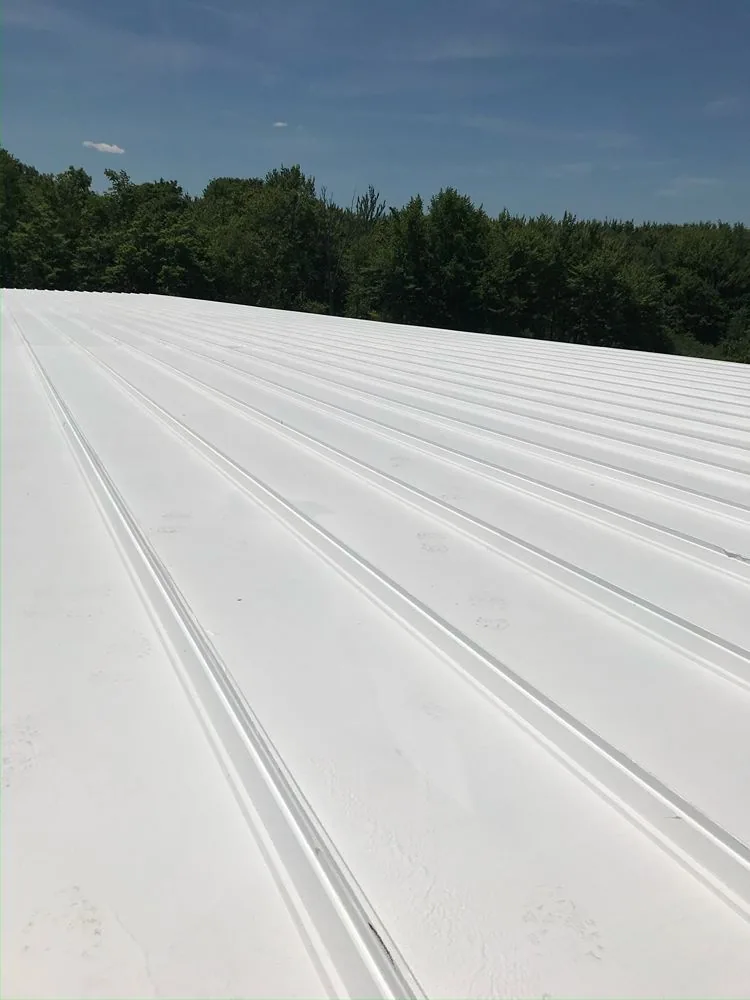
Foam roofs are sprayed, and sprayed work needs good weather. SPF goes down as a liquid, expands into a rigid foam and cures into one continuous layer. It insulates and seals in one step. It also has to be sprayed on a dry, mild day, with little wind. In Flagstaff, AZ, where freezing temperatures return in late September, that window is short.
Commercial Roofing Flagstaff sprays and repairs SPF roofs. We say plainly when the weather, the deck or the building says no.
Foam is a decision about the deck first. Foam bonds well to clean, dry concrete, metal, wood and many old roofs. It bonds poorly to dirt, grease and damp. The prep work is half the job. We clean, test and prime before the foam machine ever starts.
Two liquids are mixed at the spray gun. They react and rise into foam within seconds. The foam bonds to the deck or the old roof and fills gaps. It sets into a rigid, insulating layer with no seams. Crews spray in passes to build thickness and shape slope.
The foam must be protected. Sunlight breaks it down. A coating goes over it, usually silicone or acrylic, often with granules in high-traffic zones. The coating is the weather skin. The foam is the insulation and the substrate.
Because the foam is one continuous layer, it has no laps to open. Its weak spots are the coating, the penetrations and any place where the foam is thin.
Thickness is sprayed to a target. A thin pass over a flat roof gives little slope. Thicker foam can build a gentle slope to a drain and fix a ponding area at the same time. We measure the roof first, mark the low spots and plan the foam thickness at each. Thickness is checked with a gauge as the crew works.
SPF needs a dry surface, a mild air and substrate temperature and low wind. Wind blows overspray onto cars and walls and ruins the foam rise. Moisture on the deck causes blisters and poor bond. Cold slows the reaction.
Flagstaff has a roofing season of late spring to early fall. Monsoon thunderstorms peak in July and August, and they bring about a third of the yearly 20 to 22 inches. Mornings in shoulder weeks start with frost. We spray when the deck is dry and warm, and we stop if a cell builds.
We also protect the site. Cars move. Walls and glass get masked. Neighbors get notice. Overspray is a real cost if the wind shifts.
Gear and staging need a plan. The spray rig sits on the ground or on a truck. Heated hoses run to the roof. Drums of material wait nearby. Fire controls matter, since the chemicals are sensitive to heat and ignition. We keep extinguishers close and keep ignition sources away. Crews wear respirators, and a no-entry zone around the work keeps others clear.
A typical Flagstaff winter leaves 90 inches or more of snow. A foam roof is light compared with gravel or heavy built-up roofs. That leaves room for snow. The structure still decides the load. Several roofs collapsed under the late February 2023 snow, and parts of town took 24.5 inches. The city told owners to watch for a ceiling that droops, a truss that bows or a leak that turns severe. A sag check comes before any reroof.
Foam insulates. Less heat leaks through the roof, so there is less melt at the eave and less ice ridge. That is a plus. A smooth coating sheds snow in slabs, so guards belong over doors and walks.
Where snow drifts against a parapet or mechanical well, as on a Butler Avenue retail roof with rooftop units, the foam and coating go on thicker. A drift holds water against the wall base for weeks, and a thin coating there fails first. We build the base up and add a taller termination so meltwater has less chance to creep behind it.
About 3,475 hours of sun a year reach the roof. UV at altitude attacks any exposed foam. The coating has to stay whole. Wear, ponding and foot traffic thin it.
We check the coating on every walk. We look for pinholes, peeling, chalk and cracks. A thin coating can be recoated. A failed coating over wet foam is a bigger problem. We scan for moisture and cut cores to check density and bond.
A silicone roof coating sheds water well and tolerates ponding. An acrylic roof coating costs less but wants good drainage. Both need recoat dates in the log.
Recoat timing matters. A silicone or acrylic topcoat lasts a limited time, and the recoat should happen before the foam is exposed. We write the recoat date in the building file and look at the surface each spring. Recoating a sound coating is cheap compared with re-spraying foam.
Punctures happen. A dropped tool or a heavy boot can dent or cut the foam. Hail and falling branches can bruise the surface. A woodpecker can drill it, though that is rare. We cut out damaged foam, spray new foam and recoat the repair.
A membrane puncture repair ends with a moisture scan around the area. Water that gets into foam spreads slowly. A ponding water roof repair looks for low spots. Foam can be built up to slope water to a drain.
Penetrations need frequent checks. Pipes and curbs have flashing that meets the foam. Sealant at the joint dries out. We reseal and recoat as needed.
Hail leaves dents in foam that look minor. Hard hail can fracture the coating and open the foam to water. After any hail report, we walk the roof, probe dents and scan for moisture.
SPF suits roofs with many odd shapes, tight detailing and a need for insulation. It fits a sound, dry existing roof that can take a spray-on layer. It is a poor choice where the weather window is thin or overspray cannot be controlled. Sheet systems such as TPO roofing can be installed in a wider range of weather.
SPF is worth pricing on a downtown building with an irregular roof shape, or on a Mike's Pike building with many penetrations. The 2018 IBC and IECC, with the 2019 local amendments, set the insulation and fire-assembly lines of a foam scope. Foam fills gaps a sheet cannot, which suits a brick or stone building in downtown Flagstaff with tight corners at its parapets.
In the warm, dry, calm part of the year, roughly late spring to early fall. We stop for wind, moisture and cold. Mornings with frost are out.
Little compared with gravel or heavy built-up roofs. The structure still decides snow load, so a sag check comes first.
It protects the foam from UV and sheds water. It has to stay whole. We check it every walk and recoat on a schedule.
Wet foam is cut out and replaced. A moisture scan and cores show the extent. A coating over wet foam hides the problem.
We move cars, mask walls and glass, watch the wind and give neighbors notice. We stop when the wind shifts.
Browse the services, roof systems and building types we work with across Flagstaff and nearby Arizona communities.
A walk of the roof with photos, findings and a written scope.
Active leaks, storm damage and blocked drains get a fast response.
Roofing across Flagstaff and nearby Arizona communities.