
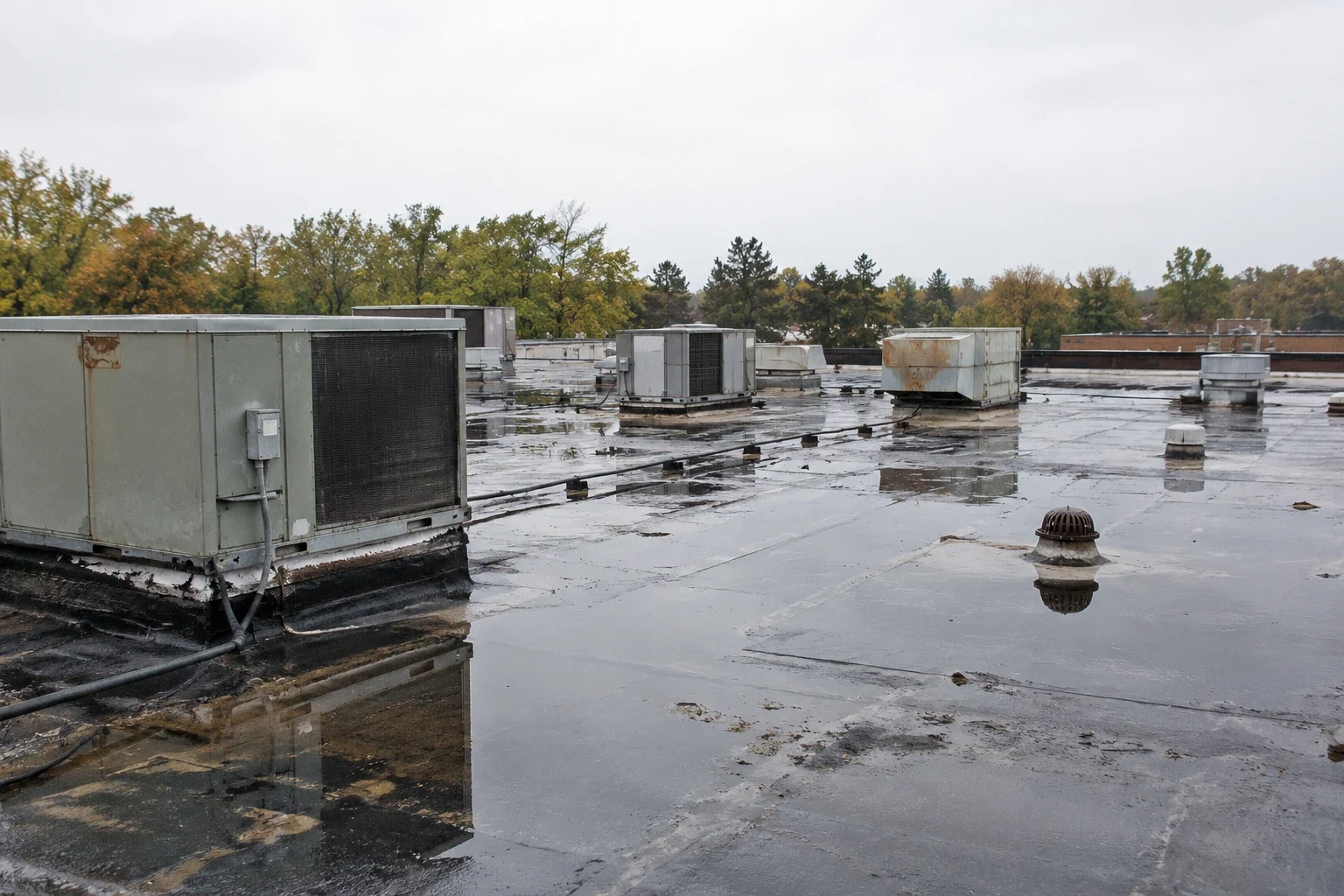
Standing water on a flat roof is a weight problem first and a leak problem second. Water weighs a lot, and a roof that holds it is carrying load nobody drew on the plans. Commercial Roofing Flagstaff repairs ponding on commercial roofs in Flagstaff, AZ, and we start by asking why the water stayed. The answer is a clogged drain, a low spot in the deck, a failed slope or a sagging structure. Each has a different fix.
In this town the question matters twice a year. Snowpack melts on a thaw cycle and the meltwater has to leave. Then the July and August monsoon drops a downpour on the same drains. A roof that ponds in either season is telling you something about its drainage.
Water that is still on the roof two days after the rain stops is ponding. A film at a seam or a damp patch near a drain is normal. A puddle with a hard edge and a dark ring left behind is not.
The ring matters. It shows the high-water mark, and dirt, algae or granule loss trace how long the water stays. We look for those rings during the walk, because they map the low spots better than any level.
We also look for ponding that comes and goes. A roof dry in August and flooded in March has a drain that freezes, not a deck that sags. That distinction decides whether we clear a line or open the roof.
Ponding comes from three places. We rule them out in order, cheapest first.
A drain that backs up is the quickest to fix, and the most common after a snow-heavy winter. Leaves, pine needles and grit from the surrounding forest collect at the strainer, and ice in the line does the rest. Deck movement is harder. It can be a structural flag, so a sag check comes before any membrane work. If the structure is moving, the roof is not the first thing to repair.
At roughly 7,000 feet, Flagstaff takes 90 to 97 inches of snow in a normal year. When that pack starts to melt, a flat-roof drain has hours to move a lot of water. If the drain is blocked, or the pack is frozen around it, the meltwater spreads outward and refreezes at night. By morning there is a ridge of ice around the drain and a pond behind it.
Between February 28 and March 2, 2023, a storm left 24.5 inches on parts of the city, and officials reported several roofs failing under the load. Their warning list: sagging ceilings, bowing trusses, severe leaks. A ponded roof under that kind of snow is carrying water weight on top of snow weight. That is the exact combination a sag check is meant to catch.
We recommend a fall walk to clear drains and set heat tape or trace where lines freeze. In early spring we walk again and mark every pond that formed over winter.
Wherever a downtown roof in the Railroad Addition sits behind a masonry parapet, the parapet traps water as easily as it traps snow. A scupper set a little high or a through-wall opening choked with debris turns the whole roof into a tray. An 1897 ordinance required brick, stone or iron downtown, so repairs there have to respect the masonry as well as the membrane.
Out on Butler Avenue near Lone Tree Road, any retail roof with rooftop units has the same issue. Every unit curb is a small dam. Water collects on the uphill side, sits there and tests the flashing. In Mike's Pike and the surrounding industrial blocks, a low-slope metal roof can show ponding where the deck has deflected along a purlin line. We find these with a straightedge, a moisture meter and, on larger roofs, an infrared survey to see where wet insulation sits under the standing water.
First we clear and test every drain, scupper and overflow. If water leaves freely and the pond still forms, we measure depth and area, then decide between tapered insulation, a new drain sump, a crickets-and-saddles package behind curbs, or a re-sloped section. Crickets divert water around equipment and cost far less than a full recover.
Wet insulation under a pond has to come out. Leaving it in place invites mold, freeze damage and a membrane that blisters in the first hot week. We cut out saturated board, dry the deck, install new insulation to the right fall and replace the membrane over it with a welded or adhered patch. Where the pond has damaged the seams around it, a seam repair goes in at the same visit.
If the deck itself has dropped, we flag the structure for an engineer before closing the roof. We do not cover a sag. When the pattern is spread across the whole membrane, a recover or full replacement with tapered insulation is the lasting answer.
Ponding that grows over time is not a roofing defect alone. A deck that keeps dropping keeps collecting more water, and the cycle ends with a failure. If a ceiling sags or a door sticks after heavy snow, the information line the city and Coconino County operate for structural roof concerns is the right call.
Our scope stops at the roof. We document depth, area and location with photos and give the owner a written summary that an engineer can use. Then we repair the membrane and drainage so the roof sheds water once the structure is sound. A snow and ice damage inspection often covers the same ground in late winter.
Two days of standing water is the line we use for repair. Beyond that, seams soften and surfacing wears faster, and a winter freeze can turn a pond into a block of ice that stresses the sheet.
Single-ply roofs tolerate some ponding if the seams are sound, but constant water speeds up seam and surface wear. Built-up and modified bitumen roofs can show blistering or granule loss where water sits. We match the repair to the system on your roof and size the fix to the depth and area of the pond.
A drain that freezes or an ice ridge around a scupper holds meltwater that would drain in warm weather. The deck is not necessarily sagging. We clear the lines in fall, add heat trace where needed and walk again after the first thaw to confirm the water leaves.
On a roof with sound membrane and a localized low area, yes. We cut out the wet section, install tapered boards to carry water to the drain and weld a new membrane over it. If low spots run across most of the roof, a full recover or replacement with a new slope plan is the more durable choice.
An engineer does. We report what we see on the roof: depth of ponds, deflection at beams, sagging ceilings below. If the numbers point to structural movement, we recommend a structural review before we close the roof, and we hold the membrane work until the deck is sound.
Browse the services, roof systems and building types we work with across Flagstaff and nearby Arizona communities.
A walk of the roof with photos, findings and a written scope.
Active leaks, storm damage and blocked drains get a fast response.
Roofing across Flagstaff and nearby Arizona communities.