
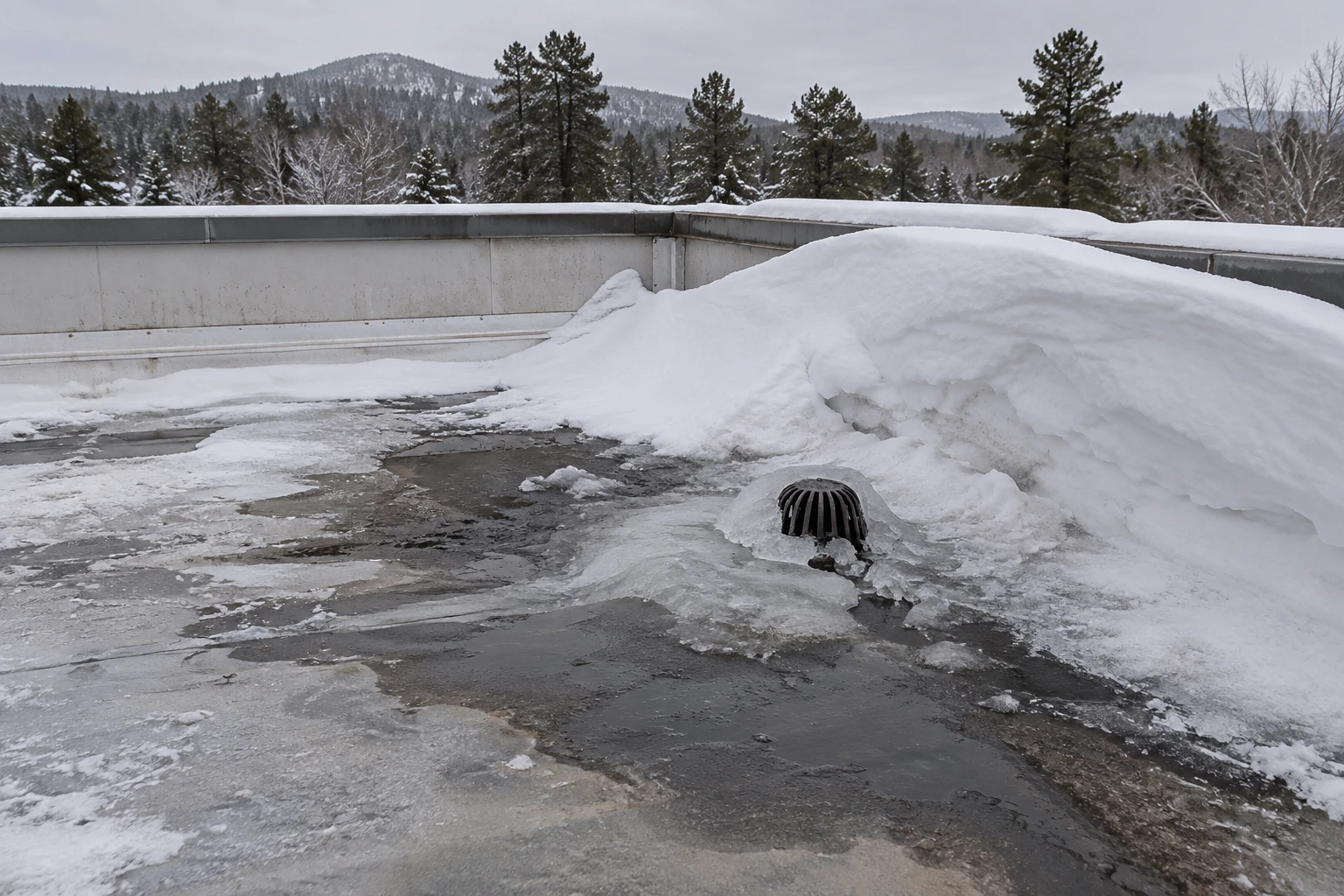
Snow is weight, and weight is what breaks roofs. Near 7,000 feet up, an average Flagstaff winter delivers 90 to 97 inches of snow. Commercial Roofing Flagstaff repairs snow and ice damage on commercial roofs in Flagstaff, AZ, and the work starts before the leak: with a check for sag, a look at the drains and a map of every drift line.
The record is plain. Snow load brought down several roofs after the February 28, 2023 storm, with 24.5 inches measured in some areas by March 2. On February 21, 2019 a single day delivered a record 35.9 inches. A roof here is tested every winter, and some winters test it hard.
The roof tells you less than the room under it. After the 2023 storm the city named three warning signs: sagging ceilings, bowing trusses and severe leaks. Add a few more to the list: doors and windows that stick, cracks running from the corners of openings, new gaps at wall tops, and ceiling tiles that no longer sit flat.
These are structural flags, not leak complaints. If you see them, do not wait for a repair crew. Clear people from the area, then call the line the City of Flagstaff and Coconino County share for residents who see structural roof trouble after heavy snow.
Our work is on the membrane side. When we see these signs from the roof, we mark them, photograph them and ask for an engineer before any roofing proceeds.
Snow does not sit evenly. Wind builds drifts behind parapets, around rooftop units and in mechanical wells, and each drift can carry several times the weight of the open field. A low roof next to a higher one collects a drift along the wall where they meet. That drift line is where deflection starts and where flashing gets crushed.
A flat roof at this elevation needs a drift map. We mark where drifts form, where the structure is tightest and where the drain sits relative to the heavy zone. If the drift sits on the weak part of the deck, the shoveling plan starts there.
Sagging shows up first at mid-span, where the beam is weakest. A sag check compares deck level to a known reference across the roof, and we repeat it after heavy storms so a slow drop is caught early.
Rooftop units add their own trouble. A unit curb acts as a small wall, and snow piles on its windward side while the lee side stays bare. That uneven load is why we mark each curb on the drift map and check the flashing at its base after the first big storm.
Ice does its work in three ways. A ridge of ice along a roof edge or wall base traps meltwater behind it, and the water finds laps and flashing. A frozen drain turns a thaw into a pond, which adds water weight on top of snow weight. Ice also forms inside a seam, expands, shoves the lap apart and leaves a gap for the next thaw.
The first freezing nights return in late September, and minus 30 degrees F is the lowest on record. That is a long season for thaw cycles. We see the damage in spring: lifted edge metal, split seams, saturated insulation below ponded areas, and flashing pulled from walls.
Prevention beats repair here. Heat trace on drain lines, cleared scuppers and a plan for ice removal at the edge go a long way. Never chip ice off a membrane with metal tools, because the sheet is more brittle in the cold and will cut.
Downtown, older masonry buildings with parapets give drifts a place to build. In the Railroad Addition, every building along Santa Fe Avenue faces the tracks, and any parapet there can hold a drift. Downtown roofs get a drift map and a drain check each fall.
Northern Arizona University sits at 6,950 feet in a large ponderosa pine forest, and the campus buildings include the Walkup Skydome and a 111,000 square foot business college complex. Pine needles and debris collect in drains, which is the first thing to clear before snow arrives.
West on I-40, Williams gets about 65 inches of snow a year, mostly November through March, and Bellemont stands at roughly 7,100 feet beside Camp Navajo. Roofs in Williams and along the corridor still carry months of snow. Near I-40 and I-17 there are five industrial parks, and a drift on a low-slope roof there can sit unseen for weeks.
In winter we triage. We clear drains and scuppers, remove snow in a pattern that protects the membrane, and place temporary dry-ins where water is entering. Emergency calls run around the clock, holidays included, and a roof with an active leak under snow does not wait for Monday.
In spring we assess. Every lifted edge, split seam and damaged flashing gets marked, repaired in dry weather and documented. Insulation that took on water is cut out and replaced. Drains are rebuilt where ice cracked them, and scuppers are reset to the correct height.
Where a roof repeatedly ponds or leaks at the same spot, we recommend a longer-term fix. Tapered insulation and added drains fix ponding water permanently. Snow guards keep avalanching snow off lower roofs and walkways. A preventive maintenance program books the fall walk and spring walk in advance, with the drain and scupper checks written in.
Cost drivers are access in snow, how much insulation is wet, and whether the structure needs engineering review first. We price winter triage separately from the spring rebuild so the owner can approve each stage on its own.
The structure sets the limit, not a number we can give from the roof. Design loads, building age and past repairs all matter. What we can tell is the pattern: deep drifts, a sagging deck or any of the warning signs listed by the city. If those are present, an engineer reviews the structure before anyone shovels.
Shovel when the snow is heavy, the drift sits over weak structure or a drain is buried. Use plastic blades, leave a layer of snow on the sheet and clear toward the drains. A thaw waits for the temperature, and a freeze after it can make the pond worse. We write a plan for each roof.
Water needs a path, and March gives it one. Meltwater runs beneath the snow, refreezes at night and finds the laps and flashing that the cold opened over the winter. The damage is done in January, and the leak appears in March. A spring walk catches what winter opened.
Mostly on pitched metal roofs or sloped sections over walkways and entries. They hold snow in place so it melts gradually instead of sliding in a sheet. On a flat roof with a parapet, the parapet does most of that work, and the better investment is drain capacity and a drift plan.
We measure deck or ceiling deflection against a fixed reference at several points, sight along rafters or beams from below when access allows, and check doors, tiles and wall joints for movement. We log the readings and compare after the next storm. A change over time, not a single reading, is the flag.
Browse the services, roof systems and building types we work with across Flagstaff and nearby Arizona communities.
A walk of the roof with photos, findings and a written scope.
Active leaks, storm damage and blocked drains get a fast response.
Roofing across Flagstaff and nearby Arizona communities.