
PVC wins where the roof gets dirty. Grease, oils and exhaust attack other membranes. PVC shrugs most of it off. In Flagstaff, AZ that matters for restaurants, clinics, labs and plants. It also has to carry snow, handle freeze-thaw and survive strong sun at 7,000 feet. It can do all of that when it is installed well.
Commercial Roofing Flagstaff installs and repairs PVC. We say where it fits and where a cheaper sheet will do.
The sheet is one part of the system. Insulation, cover board, fasteners, flashing and drains matter just as much. A good sheet over wet insulation fails early. A good sheet over blocked drains ponds. We look at the whole assembly, not just the top layer.
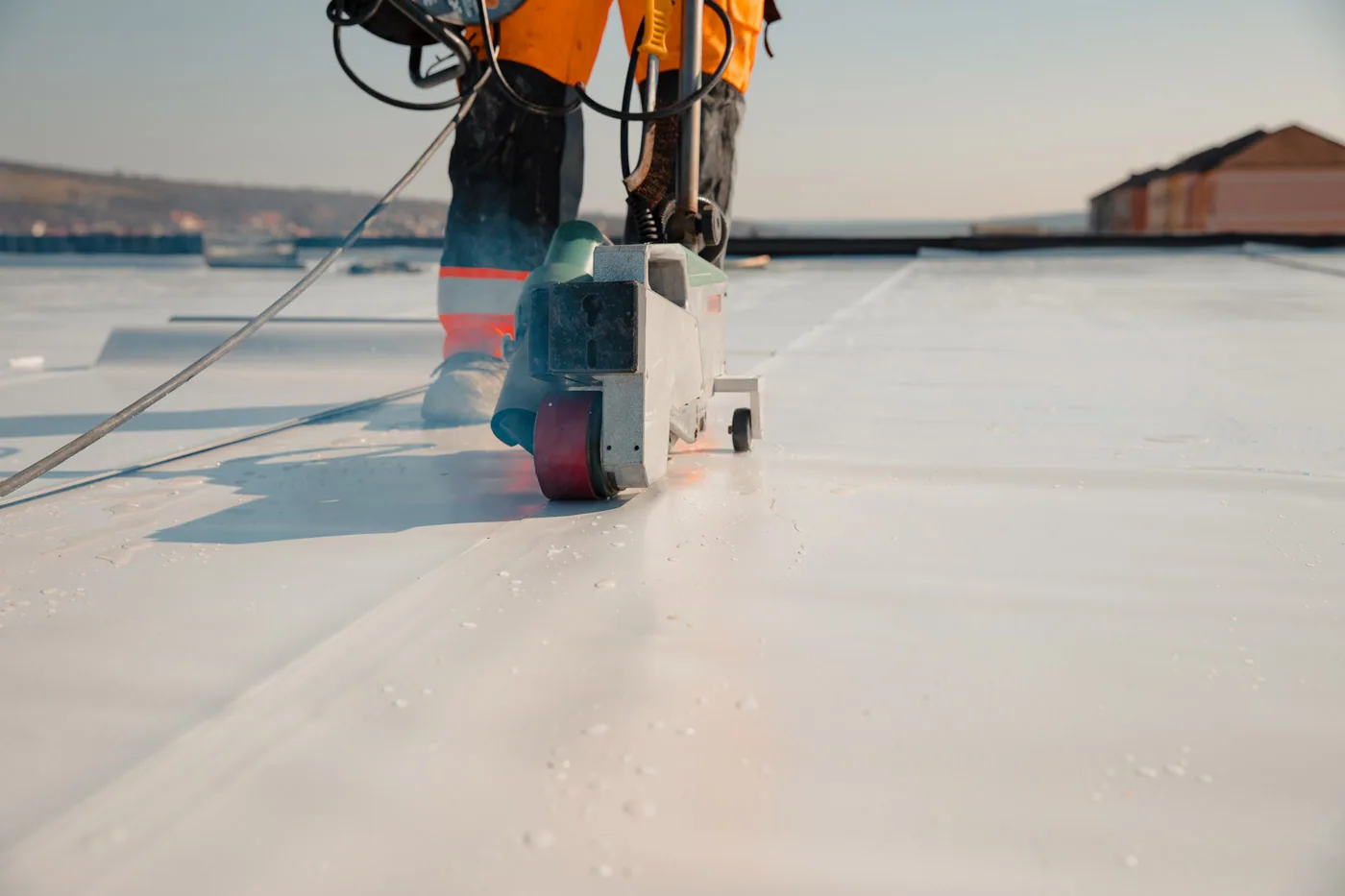
PVC is a thermoplastic single-ply. Crews roll it out, overlap the edges and weld the seams with hot air. The weld fuses the sheet. Reinforcing fabric inside gives it strength. It is often white or light gray.
Plasticizers keep the sheet flexible. Over time, some plasticizer migrates out, and the sheet stiffens. Good formulas slow that loss. Cold weather stiffens any sheet, and PVC needs care at corners and folds in a Flagstaff winter. Crews handle rolls gently in the cold.
Like TPO, PVC can be mechanically attached, fully adhered or ballasted. Attachment depends on the deck and wind. The insulation and cover board below set the thermal and fire performance of the roof.
Thickness and reinforcement vary. A thicker sheet takes more foot traffic and wear. A scrim-reinforced sheet resists tearing at fasteners. We match both to the roof's use. A roof with many service trips gets a thicker sheet and extra walk pads, and a quiet roof can use a lighter one.
Rooftop kitchen exhaust coats the membrane in grease. Some sheets swell, blister or soften from it. PVC resists animal and vegetable fats well. Labs and plants send other chemicals up through roof vents. PVC resists many acids and oils.
We still look at the exhaust. Grease containment, fan base condition and curb flashing all matter. A restaurant roofing job uses PVC near the fans and checks the sheet often. For clinics and care sites, a hospital roofing plan names chemical sources and picks the membrane to match.
A hospital or clinic building sends exhaust and intake air through its roof. Chemical sources and fan bases decide where the PVC details need the closest look. Those are the spots we weld by hand and probe twice.
Rooftop exhaust leaves a film. The film holds dirt and traps heat on the surface. We wash it off during maintenance visits with a cleaner that suits the sheet. Pressure washers can lift seams, so we use low pressure and keep the nozzle back from edges. The wash goes into the log with the date and the cleaner used.
Drains near kitchens collect grease. A greasy strainer slows flow. We clean strainers and flush lines on every visit to a restaurant roof, and we tell the manager when a wash-down practice is sending grease to the roof.
Snow totals 90 inches or more in an average winter, and the first freeze lands in late September. PVC is smooth and sheds snow well. Welded seams do not wick water. Freeze-thaw acts on seams, flashing and sealant. We probe seams each year.
After parts of the city took 24.5 inches between February 28 and March 2, 2023, the city confirmed several roof collapses. Membrane type does not change structural load. The sag check comes first. Inside, a sagging ceiling or a bowing truss is the warning.
Ice ridges form at eaves. Proper flashing height and drainage prevent backup. Heat-trace cable at drains is an option for critical outlets.
Snow guards and fences matter above entries. A smooth PVC surface lets a whole sheet of snow slide at once. Where a path, a dock or a door sits below, we add guards at the right spacing and attach them to structure, not just to the membrane.
PVC welds at a different temperature from TPO. Crews adjust the machine for the sheet, the air temperature and the speed. Cold and damp cut the bond. Welding goes in during the warm months, with a probe on each seam. A seam that lifts is cut out and rewelded.
Flashing takes hand work. Pre-molded corners and pipe boots speed it up. Detail welds around curbs and penetrations get probed twice. Walk pads protect the sheet along service routes.
Fire ratings depend on the full assembly, including the deck and insulation. We confirm the assembly before we order.
Substrate prep decides adhesion on fully adhered roofs. The board must be clean, dry and flat. Adhesive needs mild temperatures and an open time that matches the weather. A cold morning shortens the working window, so we plan smaller sections on shoulder-season days.
Old PVC can be hard to weld. The surface may be dirty or stiff. We clean it with a cleaner made for the sheet. If a hot-air weld will not take, we use a compatible adhesive repair or replace the section. A seam failure repair ends with a probe test.
Core samples show thickness and plasticizer loss. A stiff, cracked sheet is near the end. A supple one has years left. The moisture scan shows wet insulation. We use both to rank the roof.
Record keeping closes the loop. After repair we log each welded patch with a photograph and a location. A year later, the next walk compares the log with the roof. Repeat patches in one area point to a cause we can fix, such as a drain, a curb or a worn walkway.
PVC costs more than TPO. It pays back where grease or chemicals reach the roof. A related sheet, KEE roofing, adds a modifier for added flexibility and chemical resistance. TPO roofing suits plain, clean roofs on a budget.
In Flagstaff, the choice follows the building. A restaurant or hotel kitchen in the Railroad Addition Historic District, or a plant on Mike's Pike with chemical exhaust, is where PVC gets priced first. Mike's Pike in the Southside district is mostly industrial, so the question of exhaust comes up there.
Cost follows sheet thickness, insulation, detail welds and how the crew reaches the roof. PVC sheet costs more than TPO, and PVC detail work adds more hand welding. We show those lines apart, so the owner can see what a grease-resistant surface adds.
Usually yes. PVC resists grease and fats better. TPO can soften with heavy grease contact. We check the exhaust, the layout and the budget before we recommend one.
Any sheet stiffens in the cold. PVC needs gentle handling at corners and folds. Plasticizer loss over years also stiffens it. We core a sample to check flexibility on older roofs.
Only as a stopgap. A weld takes a dry, clean lap and enough heat to fuse it. Frost and cold cut the bond. Our install window is the warm months, and each seam gets probed.
Look at flexibility, thickness, seam condition and wet insulation. A core and a moisture scan answer most of it. A stiff, cracked sheet with wet insulation is near the end.
It will not. Snow load belongs to the structure. A sag check should precede any reroof. A drooping ceiling, a bowed truss or a door that binds means an engineer should look before the roofer.
Browse the services, roof systems and building types we work with across Flagstaff and nearby Arizona communities.
A walk of the roof with photos, findings and a written scope.
Active leaks, storm damage and blocked drains get a fast response.
Roofing across Flagstaff and nearby Arizona communities.