KEE is PVC with a stabilizer that keeps the sheet supple. Standard PVC loses plasticizer over time and stiffens. KEE holds on to its flexibility longer. That matters in Flagstaff, AZ, where a roof sees strong sun at 7,000 feet, long freezing months and wide temperature swings.
Commercial Roofing Flagstaff installs and repairs KEE and other PVC-alloy sheets. We tell owners when it earns its price and when plain PVC or TPO will do.
The question we ask first is what the roof breathes. A roof that never sees grease or chemicals rarely needs KEE. A roof under a busy exhaust stack probably does. We read the vents before we read the price list.
KEE stands for ketone ethylene ester. It is a polymer blended into PVC. The blend acts as a permanent plasticizer, so the sheet resists the slow stiffening that standard PVC can show. The sheet is welded at the seams with hot air, like PVC.
KEE sheets often carry a reinforcing fabric and a heavier build. They are made for harsh exposure: oils, fats, chemicals and heat. They may be fully adhered, mechanically attached or ballasted. Insulation and cover board sit below.
The sheet that goes on your roof follows the specification for your assembly, including the insulation, the deck and the attachment method.
Heavier builds change handling. A thicker sheet is stiffer on a cold morning and harder to fold into tight corners. Crews warm rolls before unrolling them in shoulder weeks. They also keep rolls off frozen ground, since a cold roll resists flattening and wrinkles at the seam.
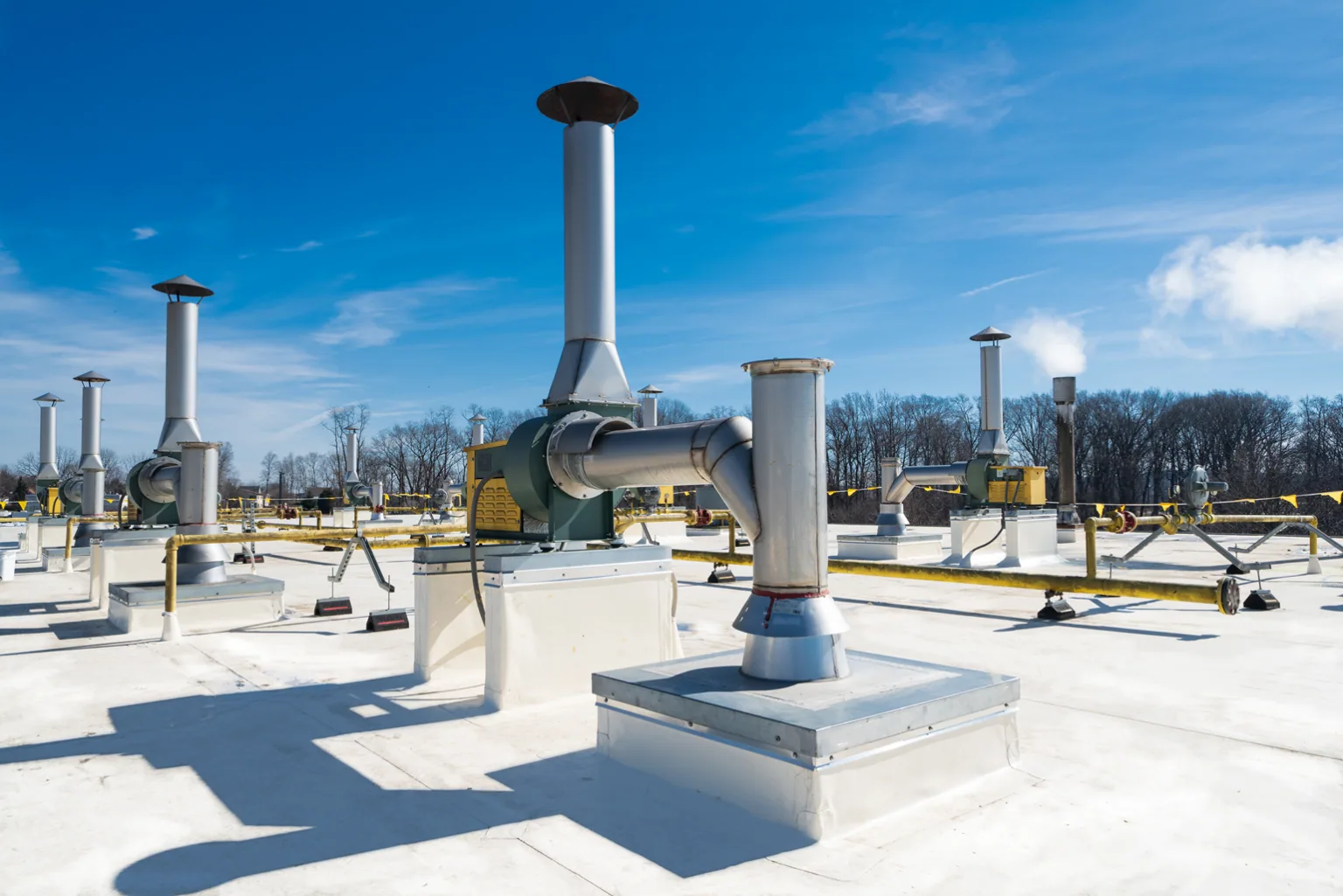
KEE fits roofs that take a beating from below. Think of kitchens that vent grease, plants that vent oils or chemicals, and buildings with heavy exhaust. It also fits roofs with lots of rooftop equipment and foot traffic, since the heavier build resists wear.
Flagstaff has food-service and process buildings that fit this profile. Hotels and restaurants in the Railroad Addition Historic District downtown run kitchens, and kitchen exhaust is greasy. Any plant on Mike's Pike or in the I-40 industrial parks that vents process exhaust gets the same exposure check. A hospital or care building carries exhaust and equipment on its roof, and the exposure list for it starts with what those units discharge. Each building gets its own exposure check.
A manufacturing plant roofing job starts with a list of what the vents discharge.
Walk traffic is the other test. Service crews cross some roofs several times a week. A heavy sheet shrugs off most of it, but a repeated path still wears. We lay pads along every route and replace worn ones. The pads cost little, and they extend the life of the sheet along the lines where it takes the most abuse.
First freezes arrive in late September, and the cold has gone as low as minus 30 degrees F. A supple sheet handles the cold better than a stiff one. Welded seams stay tight if they are good at install.
Sunshine runs near 3,475 hours a year at this elevation. UV at altitude is strong. A light-colored KEE sheet reflects much of it and runs cooler. The surface still ages, so we check thickness and flexibility by core as the roof gets older.
Thermal movement is constant. Seams, flashings and fasteners carry it. We probe seams each spring and look at terminations for pulling.
Dirt and film change the sheet's behavior. Exhaust deposits darken the surface and cut reflectivity. Heat builds under that film. We wash the surface during maintenance visits with a cleaner suited to the sheet, and we avoid pressure that could lift a seam. Each wash goes in the log.
Snow here totals 90 inches or more in a typical winter. The city counted several collapsed roofs after the 24.5 inches that fell in places between February 28 and March 2, 2023. No membrane changes the load. A sag check comes before a reroof. Flags to report: a sagging ceiling, a bowing truss, a door that sticks.
A smooth sheet lets snow slide. Guards go where a slide could hurt someone. Drains stay clear. Pooled thaw water on a KEE sheet loads the roof and stresses the welds. We walk the roof each fall, clear drains and note drift lines at parapets and mechanical wells.
Drift lines matter at parapets and mechanical wells. Wind drops snow behind anything tall. The drift adds load at one edge and holds meltwater against the flashing. We mark drift lines on the plan and check flashing height there. A taller termination or a cricket upslope keeps water out.
KEE welds like PVC but with attention to temperature and speed. Cold and damp cut the bond. Our welding season runs late spring into early fall, and every seam gets a probe. Seams that lift are cut and rewelded. Flashing takes hand welds and pre-molded corners.
Old KEE repairs with compatible patches. The surface must be clean and the weld must be tested. A seam failure repair ends with a probe. A flashing failure repair removes the failed piece and welds a new one. Core samples and a moisture scan show wet insulation and set the repair or replace line.
Specifying the repair matters on older roofs. Not every old sheet welds well. Contamination, age and oxidation can block a bond. We test a small weld first and pull it. If it fails, we change the method or replace the section. The test results go in the closeout record.
KEE costs more than PVC roofing and more than TPO roofing. The extra cost buys long-term flexibility and chemical resistance. Where exhaust is mild and the roof is quiet, TPO or standard PVC will do. Where exhaust is harsh, KEE earns its price.
City code follows the 2018 IBC and IECC with local amendments, so insulation on a KEE replacement is priced to that code. Those insulation items sit on their own lines in the scope. A plant or kitchen roof in Southside and Mike's Pike gets the exposure check before any sheet is picked.
Cost moves with sheet gauge, insulation, flashing count and roof access. KEE sheet costs more than standard PVC and TPO. We show that line on its own, so the owner sees what the harsher-duty sheet adds, and can weigh it against the exposure on the roof.
A modifier acts as a permanent plasticizer. The sheet resists the stiffening that standard PVC can show over time. It handles oils, fats and chemicals well.
On a roof with harsh exhaust, yes. On a quiet, clean roof, TPO or PVC will do. We list the vents and the discharge before we recommend one.
Not reliably. Welds need a dry, clean seam and enough heat. Weld work waits for the warm months, and the probe follows every seam.
We clean the surface, weld compatible patches and probe the seam. A core and a moisture scan show whether the insulation is wet and how much life remains.
No. The structure decides snow load. A sag check comes first. Call a structural engineer if you see sagging ceilings, bowing trusses or sticking doors.
Browse the services, roof systems and building types we work with across Flagstaff and nearby Arizona communities.
A walk of the roof with photos, findings and a written scope.
Active leaks, storm damage and blocked drains get a fast response.
Roofing across Flagstaff and nearby Arizona communities.