
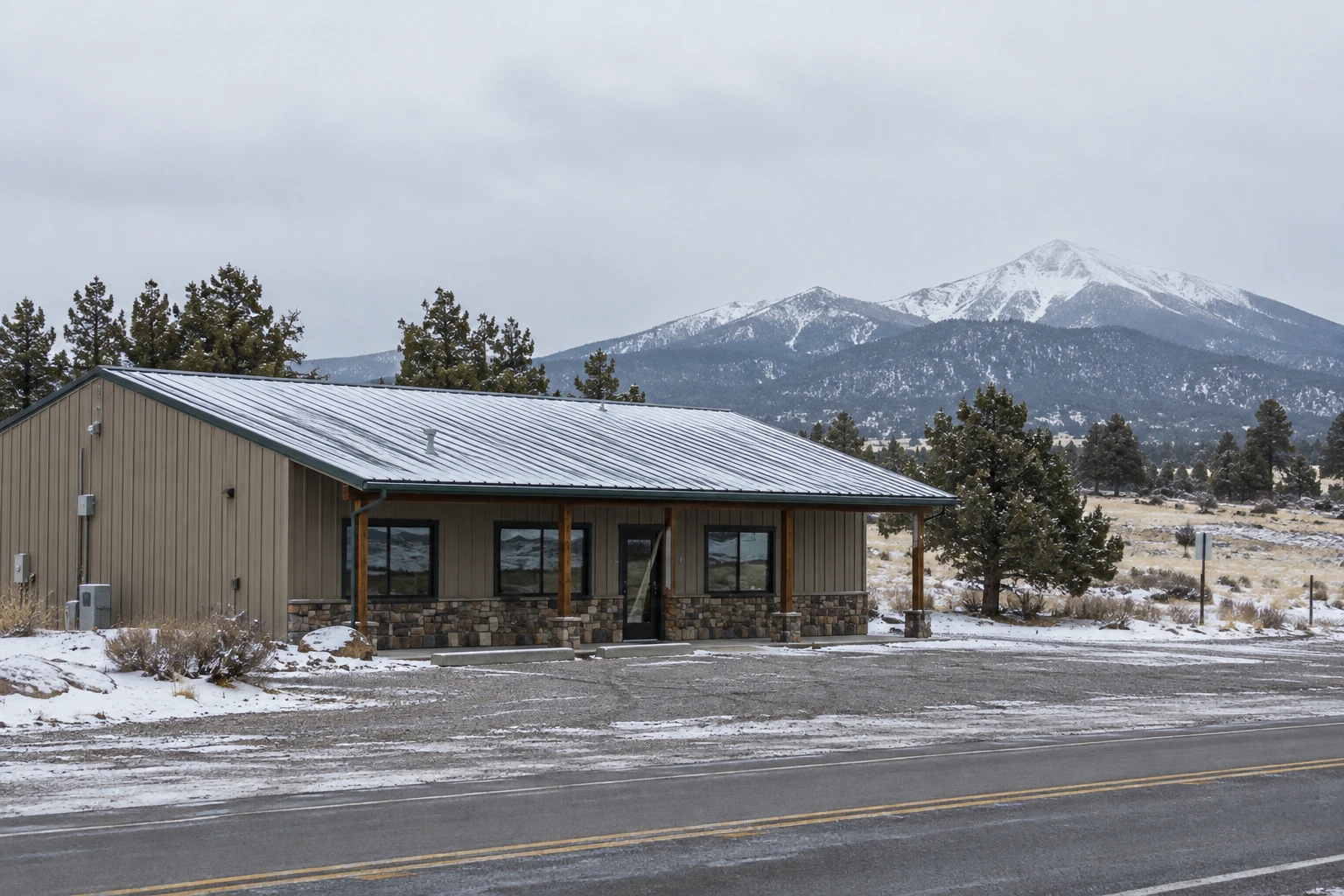
A roof near a rail line takes vibration and soot, and its fasteners can loosen over time. Commercial Roofing Flagstaff works on commercial roofs in Winona, AZ, a community about 13 miles east of Flagstaff along I-40, which follows old Route 66, at 6,263 feet. BNSF freight and the Amtrak Southwest Chief pass through, and the road in runs through CR 510, with Cosnino Road at I-40 exit 207 close by. A building in that corridor sits between a highway and a rail line.
We begin with the load and the attachment. Then we look at what the setting adds: vibration from trains and trucks, soot on the membrane and exposed roof edges.
Winona is a transport corridor. I-40 and the BNSF line run east-west, and a 2019 BNSF derailment disrupted rail traffic through the area. For a roof, the transport setting raises a few questions we ask on every first walk.
On the first walk we identify the roof system, the age and the attachment, and mark whatever the setting has done to them.
Rail and highway also mean noise and schedule limits, so the crew agrees on start times, lane access and staging with the manager before the first day. If a building operates around trucks or freight, we plan the roof work around loading hours and keep the access lane clear. Tear-off debris and fumes stay away from air intakes and doors.
The city 13 miles west, about 700 feet higher, logs 90 to 97 inches of snow across a typical year. Winona sits at 6,263 feet, below the city, so roof loads there get checked instead of assumed. We still plan for a hard winter, with Flagstaff's late-September first freeze and its minus 30 degree record as the benchmark.
Flagstaff's storm at the end of February 2023 stacked 24.5 inches on some areas, and snow load brought down roofs. The warning signs apply to any building out here: a dipping ceiling, a bowing truss, a leak that worsens. A sticking door is a clue too.
Our walk records drift lines at parapets, rooftop units and steps in the roof line. We check the drains, because a plugged drain under snow leaves a thaw standing on the roof. Where signs of sag appear, we recommend an engineer before any roofing proceeds.
Snow also slides. A metal roof edge over a door, a dock or a walkway can drop a sheet of ice. Where the walk finds that arrangement, we recommend snow guards or a relocated walkway before winter, because the fix is cheap and the failure is not.
We recommend by condition, not by habit. Several systems suit buildings in a corridor like this, and each has a place.
For a building with an aging roof that is still dry, a coating can extend service life. Our roof coating restoration work starts with cleaning and moisture checks, since a coating over wet insulation fails. When the roof is past that point, a recover or replacement comes next.
Cost follows the deck more than the surface. A firm, dry deck takes any of these systems. A soft or wet deck needs repair first, and that repair is where budgets move. We price the deck work as its own line so the owner sees it.
The first visit sorts the roof into items that need work now, items to watch and items that can wait. We probe seams, press on the membrane near edges, check every flashing and open details that look doubtful. We clear drains and test them with water.
We also check the ground side. A downspout that dumps onto a gravel drive can wash out the edge. A loading door under a metal roof edge may take a snow slide. Water running toward a wall base finds the flashing, and the first sign is often a damp floor.
Each entry on the list says patch or fix and names the price drivers: how the crew gets up, what equipment it needs, how deep the tear-off runs and when the weather allows. A flex industrial or warehouse owner can use that list to approve one scope at a time.
Roof work gets a short season. From late spring to early fall crews can work, and the July and August monsoon breaks that up. About a third of Flagstaff's roughly 21 inches of yearly precipitation comes with the monsoon, and thunderstorms peak in those two months, so a storm can stop a job without warning.
Fall is for clearing drains, resetting edge metal and refastening what summer loosened. Winter calls get a temporary dry-in at any hour. In spring, we repair what the cold opened. A maintenance calendar keeps those three steps on schedule, and the record builds with each visit.
A trip out I-40 can cover more than one roof. East Flagstaff sits on the way, and Cosnino is close by, so nearby owners can be grouped into one visit.
Repeated movement can loosen fasteners, open laps and shake sealant out of joints on some roofs, especially older ones. We check fastener pull, edge metal and flashing terminations as a standard part of the walk. If we find loosening, we refasten and reseal before it widens through a winter.
Plan for heavy snow. Flagstaff, 13 miles west, averages about 90 to 97 inches a year, and Winona is lower at 6,263 feet, so local totals may differ. We confirm the actual load on your roof by mapping drifts, checking drains and watching for sag signs after storms.
Roofs with dry insulation, a sound deck and a membrane that is worn but intact. We test moisture first. If insulation is wet or the deck is damaged, a coating only traps the problem. We clean, repair the defects and apply a coating system matched to the existing membrane.
I-40 runs through the area, and Winona is about 13 miles from Flagstaff. Winter driving may add time. Someone answers at any hour, and an active leak gets covered by a temporary dry-in first.
On larger or hard-to-reach roofs, yes. A drone pass shows the whole surface and finds problem areas fast. Infrared maps wet insulation at the right time of day. Both feed the same ranked repair list, and both help an owner decide between repair and a larger scope.
Browse the services, roof systems and building types we work with across Flagstaff and nearby Arizona communities.
A walk of the roof with photos, findings and a written scope.
Active leaks, storm damage and blocked drains get a fast response.
Roofing across Flagstaff and nearby Arizona communities.