
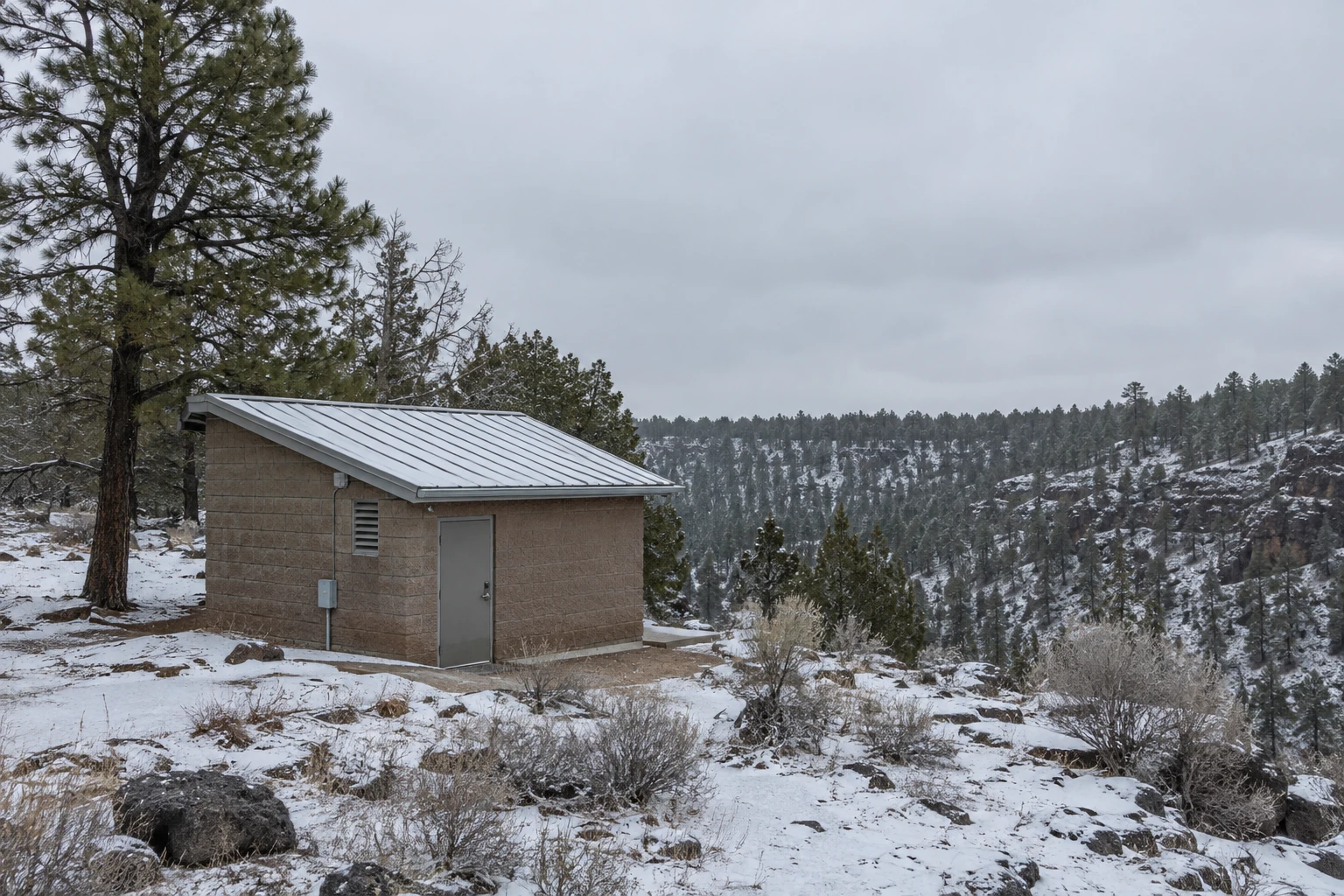
Snow once closed a school here from November to March. That tells you what a roof in Cosnino, AZ has to survive. Commercial Roofing Flagstaff works on commercial roofs in this rural community several miles east of Flagstaff, at about 6,467 feet, where the place began as a Santa Fe railroad siding. The buildings are spread out, the roads are long, and a roof problem can sit unseen for weeks.
So we start with the things a distance hides: the drain nobody can see, the edge metal loosened by wind and the sag nobody has measured. A first walk turns those into a list.
Cosnino is rural, and the setting tells us what a roof must handle: elevation near 6,467 feet, heavy winter snow that once shut a one-room school for months and an arena used for 4-H and agricultural events. A 1988 train derailment led to the evacuation of Cosnino Estates, so the rail line has already touched this community once.
Each of those facts changes a roof plan. Long winters mean snow load matters more than rain. Distance means response time matters. An arena or an agricultural building with a wide-span roof needs its own checks for sag, fasteners and underside moisture.
The first visit records the roof system, its age, its attachment and its drainage. The plan follows that record.
Flagstaff, a few miles west and about 500 feet higher, collects 90 to 97 inches of snow in its average winter. Cosnino sits at about 6,467 feet, so we plan its roofs from the Flagstaff record and then confirm each one on the roof. A school that stayed shut from November to March says the winters here run long.
By March 2, 2023, a late-February storm had piled 24.5 inches onto parts of Flagstaff, and the city reported roofs failing under snow load. The warning signs they listed were sagging ceilings, bowing trusses and severe leaks. In a rural building that no one visits daily, we recommend a simple monthly check in winter: look at ceilings, check that doors close, and watch for new cracks at wall tops.
If anything shows, call an engineer first. The roof work follows once the structure is cleared. Our drift maps and sag checks give the engineer a starting point.
A long-span metal roof, wherever one stands, has four winter faults. Fasteners back out as panels expand and contract. Seam sealant dries and cracks. Snow lets go in a single slide. And condensation forms on the underside when warm air meets a cold panel.
We check each. We pull a sample of fasteners, replace those that spin and add washers or oversized screws where the hole is worn. We reseal seams and laps with a sealant that stays flexible in the cold. We look at the eave and the ground below for slide paths. We inspect the underside for rust staining and wet insulation.
Where panels are worn, a metal roof retrofit can put a new standing seam system over the old, if the framing is sound. A standing seam roof sheds snow cleanly, but it needs snow guards over doors and walkways so the slide lands where nobody is.
Not every roof here is metal. Low-slope roofs on small commercial buildings depend on drains and scuppers, and a blocked drain is the cheapest failure to prevent. Snow packed over a dead drain melts into a pond, and that pond puts water weight on a deck already loaded with snow.
The fall walk covers every drain: we clear it, run water through it and then look at the gutters, downspouts and overflow openings. We reset a scupper that sits too high. We check that water leaves the building and does not run along the foundation. In winter, a frozen drain gets thawed or heated if the pattern repeats.
Edges get the same attention. A ridge of ice at an edge traps meltwater behind it, and the meltwater finds the laps. We mark those edges and fix the cause, whether that is a missing drip edge, a poor slope or an insulation gap. Low spots that drains cannot reach call for ponding water repair.
Cosnino lies east of Flagstaff, near the rail line that created it. Access depends on weather and road conditions, and a roof job needs materials, a lift and a crew to arrive together. We stage supplies ahead of a snow forecast and book larger work in the dry season.
For emergency leaks, our line runs around the clock, holidays included. Stopping the water comes first, with a temporary cover set once the roof is safe underfoot. The permanent repair waits for the next workable window. Because trips are long, we combine tasks: drains, flashing, a fastener check and a photo record in one visit.
Owners nearby, including those in Winona, East Flagstaff and along I-40, can be grouped so one trip serves several roofs. The repair list from each walk marks what needs doing now and what can wait for spring.
Four paths exist for an aging roof. Repair fixes local defects on a sound system. Coating extends a dry membrane that is worn but intact. A recover installs a new system over a dry old one. Replacement removes everything when insulation is wet or the deck needs work. Moisture testing decides.
Timing matters because the working window is short. Flagstaff's monsoon brings thunderstorms in July and August, and it delivers about a third of the year's 20 to 22 inches of precipitation. Freezing returns in late September. That leaves late spring and early fall for major work. A maintenance program books the fall and spring walks a year out, so a repair-or-replace choice never lands in the middle of a storm week.
Look inside monthly, and walk the roof after any large snow if it is safe and the load looks heavy. Sagging ceilings, bowing members and sticking doors are the signs city officials listed after the 2023 storm. If one shows, keep people out of that area and call an engineer. The roof repair gets scheduled behind the engineer.
Panels move with temperature, so fasteners loosen and seam sealant cracks. Snow slides all at once, and condensation can form on the underside. The care list is fasteners, sealant, slide paths and underside moisture. We check all four and repair what we find before winter.
The emergency line runs all day and night. Cosnino sits several miles east of Flagstaff, and winter roads may add time. On an active leak we dry in the roof first, once it is safe to walk, and make the permanent repair when the weather allows.
Sometimes. If the panels are sound, the insulation is dry and the fasteners can be reset, a coating or retrofit extends life at lower cost than tear-off. If rust has eaten through panels or the underside is wet, replacement is the path. A walk and moisture test tell us.
Yes. A wide clear span carries snow across a long distance with few supports beneath it. We check the sag from below, the connections at each support and the fasteners along every seam. Cosnino has an arena used for 4-H and agricultural events, and any building of that shape gets the same four checks: sag, connections, fasteners and underside moisture.
Browse the services, roof systems and building types we work with across Flagstaff and nearby Arizona communities.
A walk of the roof with photos, findings and a written scope.
Active leaks, storm damage and blocked drains get a fast response.
Roofing across Flagstaff and nearby Arizona communities.