
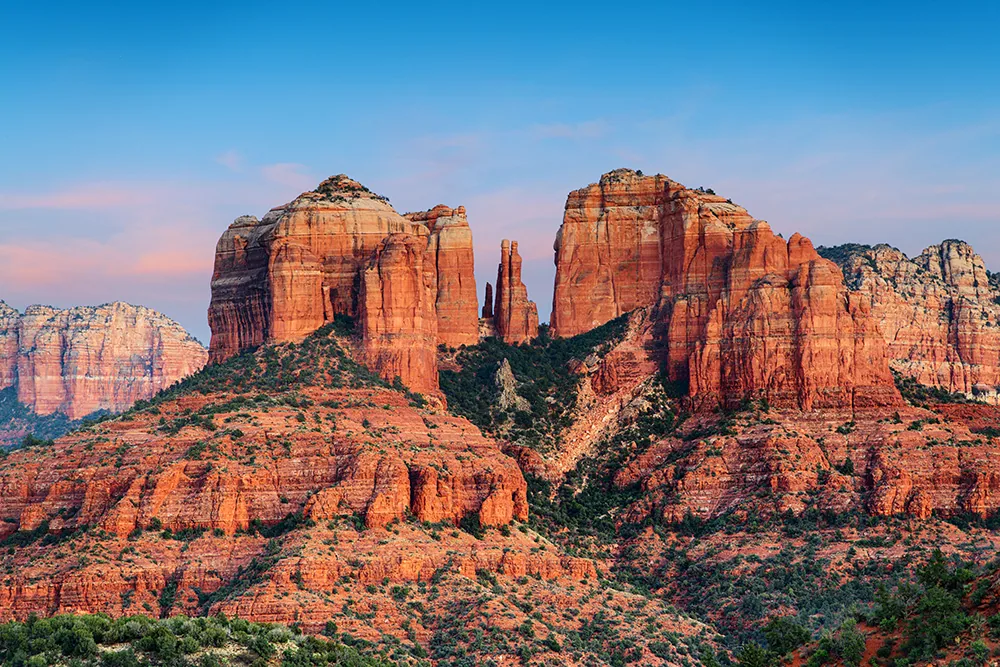
A Sedona roof sits about 2,640 feet lower than a Flagstaff roof, and the work it needs follows from that. At 4,360 feet, against Flagstaff's roughly 7,000, sun and heat come first on the inspection list. Commercial Roofing Flagstaff works on commercial roofs in Sedona, AZ, on the Coconino County side, where Uptown Sedona and the Chapel area sit. Tourism is central to the local economy, which means lodging, dining and retail roofs that cannot go out of service in the busy season.
We begin with sun, heat and drainage. Then we plan the work around the calendar the building lives on.
Sedona straddles Coconino and Yavapai counties. We serve the Coconino side, which includes Uptown Sedona and the Chapel area. The town had 9,684 residents in 2020 and draws visitors through SR 89A, which links it to Flagstaff by way of Oak Creek Canyon.
A tourism economy puts specific pressure on roofs. A leak over a guest room is a room out of service. A leak over a dining room or a shop floor stops sales in the weeks the business depends on. Work has to be planned around guests, deliveries and events, and the roof has to be closed each night.
Roof types in town vary by building, so the first walk sets the plan. It records the roof system, its age and how it is attached, and the plan follows from what is on the building.
Rooftop equipment is the second thing every walk covers. Kitchens, guest-room systems and retail units put curbs, vents and exhaust fans up there, and each is a penetration to flash and a reason for foot traffic across the membrane. We map the equipment on the first walk and check every curb.
At 4,360 feet, the main wear to plan for on a Sedona roof is ultraviolet exposure and thermal movement. Membranes harden and craze. Sealants dry and crack. Fasteners work as panels expand in the day and contract at night. The damage is slow, and it shows up first at flashing, seams and penetrations.
We check those details on every walk. We look for chalking and cracking on single-ply surfaces, granule loss on bituminous roofs and failed sealant at curbs and pipes. Reflective coatings can cut heat load on a worn but dry roof, and our cool roof installation work covers white membranes and coating systems that lower surface temperature.
A coating restoration can extend a sound membrane after a thorough cleaning and moisture test. If the insulation is wet, the coating waits and the wet board comes out.
Heat also affects the work itself. Adhesives and sealants have temperature limits, and a dark surface in afternoon sun can run far hotter than the air. We schedule welding, bonding and coating for the cooler part of the day, and we avoid applying coatings to hot surfaces.
Up the canyon, Flagstaff takes roughly a third of its 20 to 22 inches of yearly precipitation from the summer monsoon, with July and August the peak for thunderstorms. We plan Sedona drains for that kind of summer downpour, which tests every drain, scupper and flashing detail within minutes.
That kind of rain exposes weak points fast. A drain with a loose strainer or a crushed line backs up. A scupper that sits too high holds a pond. A curb flashing with a cracked bead leaks immediately. We clear and test drains before the season, reset scuppers and reseal terminations, and we record each fix.
Our ponding water repair work handles low spots that stay wet after the rain ends, and a leak repair call after a storm starts with tracing the entry, which is rarely where the stain shows.
Winter still needs a plan for a Sedona roof. Flagstaff, up the canyon, reached 24.5 inches in some areas during the storm that began February 28, 2023. A Sedona roof still needs drains that work and a structure that has been checked before any cold spell.
Flagstaff's freezes start in late September, and an unheated drain line or a pooled low spot on a Sedona roof can freeze whenever the temperature drops far enough. We check for those before winter, and we flag any sag or ceiling sign for an engineer.
Winter also changes the work window. Cooler months suit adhesive and sealant work, and crews are more comfortable on the roof. Summer afternoons make a hot surface that limits some repairs.
A worn roof ends up on one of four paths. Repair clears local defects on a roof that is otherwise sound. A coating stretches the life of a dry membrane. A recover adds a new system over a dry old one. Replacement strips everything when moisture or deck damage rules out the others. We test moisture before we choose.
For lodging and dining owners, schedule shapes the choice. A recover or coating takes less time than a tear-off, with less noise and fewer open sections. We plan in zones, close each zone every day and keep fumes away from air intakes and patios.
Tourism sets the busy weeks for lodging and dining, so large jobs go into the quieter stretches the manager names. Cost depends on the roof size, the access, the insulation condition and the schedule, and we list each driver next to the price. A maintenance program keeps small repairs from becoming guest-facing leaks.
SR 89A links Sedona to Flagstaff, and Flagstaff Pulliam Airport, south of the city, is 26 miles away. Crews come by that road through Oak Creek Canyon, so a trip can be shared with owners along the canyon, and with owners in Fort Valley at the north end of the run. Send the street address and the roof type, plus the date the roof was last inspected, and the visit gets scheduled.
Findings go on a ranked list, each tagged patch or fix with its main cost driver beside it. A manager can approve the guest-facing items first and plan the rest for the quiet weeks.
Often a different priority. Flagstaff roofs are planned around snow load and freeze-thaw. Sedona sits 2,640 feet lower, so UV resistance, reflectivity and heat tolerance move up the list. Membrane type, coating choice and insulation levels follow from what the building needs, and we choose after the walk.
We work in zones and close each one at day's end, so the roof is watertight overnight. Noise, fumes and debris stay away from guest areas and air intakes. We plan with the manager around check-in, service hours and events, and we schedule large work for the slower weeks.
A reflective surface lowers roof temperature, which can reduce heat entering the building. The effect depends on the roof, the insulation and the equipment. We apply coatings only over dry, sound membranes, after cleaning and repair, and we do not promise a savings figure.
Water backs up, finds the lowest edge or flashing and enters. The stain on a ceiling can be far from the entry point. We clear drains before July, reset scuppers, reseal curbs and check overflow openings so a short downpour has a clear path off the roof.
The Coconino County side, which includes Uptown Sedona and the Chapel area. The town straddles two counties, and our service area follows Coconino. If you are unsure which side your building sits on, send the address and we will confirm before booking.
Browse the services, roof systems and building types we work with across Flagstaff and nearby Arizona communities.
A walk of the roof with photos, findings and a written scope.
Active leaks, storm damage and blocked drains get a fast response.
Roofing across Flagstaff and nearby Arizona communities.