
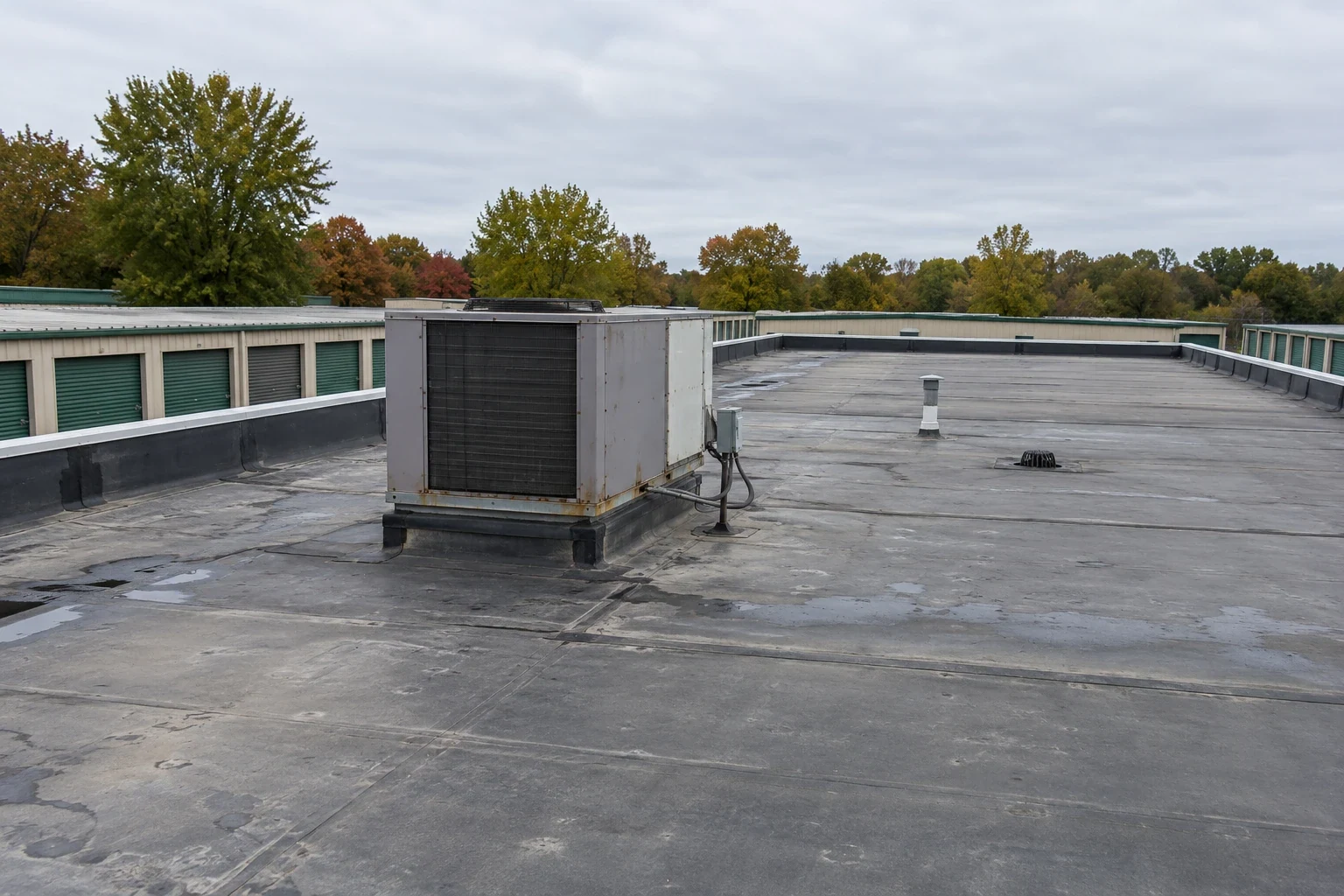
Self-storage buildings are long rows with simple roofs, and snow loves a simple roof. It piles on, slides off and leaves a drift against the next building in the row. Flagstaff, AZ sits near 7,000 feet, and a storage site there repeats that pile, slide and drift cycle through each long winter. The roof over a unit protects someone's furniture, records or tools. A leak means a claim, a call and a lost customer. So the plan is row by row. Check the load, check the fasteners, clear the drainage and fix the small things before the thaw finds them.
A manager running several sites needs a short, ranked list of rows, not a thick report.
Buildings set side by side trap snow between them. Slide from a high roof drops into the gap and builds a pile against the wall. The storm that arrived February 28, 2023 left up to 24.5 inches in parts of Flagstaff by March 2. Officials reported several roof collapses and told owners to look for ceilings that sag, trusses that bow and bad leaks.
Inside a unit corridor the ceiling runs clear, so a sag shows from the doorway. Staff should look up when they walk a row. A bowed purlin, a gap at a wall top or a door that will not roll is a structural flag. Clear the row and call. A snow and ice damage review on a storage row begins with those flags, then moves to the panel surface.
Where a storage roof is long metal panels held down by fasteners, the fasteners are the first check. Heat cycling works them loose. Flagstaff has logged minus 30 degrees F, and it also gets sun for about 78 percent of possible daylight hours. Metal expands and contracts with every swing, and fasteners back out, wash and crack. Each loose fastener is a leak point.
We walk the panels, check fastener heads and washers, probe sealant at laps, inspect ridge caps and edge trim and look for rust at cut edges. A fastener pull test shows how well the framing holds. Where panels are standing seam, we check clips and seam locks. When panels are tired, the options are new fasteners and coating, a metal roof retrofit over the old panels, or a new standing seam roof. A retrofit can avoid a tear-off if the structure carries it.
Rust at cut edges and fastener holes is the quiet failure. Water sits in the cut, rust spreads under the paint and the panel thins. We scrape a test spot to see how deep it goes, photograph it and record it by panel number. Early rust can be treated and coated. Deep rust means replacing the panel.
Metal sheds snow fast. A slide can crush a door, hit a vehicle or injure a person. Snow guards hold the pack in place and let it melt in stages. We place them above doors, walkways and drive aisles. We check that the guards are fastened to the structure and not just to the panel.
Gutters and drip edges take the melt. Ice builds at eaves and sheds in sheets. We check edge trim and gutters, clear debris and note where ice forms each year. Where ice repeats in the same spot, the cause is often poor ventilation or a heat source. We flag it. A preventive maintenance visit in late fall includes the guards, the gutters and every door line.
Drift also loads the lower roof. A taller building beside a lower one dumps snow onto it, and the lower roof sees far more than the open field. We mark those pairs on the site plan and check the lower framing first after a big storm. If a lower roof has shown stress before, we recommend a clearing plan that a trained crew can follow.
Monsoon season in July and August delivers roughly a third of Flagstaff's yearly moisture, much of it in short bursts. A single cell can empty onto a long metal slope in minutes. Gutters overflow, water runs under panel laps and a minor gap turns into a leak. Flat sections, such as an office roof, need drains cleared before the monsoon.
After the 2022 Pipeline and Tunnel fires burned land north of Flagstaff, monsoon storms brought flash flooding, and the city says the Schultz Creek watershed now carries added flood risk for Highway 180 neighborhoods. Clean downspouts and a clear path away from each building base matter more after floods like that. We check that water leaves each row and does not pool at the base of a wall. We clear, reset and add overflow openings on the flat sections and the gutters.
A leak over a unit puts someone's property at risk. The response has to be quick. Managers need a way to reach us at any hour, and we run around the clock. We stop the water first with tape, a patch or a tarp. Then we record the unit number, the roof panel and the cause. The manager contacts the tenant with a photo and a plain statement.
Records help with disputes. A dated log with photos shows when a leak began and what was done. We also advise on unit placement: move stock away from the wall and off the floor where water runs. Good habits at the unit reduce claims. For sites with many buildings, the same log format covers every row.
Office roofs and gate buildings need care too. A small flat roof over the rental office often has a single drain and a few penetrations, and a leak there puts records and cash handling at risk. We check it on every visit and include it in the same log.
Book a visit ahead of the first heavy storm. Tell us the site address, how many buildings stand there, the roof type and the last time anyone walked it. Then we put sag and drain checks on the calendar, rank the rows by condition and attach a cost range to each. Inside the city, a new storage roof is permitted under the adopted 2018 codes with their local amendments.
Flagstaff counts five industrial parks along I-40 and I-17, and storage owners near Southside and Mike's Pike or out at Bellemont and Williams work along those same highways. A site that mixes storage rows with a warehouse or a flex industrial building can sit in a single building file.
Twice a year at minimum: late fall before snow and late spring after the thaw. Add a walk after a storm that leaves a foot or more on the ground. Keep a log with the date, the row and the condition.
Yes, on metal roofs above doors, aisles and walkways. They hold the pack and release it slowly. We install them into structure and check them each fall. Place them before the first storm, not after a slide.
Stop the water, photograph the roof and the unit and tell the tenant at once. We provide a dated report with the cause. Your lease and insurance terms decide who pays, but the record helps.
Often, with new fasteners, sealant and coating. If panels are corroded through or the structure is weak, replacement or a retrofit is better. We price both and show the years gained.
Arrange access in advance and give us a contact. We inspect, photograph and report. For emergencies, we respond around the clock and call the manager from the roof.
Browse the services, roof systems and building types we work with across Flagstaff and nearby Arizona communities.
A walk of the roof with photos, findings and a written scope.
Active leaks, storm damage and blocked drains get a fast response.
Roofing across Flagstaff and nearby Arizona communities.