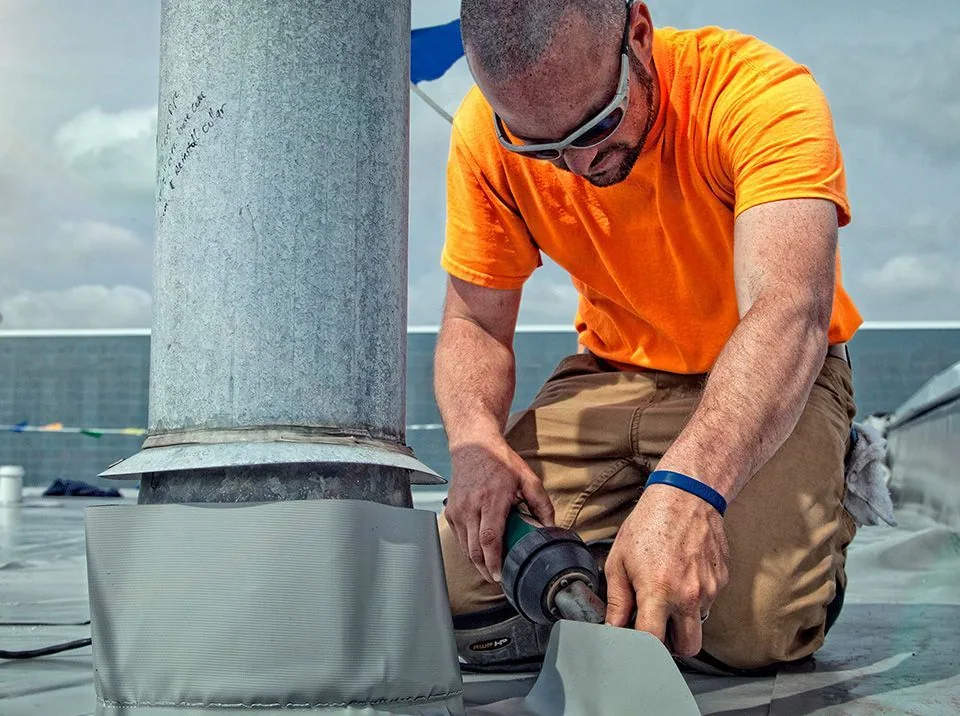
The sheet is built before it reaches the roof. Duro-Last is a maker of prefabricated PVC roof systems. A crew measures the roof, the manufacturer fabricates the panels and flashings to those dimensions, and the pieces arrive ready to unroll and weld. In Flagstaff, AZ that approach trades field work for factory work, which helps when winter windows are short. We repair these roofs and keep them maintained. The system is only as good as the first measurement, so we check that first.
A prefabricated system arrives as large panels with welds already made in the factory, along with pre-formed flashings for pipes, curbs and corners. On the roof, installers lay the panels over insulation, attach them mechanically or adhere them, and weld the field seams with hot air. The result has fewer field welds than a roll-by-roll roof, and the flashings are made to fit. The weak points are the field seams between panels, the attachment at the edges and any custom detail that did not fit the measurement. We find those first.
Insulation sits under the sheet. Rigid board supplies the R-value, and a cover board or plates pin the sheet to it. The deck below carries the snow. Edge metal finishes the perimeter and holds the sheet at its edge. Each of those parts affects how the roof ages, and a prefabricated sheet does not change that. We check the stack, not just the surface.
A good measurement gives a good fit. A poor one gives gaps at corners, flashings that do not reach and panels that pull. Existing roofs change over time. Equipment gets added, curbs get moved and walls get repaired. When we repair or extend a roof of this type, we re-measure the area and compare it with the original drawings. If a rooftop unit was added, we check that its flashing is a true fit and not a field patch. Photographs and a sketch go into the file. A drone roof inspection helps map a large roof quickly before anyone sets foot on it.
Panels have layouts. Each panel has a number, a direction and a place. A repair that replaces a panel or adds one needs the layout drawing, or a field survey if the drawing is lost. Without it, a patch can end up in the wrong direction or lap the wrong way, and water runs under the lap. We rebuild the layout from the roof if we have to, mark it on the sketch and keep a copy in the file for the next crew.
Average snowfall is 90 to 97 inches a winter, and within days the storm of February 28, 2023 laid down 24.5 inches in parts of town. Collapses followed on several roofs, and officials listed three warnings: sagging ceilings, bowing trusses and severe leaks. PVC does not carry that load. The deck does. PVC also stiffens in the cold, so a fold or a corner that flexes easily in summer can crack on a January morning. Metal shovels cut the sheet. We write the snow plan with plastic tools, no ice chipping at drains and a sag check from below before anyone climbs up.
Drift lines matter on a prefabricated roof the same as any other. Snow piles behind parapets and equipment, and the deck there carries the heaviest load. We mark every drift line on the sketch and check the deck below it. Framing that shows stress goes to a structural engineer before we do more roofing work. A roof that holds weight well in an average winter can still fail in the one storm that breaks the record.
Walk the roof in September. Freezing returns in late September. Clear every drain and scupper. Probe the field seams between panels, since those were welded on site. Check the edge terminations and the metal that holds them. Look at each prefabricated flashing for cracks at folds and corners. Check pipe boots and curb flashings for fit and welds. Press the sheet near the fasteners for raised plates. Foot traffic wears the sheet along the paths to rooftop units, so look there too. Photograph each finding and mark the sketch.
Inside, look for signs the roof does not show. A stain that returns after rain points to a flashing or a drain. A stain that spreads slowly points to wet insulation. A door that sticks or a tile that has sagged points to the deck. Match each sign to a spot on the roof sketch. The match saves hours of searching on a cold, windy roof.
A repair needs matching PVC and a clean, dry surface. Dirt, oil and age can keep a weld from taking, so weathered sheet gets extra cleaning first. We clean, test a small weld and peel it to check the bond. Then we cap the open seam or patch the hole with matching sheet, and run a probe along the finished weld. Cold or wet weather stops welding, so winter repairs are temporary. We stop the water, mark the patch and schedule the permanent weld for a workable window. A PVC roof with sound welds and a dry base can last a long time.
Parts matter. A pre-formed flashing replaces a failed one without cutting a new one in the field, if the part is on hand. We order custom parts for odd shapes and common parts for standard ones. A made-to-fit piece welded to a clean sheet is stronger than a hand-cut patch. When a roof needs many such parts, that is a sign to price a replacement.
Flagstaff's industrial parks, five in all near I-40 and I-17, hold buildings of many kinds. Mike's Pike, in the Southside district, is mostly industrial, with boxy metal, wooden and concrete buildings. Pulliam Airport sits about 5 miles south of the city at 7,014 feet, and the technology park on its land has direct access to I-17, I-40 and SR 89A. A plain, regular roof outline is where a made-to-measure sheet earns its keep. The airport technology park area and Southside and Mike's Pike show how different two industrial districts can be. Each roof gets its own walk.
Put the original measurement and drawings in the file. Re-measure before any extension. Walk the roof before October and probe every field seam. Fix lifted edges while the weather is dry. If the sheet is brittle or wet across wide areas, plan a commercial roof replacement. If the board is dry and the code allows, a recover may work. Flagstaff runs on the 2018 IBC and 2018 energy code with its 2019 amendments, and a new PVC sheet is specified to match. Sika Sarnafil and Holcim Elevate also sell PVC sheet, so an owner choosing between them should weigh the measuring and weld details of the roof in hand.
The panels and flashings are made to measure in a factory, so there are fewer field seams. The weak points shift to the field welds, the edges and any detail that did not fit. We check both on every walk, and we keep the original measurements in the file.
We re-measure and check that each new flashing is a true fit. A field patch around a new curb is a common leak. We rebuild it to match the system.
It stiffens in low temperatures, and folds and corners can crack. We check those spots every fall and keep foot traffic off the roof in deep cold.
Only temporarily. A patch stops the water, we mark it, and the permanent weld waits for a dry surface above freezing.
Once the insulation tests dry, the deck is sound and the code allows another layer. A moisture scan and a core confirm it before we price the work.
Browse the services, roof systems and building types we work with across Flagstaff and nearby Arizona communities.
A walk of the roof with photos, findings and a written scope.
Active leaks, storm damage and blocked drains get a fast response.
Roofing across Flagstaff and nearby Arizona communities.