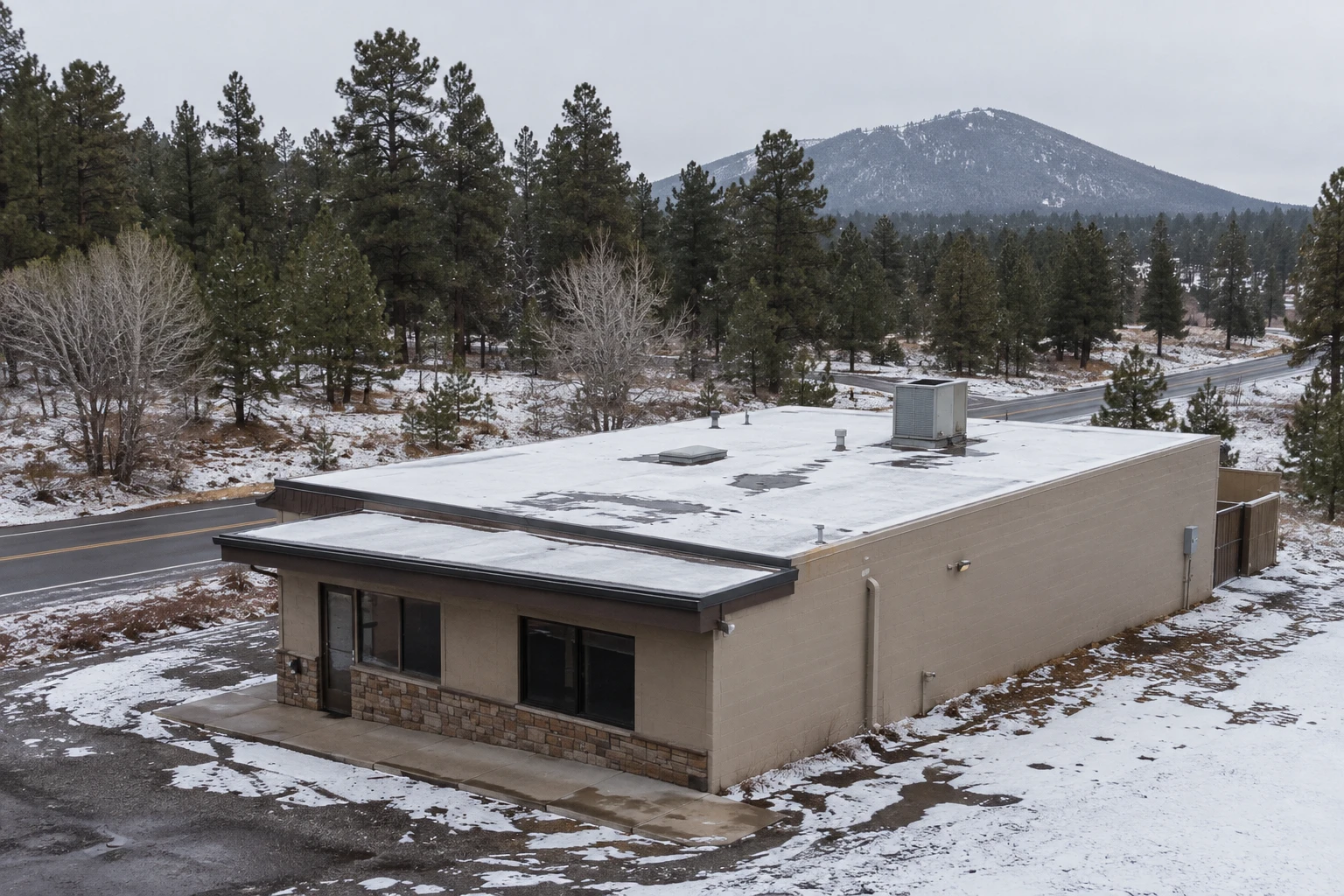
A quiet roof at 7,304 feet is still a loaded roof. Parks is a rural community along I-40, and it sits higher than Flagstaff does. Snow stacks up on a building whether anyone is inside or not. Commercial Roofing Flagstaff inspects and repairs commercial roofs in Parks, AZ. We look at the load, the drains and the details, in that order.
A building that gets little foot traffic still gets the full winter. The roof has to carry it alone, so the check has to happen before the first heavy storm and not after the first stain.
Parks had 1,382 residents in 2020. I-40 exit 178 serves Parks Road, and exit 171 serves Deer Farm Road and Pittman Valley Road. Those two exits are how a crew reaches a building here, and both sit on the interstate west of Flagstaff.
We keep the picture simple. The place is rural, high and exposed to winter. Roof type varies by building, so the first walk comes before any plan. Any shop, storage building, roadside business or community building starts with that walk, which gives us the roof type, the membrane age and the state of the deck. The plan comes after that. We also ask how the building is used. A shop that opens daily gets a different access plan than a storage building visited once a week. Owners tell us which doors stay locked, where the ladder can go and who holds the key, and the crew works.
Flagstaff's biggest single day dropped 35.9 inches on February 21, 2019, and a normal winter there brings 90 to 97 inches near 7,000 feet. Parks is higher than that mark. The planning assumption starts with the Flagstaff numbers and does not go down.
When the storm of February 28, 2023 reached Flagstaff, city officials reported several roof collapses from snow load. Their list of warning signs ran from sagging ceilings to bowing trusses and severe leaks. Treat them as structural flags. A building with a flat or low-slope roof and a heavy drift behind a wall needs the snow moved, and it needs a look at the structure under it. Snow that slides from a higher wall piles onto the lower roof and lands as a drift that can run several times deeper than the open field. We mark those drift lines on the plan and tell the owner where to clear first.
About 46.8 percent of housing units in Parks were vacant in the 2020 census count. That figure counts homes, not shops, but a commercial building that sits quiet part of the year carries the same risk, because nobody is there to see the drip.
A leak in an unwatched building runs for weeks. Wet insulation spreads the damage sideways, and the freeze-thaw cycle opens every seam it finds. We set up a walk schedule for these owners. One walk in early fall and one after the main snow season. The report arrives with photos, so a manager who lives elsewhere can see the roof from a distance. If we find standing water, torn flashing or loose metal, the report ranks each item as repair now, repair this season or watch. Money goes to the first group before the snow, and the rest is scheduled.
Drains fail first on a flat roof. Pine needles, grit and ice block them, and the water has nowhere to go. Under a snowpack, a plugged drain turns a thaw into standing water, and that water adds weight on top of the snow. We clear each roof drain, check the scuppers and follow the water to the edge.
Edges are the next weak point. Metal at the perimeter lifts in wind and cracks in the cold. We check the edge metal and gutters for gaps, because ice that forms there pulls the metal further out each cycle. A loose coping cap or a bent drip edge lets meltwater run behind the membrane. That water freezes overnight and lifts the edge a little more. By spring a small gap has become a leak path.
Each roof lands in one of four bins after the walk. A few failed seams and dry insulation mean repair. A tight but weathered membrane may take a coating. A roof with dry, fastened layers may take a recover. Wet insulation or a failing deck means replacement. The commercial roof replacement scope covers tear-off, deck repair, insulation and the new membrane.
Cost follows roof area, the system, access and deck condition. Timing follows the weather. Late spring and early fall are the workable windows, and the July and August monsoon cuts into both. Book early for a replacement. A recover saves tear-off cost but only works over dry layers, which is why the moisture survey and a core cut come first. An infrared moisture survey maps wet insulation under a surface that looks dry.
Parks is on the same interstate run as Bellemont and Williams. Crews can combine stops in one day and keep the schedule tight. Materials come by truck, and winter roads can slow a delivery, so we order early. Deep winter narrows the job to emergency roof repair and temporary stabilization, with permanent work following in the dry months.
Property managers in Flagstaff with a building out here can book one walk for both locations. We send one report format for every roof, so the buildings compare line by line.
Twice a year works for most low-use buildings. Walk it in early September, ahead of Flagstaff's late-September freezes, and again once the main snow season ends. Add a call after any storm that drops a heavy load. The reports let an owner who lives elsewhere track the roof from a distance.
Check the ceiling and the doors. After the 2023 storm, Flagstaff officials pointed to sagging ceilings and bowing trusses, and a door that sticks tells the same story. If you see one, rake the roof edge from the ground and ask us for a structural look. Do not climb onto a loaded roof.
It is, provided the insulation is dry and the membrane sound. We confirm both with a moisture survey and a core sample. A coating adds a reflective, sealed surface that resists UV and freeze-thaw wear. Over wet insulation it only hides the problem, so the survey comes first.
Yes, with temporary measures. We secure loose membrane, seal the opening and protect the insulation. Permanent work waits for dry weather and workable temperatures, which means late spring or early fall. Send the address and a photo of the stain when you call.
Begin with the building's address and the date the roof was last walked, and name the roof type if you know it. Add any earlier reports. We use those to plan the drain, sag and seam checks and to decide whether to pair the visit with calls elsewhere on I-40.
Browse the services, roof systems and building types we work with across Flagstaff and nearby Arizona communities.
A walk of the roof with photos, findings and a written scope.
Active leaks, storm damage and blocked drains get a fast response.
Roofing across Flagstaff and nearby Arizona communities.