
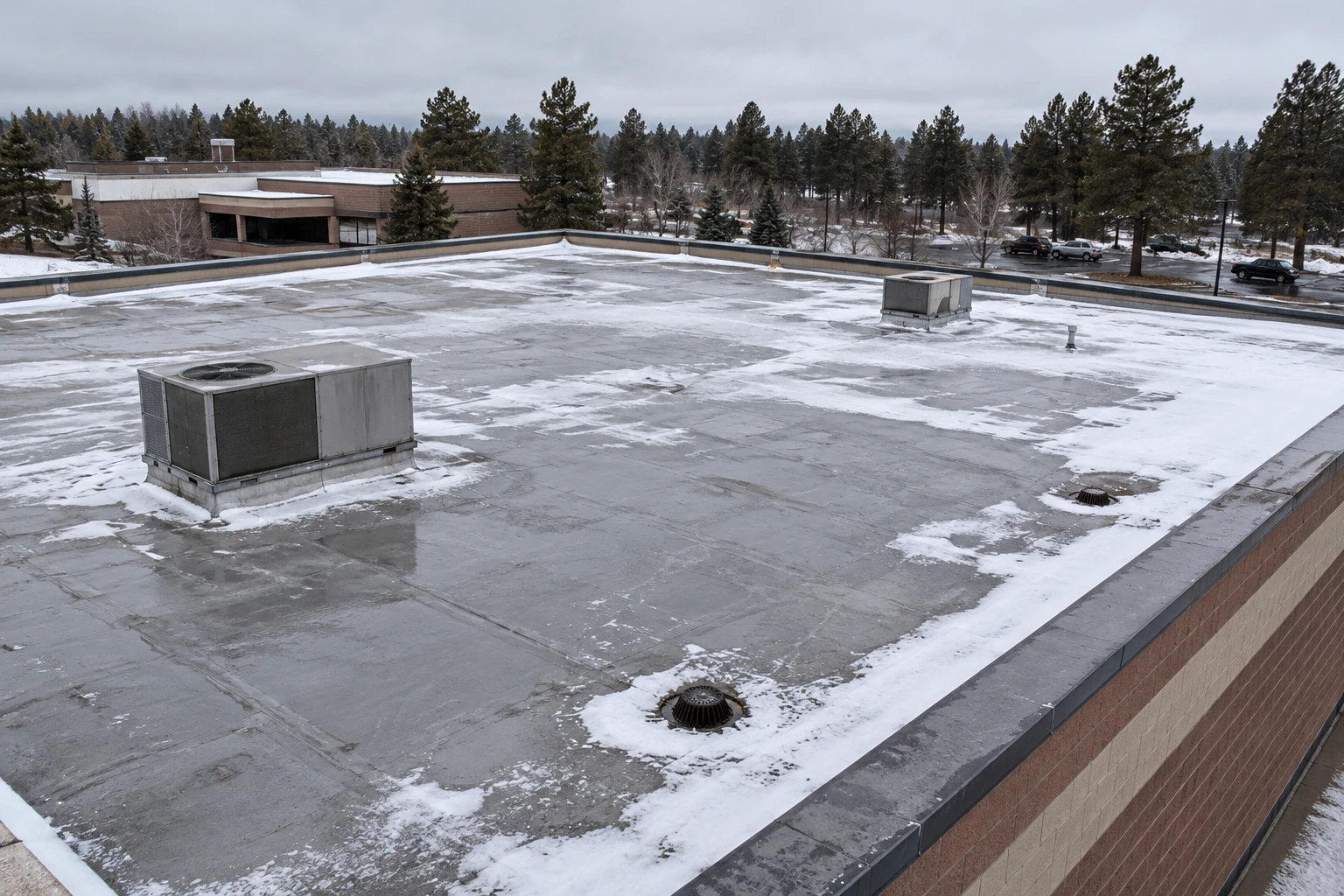
An armory roof covers a drill hall, and a drill hall is a big open room. Nothing inside holds the roof up. Snow does not care that the building belongs to the Guard. Flagstaff, AZ sits at 7,000 feet and its winters stack up snow by the foot, so the first question on a readiness center roof is load. After that come the vehicle bays, the classrooms, the offices and the access rules that decide when a crew can set foot on site. We take those in order and write each one down, so the facility file stays complete.
The goal is a roof that keeps the mission dry and a file that shows how it got that way.
A drill hall has a long clear span and a high ceiling. The trusses or frames do all the work. Up to 24.5 inches fell in places by March 2, 2023, and city officials later reported several roof collapses from the snow load. The warning signs it named were a sagging ceiling, a bowing truss and a bad leak. A wide hall shows them first.
Look up from the floor. Scan the ceiling line, the tops of the walls and the door frames. Anything that sags or binds means the room empties and the phone comes out. The city and Coconino County keep a shared phone line for reporting structural roof trouble after a heavy snowfall, and a hall manager should know the number. We do not put a crew on a doubtful roof until the structure is checked. A snow and ice damage review on a hall starts with the frame and moves to the surface after.
Readiness centers have more than a hall. Vehicle bays have big doors and exhaust. Offices and classrooms sit under lower roofs. Mechanical equipment sits on curbs. Each part of the building has its own roof section, its own age and its own drainage.
We walk each section. We check flashing at the high wall where the hall meets a lower roof, because drift builds there. We inspect door headers on the bays and the exhaust penetrations. We probe seams and check fasteners on metal panels. Where the roof carries equipment, we look at curbs and walk routes. A short written plan, drawn by section, goes to the facility manager. The plan sorts the roof into repair, watch and replace groups, with a cost range for each.
Armories often have lower roofs for classrooms, supply rooms and kitchens attached to the hall. Those joints are drift traps. Snow slides off the high roof, piles against the wall and loads the lower roof with far more than the open field. We mark every joint on the plan and look at the lower framing first after a big storm.
Flat roofs and gutters carry the water. A drain choked under packed snow lets the first warm day pool on the membrane. The July and August monsoon adds a second test, with cloudbursts landing on a roof that spent the winter under snow. The same drains that carry March melt take monsoon cells in July.
Hard freezes start in late September, and nights have fallen to minus 30 degrees F. Ice blocks gutters and downspouts. We clear lines in fall, check slope and put heat cable on the spot where ice keeps forming. Slide zones above doors and walks get snow guards or marked-off areas. Soldiers and staff cross those walks in every season, and a sheet of ice from a roof is a safety hazard. We mark the zones on the plan.
Military sites run on access rules. Contractors may need badges, vehicle inspections, escorts and advance notice. Work may be limited by drill schedules, training weekends and mission needs. We ask for the rules early and plan around them. We list the people who will be on site, the vehicles, the equipment and the hours. We follow the owner's procedures for gates, photography and storage of materials.
Roofing on installations often follows Unified Facilities Criteria, the standards that cover roofing design and installation for military work. We build scopes with those standards in mind, so a facility manager has a clean, written plan to check against the criteria. The same access steps apply to any base, depot or readiness center, and our military installation roofing work follows them.
Materials need a plan too. Loads arrive by truck and pass through inspection at the gate. We arrange delivery windows, staging areas and lift positions in advance, and we keep tools, fasteners and debris under control so nothing is left behind. At the end of each shift the crew sweeps the work area and the access route, and the site contact signs off the condition of the roof and the ground.
Camp Navajo is in Bellemont, along I-40 roughly 11 miles west-northwest of town. It opened in 1942 as the Navajo Ordnance Depot and has 776 igloo structures for munitions storage and a railroad network of about 38 miles of track. The Arizona Army National Guard operates the post as an industrial park, a munitions storage site and a regional training site. Tenants on the post range from a military police company and a transportation company to engineer detachments and Field Maintenance Shop 6.
Storage igloos and a maintenance shop make for very different roofs on one post. Each gets its own walk and its own report. For owners in Bellemont and along I-40, the method is simple: walk each building on its own terms, record what the roof shows and plan access with the site. A shop with tall bay doors raises the same drift and door-header questions as a hangar roof, so the checks follow the building.
Reach us before snow season starts. Pass along the building address, the roof material, when it was last walked and the gate rules for the site. We will schedule the sag and drain checks and deliver a ranked list. Inside the city, the adopted code is the 2018 building and energy set with 2019 local changes. Military projects may follow other criteria, and we confirm which standard applies before pricing.
Public owners with several types of buildings can use one file for all of them. An agency that also holds government buildings can run armories and offices on one format and one schedule, which suits public agencies with a mixed portfolio.
Sagging ceilings, bowed trusses, sticking doors and new cracks at wall tops. Clear the hall and call. Post the call number near the facility office and train one person per shift.
We ask for them in advance and list the people, vehicles and equipment on site. We follow gate, badge and escort procedures, and we plan work around drill schedules.
We write scopes with those criteria in mind and give the facility manager a document to check against them. The owner decides which criteria govern, and we follow that decision.
Usually not planned work. Emergency repairs can. We schedule projects for weekdays between drills and keep each section watertight at day's end.
A section plan, dated photos, moisture results, a repair log and a ranked list with cost ranges. Filing is simple and the format works for audits.
Browse the services, roof systems and building types we work with across Flagstaff and nearby Arizona communities.
A walk of the roof with photos, findings and a written scope.
Active leaks, storm damage and blocked drains get a fast response.
Roofing across Flagstaff and nearby Arizona communities.