
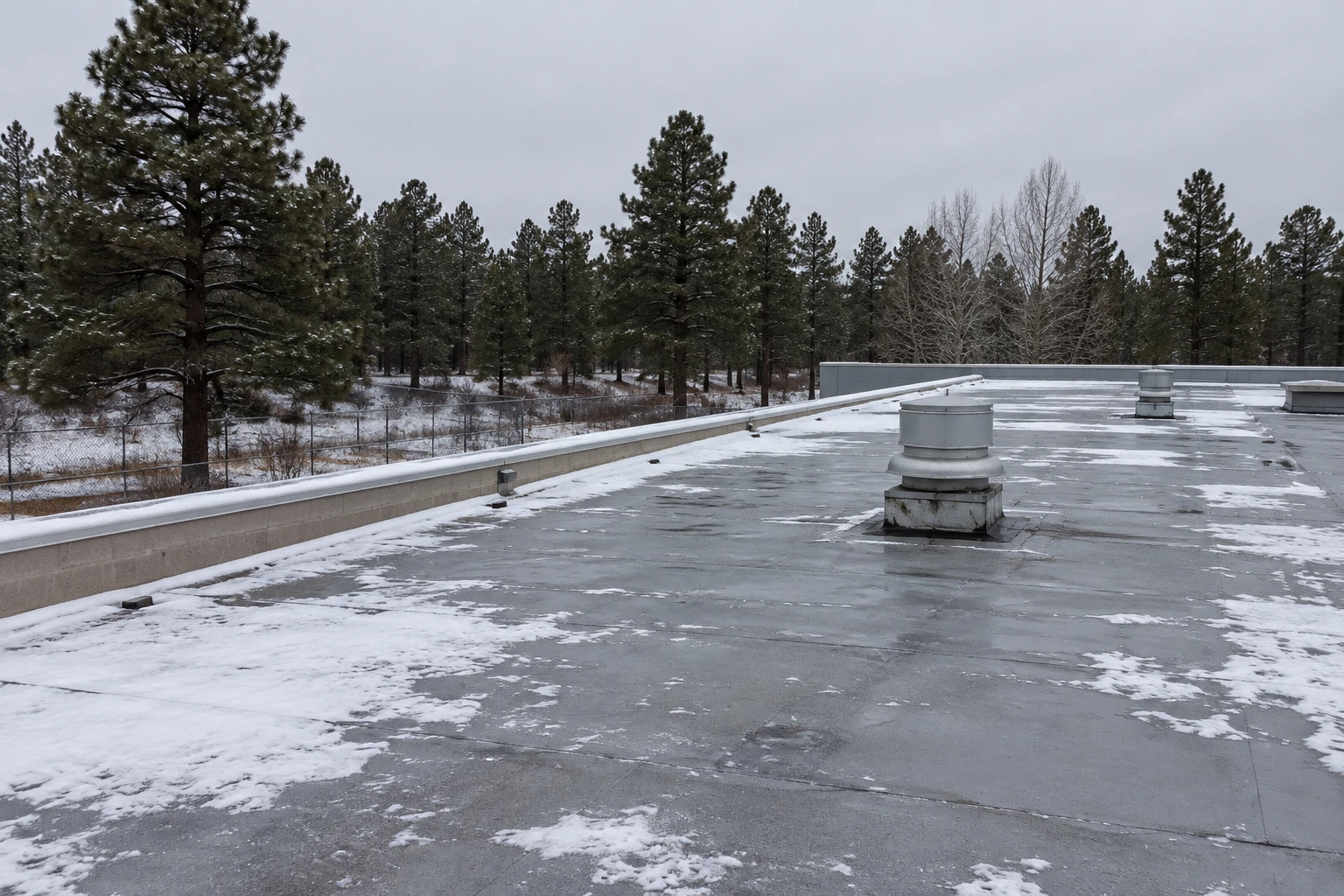
Snow does not care whose roof it is. A military building near Flagstaff, AZ carries the same snow load as any building at 7,000 feet, and it fails the same way. What changes is the path to the roof. Gates, badges, escorts and mission schedules decide when a crew can climb, and the snow calendar does not move for them.
Roofing on an installation follows a fixed order: access approval, submittals, staging, then the roof. An owner or contracting officer who plans in that order avoids lost weeks.
Planning starts with three documents: the contract scope, the site rules and the roof record. We read all three before we price. If the roof record is thin, we propose an inspection with cores and a moisture scan, so the baseline is a measured one.
Camp Navajo is run by the Arizona Army National Guard. It sits about 11 miles west-northwest of Flagstaff, in Bellemont along I-40. It opened in 1942 as the Navajo Ordnance Depot. It has 776 igloo structures for munitions storage and about 38 miles of railroad track. It is described as an industrial park, munitions storage facility and regional training site.
Units based there include a military police company, a transportation company, engineer detachments and Field Maintenance Shop 6. That mix points to the kinds of buildings an installation holds: shops, offices, storage and maintenance space, each with its own roof questions.
Bellemont's position on I-40 matters to logistics. Trucks reach the area from the interstate, and material can arrive from the Flagstaff exits. The route into the gate is the last stretch. We confirm the approach, the turning room and the inspection point before the first delivery, so trucks are not turned around at the gate.
Work on an installation starts at the gate. Each crew member needs approval to enter. The base sets what ID is required, how long approval takes and whether an escort is needed. Some areas, such as munitions storage, add stricter rules.
We plan for that time. Lists of names go in early. Vehicles are registered. Tools and materials may be inspected at the gate. An escort may need to stay with the crew all day, which sets the working hours. The schedule carries the lead time for each step, so the first day on the roof is a real date.
Photography is usually limited on installations. We ask what is allowed and agree on it in writing before the walk.
Delivery trucks face the same checks. Drivers need approval, loads may be inspected and the route inside the gate may be fixed. Material arrives in planned drops, not as needed. A missing pallet can cost a day, so the pre-job checklist counts every roll, tube and fastener box.
Military roofing follows Unified Facilities Criteria for roofing. These set design, material and installation requirements for federal buildings. They cover items such as membrane type, insulation, attachment, drainage, flashing and wind uplift. Specifications from the contracting agency add detail.
The scope for a roof on an installation reads against those criteria. Submittals list products and data. Substitutions need approval. We plan the paper time into the schedule, since submittals can take weeks. Core samples and moisture scans give the baseline, and the final report lists what was installed and where.
Do not assume a commercial spec applies. The contract documents rule.
Quality control is formal. Daily reports list weather, crew, work done and tests. Photographs follow the base's rules. Seam probes, pull tests and moisture readings go into the closeout file. The agency reviews the file and accepts the roof against the criteria.
The cold season begins in late September, and the snowpack that follows is heavy enough that the city tied several roof collapses to the February 2023 storm.
Installation roofs carry the same loads. A bowing truss or a ceiling that sags in a shop or storage building is a structural flag first and a leak second. We do a sag check before any reroof and flag structure problems to the owner. Roofing work needs dry days and mild temperatures, so the season runs from late spring to early fall.
Gate delays eat that season. A badge that takes weeks can push a job into winter. So the access request goes in as soon as the scope is set.
Structure comes first on older buildings. On an older building, decks, framing and drainage reflect the era it was built in. We check the deck by probe and by core, look for corrosion at fasteners and note any rot or sag. A bad deck changes the scope from roofing to repair-and-roofing, and the contracting officer needs that news early.
A base has training weekends, inspections, deployments and ordinary shift change. The roof schedule works around them. We ask for blackout dates, quiet hours and areas that cannot be disturbed. Work near active roads or rail needs traffic control. At a site with a rail network, such as one with about 38 miles of track, crews stay clear of train movements and follow the safety rules.
Materials can be an issue. Hot work near munitions or fuel is restricted or banned. We pick cold-applied or mechanically attached systems where the rules call for them. Fire watch and extinguishers stay on site. Each constraint goes into the scope before bid.
Weather windows interact with mission windows. If a dry week and a blackout week fall together, the job waits. We hold a backup week on the calendar and keep a temporary dry-in ready for any open section, so the building stays protected while the schedule resolves.
Guard facilities include armories, motor pools and maintenance shops. Each has big doors, long spans and equipment bays. An armory roof and a hangar roof share the same big-span problems, and the methods for National Guard armory roofing carry over to aircraft hangar roofing.
Bellemont sits at about 7,100 feet on I-40, higher than Flagstaff itself. Camp Navajo is described as an industrial park, so roof work in Bellemont mixes Guard buildings with industrial space. A hands-on commercial roof inspection comes first, and occupied building reroofing methods apply when the building stays in use. A roof capital planning report then ranks the work by budget year.
Records move upward. The roof record we build for a base building goes to the owner and, where required, to the agency. It lists the system, the area, the repair history and the remaining service. A ranked list across buildings tells the agency where to spend first.
Each installation sets its own clock. Plan on weeks for badges and vehicle registration. Send names early. Lead time goes into the schedule so the first work day is a real date.
No. Federal buildings follow Unified Facilities Criteria for roofing and the contracting agency's specifications. Submittals and substitutions need approval.
Gate and escort delays shrink the working window. Late spring to early fall is the season. A badge delay of a few weeks can push a job into winter, so request access early.
Usually not. Restrictions apply to hot work near munitions or fuel. We use cold-applied or mechanically attached systems and follow base fire rules.
Access steps, escort rules, blackout dates, staging areas, fire rules and photography limits. We write the decisions into the schedule. The owner and contracting officer sign off before the crew arrives.
Browse the services, roof systems and building types we work with across Flagstaff and nearby Arizona communities.
A walk of the roof with photos, findings and a written scope.
Active leaks, storm damage and blocked drains get a fast response.
Roofing across Flagstaff and nearby Arizona communities.