Ballast is weight, and snow is more weight. A ballasted single-ply roof in Flagstaff, AZ carries stone on the membrane all year, then adds a winter load that averages 90 to 97 inches of snow. That stack is the first question on any Carlisle SynTec roof of that type. Carlisle SynTec is a manufacturer of single-ply systems, mostly TPO, PVC and EPDM, with the insulation and flashing parts that go with them. Repair and maintenance of these roofs is our work. We start with the attachment method, then the deck, then the membrane.
TPO and PVC are thermoplastic. The seams are welded with hot air and become one sheet. Sure-Weld is the Carlisle name for its TPO. EPDM is a cured rubber sheet. Seams are taped or glued, and flashing is often a separate piece. Each has its own limits. TPO is white and reflective, and welds are strong when the surface is clean. PVC resists oils and grease. EPDM stays flexible in cold and tolerates a wide swing in temperature. We identify which sheet is on the roof by feel, by seam type and by a small test, before any repair is chosen.
Insulation and cover board sit under all three. Polyiso board is common, and a cover board adds impact resistance and a firm base. Edge metal and coping finish the perimeter. A system is a stack of parts, and the weakest part sets the life. We check the stack, not just the sheet.
The attachment method sets the risk. A mechanically fastened sheet is held by plates and screws into the deck. Under wind and thaw, fasteners can back out and push bumps through the sheet. A fully adhered sheet is glued to the board, so a leak stays near its source but a bubble means lost adhesion. A ballasted sheet is held by stone or pavers. It needs a deck that can carry the added weight with a snow load on top. Ballast also hides the membrane, so a leak is harder to find. We ask which method the roof uses before we plan a visit, because each calls for a different walk and different tools.
Wind and thaw work on fastened sheets differently. Wind lifts the field between plates and flutters the sheet. Thaw cycles work the plates loose from the deck. A fluttering sheet wears at each plate, and the wear shows as a line of small cuts. We look for those lines, because they mean the sheet is moving. Fixes include added plates, new fasteners and, on a failing field, a new attachment pattern with a replacement.
On February 28, 2023 a storm reached the city, and by March 2 it had left 24.5 inches in some areas and brought several roof collapses, according to city officials. Owners were told to look for ceilings that sag, trusses that bow and leaks that turn severe. On a ballasted roof, those signs matter doubly. The deck is already loaded, and the snow adds to it. We do not advise clearing a ballasted roof without a structural opinion. Stone shifts underfoot, and a crew can fall or damage the sheet. A sag check from below comes first, and the structural engineer decides whether to remove snow, and how.
Thaw adds a second load. Melting snow runs to drains, and ice at the drain holds the water back. A pond forms on the roof and freezes at the edges. The pond adds weight and stresses the seams. Heat cables, clear drain bowls and a snow plan keep the path open. We note every drain that sits under a drift line, because that drain sees the most water in the first warm spell.
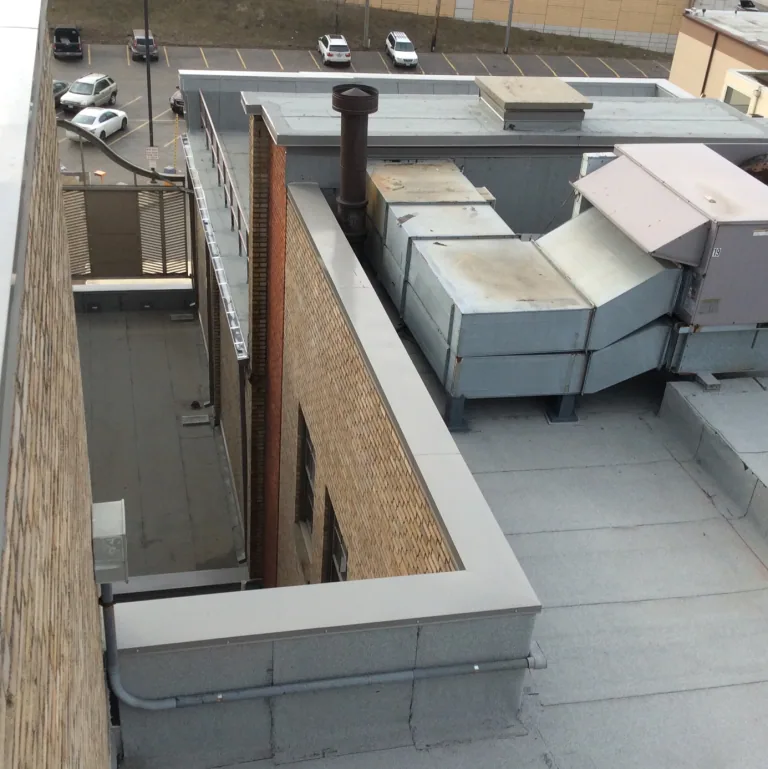
The fall walk follows a set order. Clear every drain, scupper and gutter. Probe the welded seams for lifted edges and the taped seams for open laps. Press the surface near fasteners for raised plates. Check every base flashing at walls and curbs, since flashing leaks more often than the field. Look at the pipe boots, the pitch pans and the sealant at terminations. On a ballasted roof, rake back the stone at drains, curbs and parapets, and look at the sheet beneath. Photograph each finding and mark it on the roof sketch. A membrane puncture repair comes after the cause is known.
Document the stone on a ballasted roof. Note where it is thin, where it has blown to the edge and where bare membrane shows. Bare membrane takes sun and wears faster. Thin ballast near a parapet is a wind risk. We record both on the sketch and replace stone where it has gone.
A TPO patch welded to TPO holds. A glued patch on EPDM holds if the surface is clean and the primer is right. A TPO patch on EPDM does not. We clean the area, test the bond and repair with the matching material and the system's detail. Flashing repairs follow the same rule. Where a roof has aged past patching, a commercial roof replacement allows a new attachment plan, tapered insulation and better drains. Drains are the first fix. A drain and scupper review often shows why a roof leaks in a thaw.
Cold-weather repair has limits. Adhesives and sealants cure slowly in the cold, and welds need dry, above-freezing surfaces. In winter we make temporary repairs that stop water, then schedule the permanent work for a dry window. We mark each temporary fix on the sketch with its date.
The Northern Arizona Technology Park takes up about 31 acres of city-owned airport land, with its Phase I hotel, restaurant and first office and research buildings. Flagstaff Medical Center, a Level I trauma center that opened in 1936, sits in the same winter. Any single-ply roof at either site is walked on its own terms, with the attachment method, the deck and the drains recorded first. The technology park area and the hospital answer to the same snow load, whatever each building's age, and so do the metal and concrete industrial roofs along Mike's Pike.
Put the attachment method in the roof file. Put the walk on the calendar before October. Fix lifted seams and loose plates while the weather is dry. A preventive roof maintenance plan keeps the file current. If the roof carries stone, get the deck rated before the next heavy winter. A replacement here is specified to the 2018 building and energy codes as Flagstaff amended them in 2019, so the new attachment pattern and insulation are drawn to that. An owner weighing a Carlisle sheet against Versico or Holcim Elevate single-ply should start from the attachment method and the deck, not the label.
Fund the roofs that fail the sag check first. Then the ones with open seams. Then the ones that are merely old. That order spends money where the risk is highest.
Not without a structural check. The deck already carries stone. Get a sag check and an engineer's opinion before deciding to clear it, and never send untrained people up.
A fastened sheet is screwed to the deck through plates and can show bumps if fasteners back out. An adhered sheet is glued to the board and shows bubbles if adhesion fails. Each leaks differently.
It stays flexible in low temperatures, which helps. Seams and flashing are the weak points, so inspect them in the fall and again after the thaw.
Clean the area, dry it, then hot-air weld a matching patch over the open seam. Cold or wet surfaces do not weld, so we wait for a dry, above-freezing day.
Plan a replacement once wet insulation spreads across wide areas, seams open in rows or the sheet turns brittle. A core sample and a moisture scan show the answer.
Browse the services, roof systems and building types we work with across Flagstaff and nearby Arizona communities.
A walk of the roof with photos, findings and a written scope.
Active leaks, storm damage and blocked drains get a fast response.
Roofing across Flagstaff and nearby Arizona communities.