
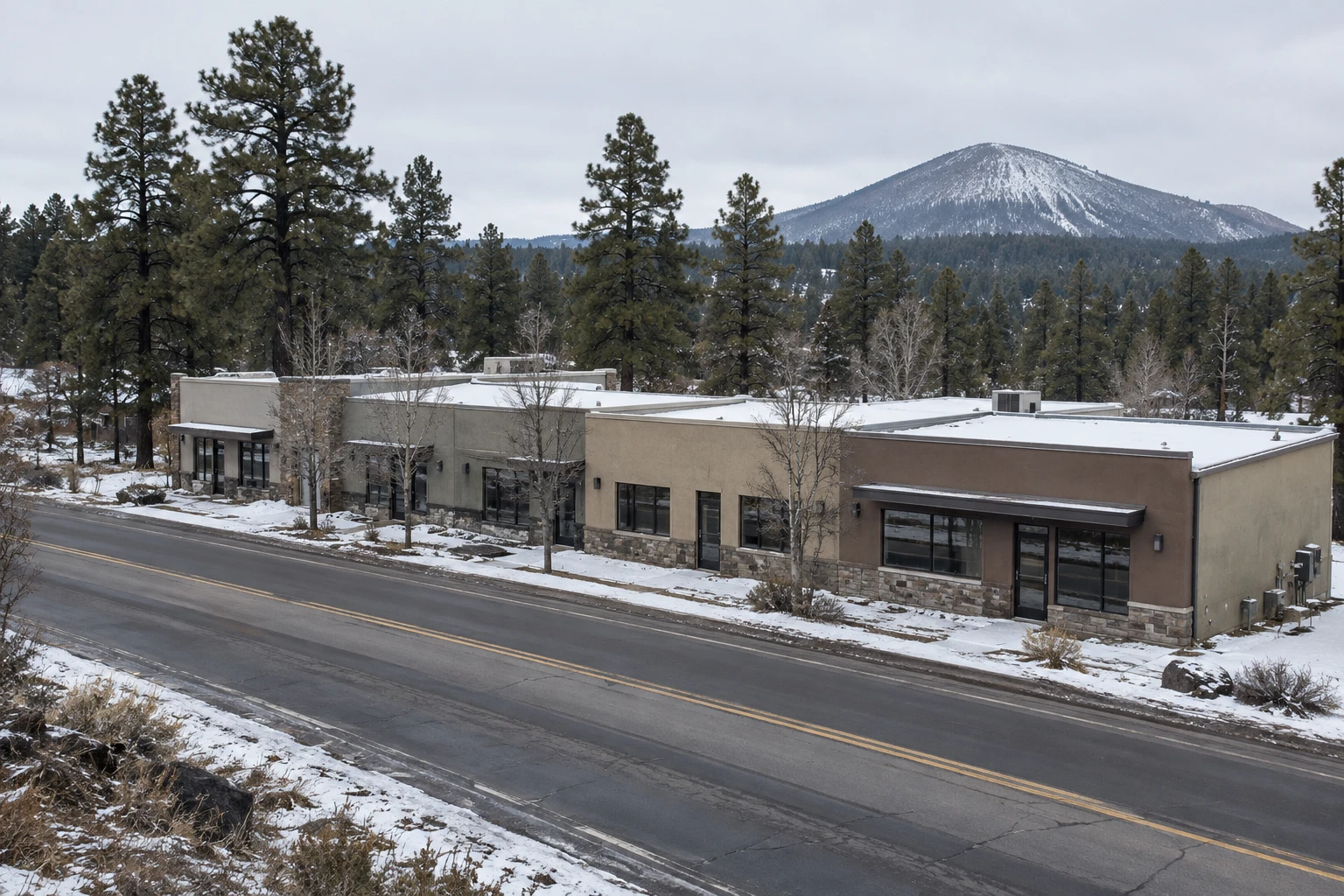
Cool summers spare a roof the heat and hand it the freeze. Mountainaire covers 10.2 square miles at 6,952 feet, with 1,068 residents in 2020, and summers there are warm but not hot. No average monthly temperature climbs above 71.6 degrees F. That gentle summer leaves winter as the season that tests a roof. Commercial Roofing Flagstaff inspects and repairs commercial roofs in Mountainaire, AZ, and we begin with the snow.
A roof that never bakes still ages. Freeze-thaw cycles, ultraviolet light at altitude and ponded water do the work that heat does elsewhere.
Mountainaire spreads across 10.2 square miles, which is a wide area for 1,068 residents. I-17 exit 333 serves Kachina Boulevard and Mountainaire Road. Crews come down from Flagstaff on the interstate and reach the community in a short drive.
About 22.9 percent of housing units were vacant in 2020. Homes are not shops, but a quiet commercial building runs the same risk: a leak goes unseen for weeks, and wet insulation carries the damage sideways under the membrane. Every first walk records the roof system, its age and its condition, and the plan builds from that record. The report goes to the owner with photos tied to places on the roof, so a manager who lives elsewhere can read it without a site visit.
Mountainaire's own summer record is cool, but the freeze season is long. Flagstaff, the nearest big city, logs its first freezes in late September, with a record low of minus 30 degrees F. Flagstaff's yearly snow of 90 to 97 inches comes at roughly 7,000 feet, and Mountainaire sits just under that elevation.
Grit and debris pile up at every drain in the dry stretch between storms, and the monsoon then tests each one. Summer storms bring about a third of Flagstaff's yearly precipitation, and July and August are the busiest months for thunderstorms. A roof must shed that rain and then carry the winter snow. Between the two sits the fall walk, the one visit where a crew can fix a lifted flashing, reset a loose fastener and clear a drain while the weather is still dry and the membrane is still pliable. Drains and flashings do both jobs, so they get the first look, and every corner and wall joint gets a hand press because corners lift first.
In the Flagstaff storm that ran from February 28 to March 2, 2023, some areas collected 24.5 inches. Officials counted several snow-load roof collapses after it. The city's list of warning signs began with ceilings that sag, then trusses that bow and leaks that turn severe. We treat those as structural flags.
A flat or low-slope roof shows trouble from below. Look at the ceiling tiles. Look at the doors. Look at the gap where a wall meets the ceiling. Look at sprinkler heads and light fixtures that have dropped out of line. If anything has shifted, rake the roof edge from the ground and have us look at the structure. Do not walk a loaded roof to find out. Snow also drifts against taller walls and equipment, so the roof edge may look light while a drift behind a parapet or a mechanical well holds far more. We mark those spots on the roof plan and tell the owner where to clear first.
Flagstaff gets sun for about 78 percent of its possible hours, near 3,475 hours a year, and Mountainaire sits a short drive south. Thin air at this elevation lets plenty of ultraviolet light through, and a membrane takes it every day it is not covered by snow. The surface chalks, cracks at seams and loses flexibility, and cold weather finishes the job.
A roof coating can renew a sound membrane and add a reflective layer, but only over dry insulation. We confirm that with a moisture survey before a coating goes on. A coating on a wet roof seals the water in. The coating also needs a clean surface, so we wash the roof, repair seams and flashings, and let the membrane dry before the first coat goes down. Coating work belongs in the dry window of late spring or early fall.
Meltwater that cannot reach a drain spreads across the field and ponds. Pine needles and grit collect at the drains and scuppers, ice seals them, and the pond sits on the roof. We clear each one and flag any low spot that holds water after rain.
Seams and flashings fail at the edges of the roof first. We probe each seam and check each flashing on the fall walk. A seam failure found in October costs far less to fix than one found after a January thaw. Fasteners get the same attention. A fastener that has backed out of a metal panel or a membrane plate lifts the material around it, and wind and ice then work that lift into a tear.
The walk sorts the roof into repair, coat, recover or replace. Cost follows roof area, system, access and deck condition. Timing follows the weather, and late spring and early fall are the workable windows.
Kachina Village lies on the same I-17 run, and one trip can cover both. Mid-winter calls come down to emergency roof repair, with the permanent fix held for a dry stretch. Book a replacement through our commercial roof replacement crew well before fall. If the budget cannot cover a full replacement, we set a repair list for this season and a dated watch list for the next walk. Owners then know what money goes where, and the watch list carries a date so nothing drifts into the next winter unchecked. A second stop on the same trip can be a walk in downtown Flagstaff when the schedule allows.
Lower heat helps, but freeze-thaw cycles, ultraviolet light and ponded water wear a membrane down anyway. The walk tells us the actual condition, and the age of the roof matters less than what the seams, flashings and drains look like.
Move people out from under that spot, then rake the roof edge from the ground. Then call. A sagging ceiling, a bowing truss or a severe leak, the signs the city listed after the 2023 storm, calls for a structural look before any membrane work.
Yes. A survey reads the insulation under a surface that looks dry. If the insulation is wet, the coating wastes money. If it is dry, the coating can extend the roof, and we know the repair list is complete before work starts.
Book in winter or early spring for work in the dry window. The window runs from late spring to early fall, with the monsoon cutting in during July and August. Material lead times and crew schedules fill the calendar, so early requests get first pick.
Tell us the address and the roof type if you know it, say when the roof was last walked and pass along any earlier reports. We plan the drain, sag and seam checks from those and pair the visit with other stops on I-17 when we can.
Browse the services, roof systems and building types we work with across Flagstaff and nearby Arizona communities.
A walk of the roof with photos, findings and a written scope.
Active leaks, storm damage and blocked drains get a fast response.
Roofing across Flagstaff and nearby Arizona communities.