
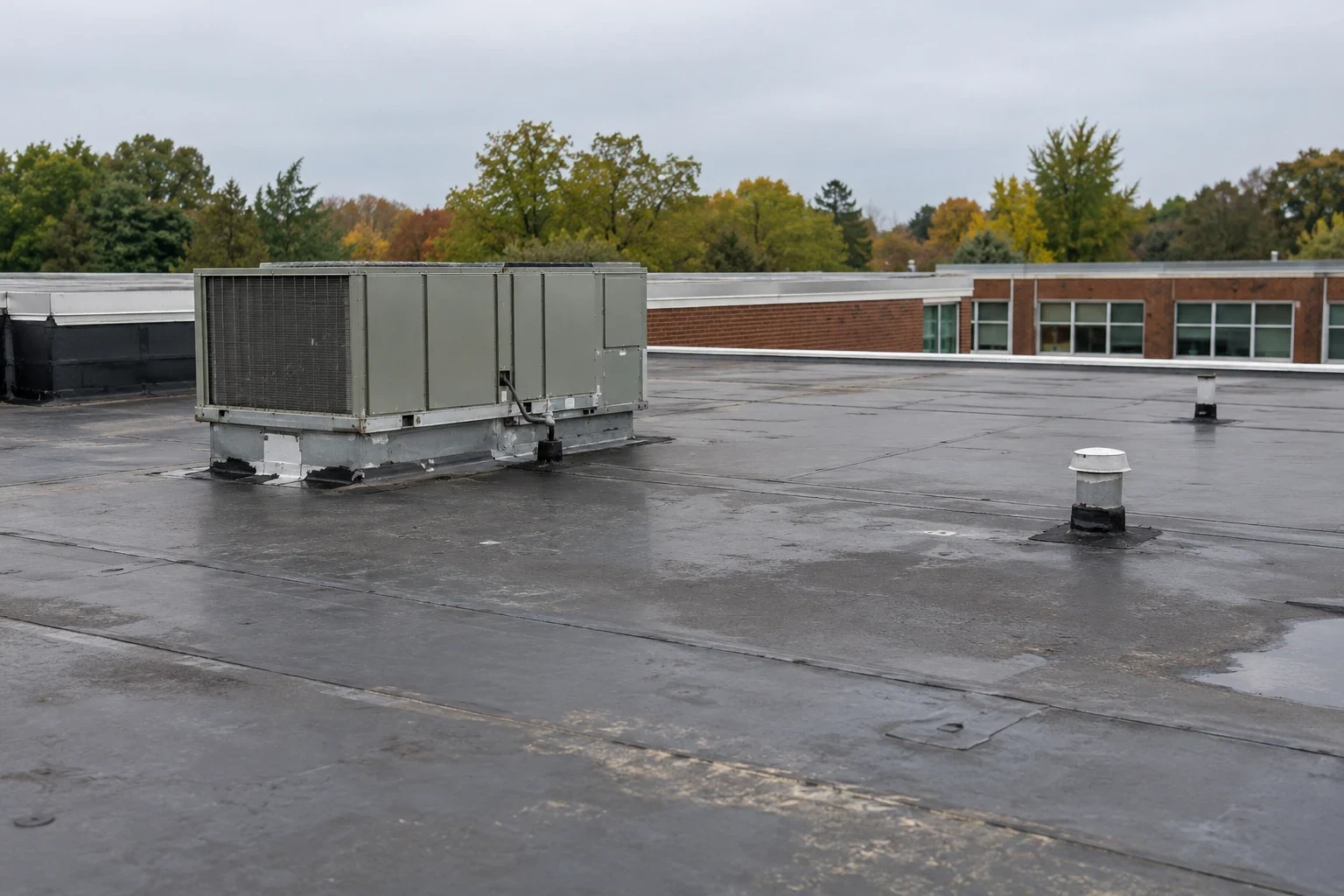
Snow on a school roof is a safety problem before it is a leak problem. Ice slides off an eave onto a walkway. A drift loads a gym roof. A frozen drain floods a hallway. In Flagstaff, AZ, where winters stack snow for months, a facilities director can face all three before spring.
Phone us ahead of the first big storm and name the campus, what covers its roofs and the last time anyone walked them. We book the sag and drain checks, and repairs wait for a gap in the school year.
School roofs have long spans over gyms, cafeterias and auditoriums. Those spans carry snow with little help. February 21, 2019 holds the one-day mark, 35.9 inches. The storm that began February 28, 2023 brought reports of several roof collapses, with ceilings that sag, trusses that bow and severe leaks named as the signs.
Teachers and custodians need the signs on a card. A sagging ceiling tile, a door that sticks and a new crack are structural flags. Close the room, keep students out and call an engineer. A joint line run by the city and Coconino County takes reports of structural roof trouble after heavy snow, and the number belongs in the front office.
A slab of sliding snow is the next hazard. A heavy slab can release from a sloped section onto a lower roof or a walkway. Map the lower roofs under higher ones. Add snow retention or a protected zone where they exist. Keep that map in the facilities file, so a new staff member knows where not to stand after a storm.
Flagstaff Unified School District had about 1,590 employees in 2017, among the larger payrolls in the county. A campus that grew in stages can hold older classrooms, a gym, a later addition and portable buildings, and each roof differs in type, age and detail.
A university runs on the same academic calendar, so a college and university roof faces the same summer window, and a church hall roof spans a large room much as a gym does.
Start at the roof edges over walkways and entrances. Ice forms at eaves and slides off in sheets. Look for snow guards, heat cable and clear signs. Then check each drain and scupper. Test flow. Clear grit. Find drift lines against walls, units and mechanical wells.
Check expansion joints between wings. Cracked covers let water into the gap. Check roof hatches and ladders, since staff need safe access after a storm. Photograph every roof from fixed points in fall. A commercial roof inspection can follow this order and end in a report fit for the school board.
Look hardest at the gym and the auditorium. Long trusses carry the most snow. Look at the underside of the roof from inside. Note any bow, new crack or water stain. Take a photo with the date. If it changes between visits, call an engineer.
The July and August monsoon brings about a third of the year's moisture to a campus that sits empty. Summer storms test flashings while the school is closed, so leaks can start unseen. Walk the roofs in August, before students return.
Winter melt tests drains and edges. Freezes arrive late in September, and Flagstaff has recorded minus 30 degrees F. Snow melts by day and refreezes by night. Ice builds at eaves and dams the next melt. We fix the edge detail and the drain, not just the stain on the ceiling.
Sun matters here. With sun for about 78 percent of possible hours, south-facing slopes clear quickly and north-facing ones keep snow for weeks. A school roof with both has uneven load. Note which side holds snow, and plan clearing there first.
Decide how snow and ice come off before the storm hits. One named lead goes up with plastic shovels, and drains and drift pockets are cleared before open roof. Any walkway under a roof being cleared is closed first. Crews working the roof wear fall protection and keep an exit open. Do not let students or volunteers on a snowy roof.
Roof repair works around the school day. Loud work waits for evenings, weekends and breaks. Staging stays away from bus lanes and entrances. Crews are badged and escorted as the district requires. The district's facilities office gets a daily update and a closeout package.
A short notice to families and staff, with dates and what to expect, keeps the work from becoming a rumor. We provide wording on request, with the work areas marked on a simple site plan.
Repair local failures with the right material. When wet insulation covers a big area, schedule a commercial roof replacement for summer break. Cores and an infrared scan show how far the wet reaches. A recover over a dry, sound roof is possible, but heavy snow loads leave little room for an extra layer.
Split the job into phases, and the rest of the building stays in use. Specify a system that tolerates cold, movement and ice. Add snow guards where sliding snow could hit a walkway. Keep a record of the materials and methods for the district file.
Put money into the details first. Edges, drains and curbs cause most leaks. A school that fixes them before winter spends less than one that chases leaks all spring. Where a roof is near the end of its life, the district should budget for replacement before the next heavy winter, not after a failure.
Test the finished work. Run water to the drains. Probe the seams. Take new moisture readings. Record them against the baseline.
Hold one list district-wide: the roof type, its age, the last walk, open items and what lies underneath. Rank by consequence, then condition, then snow exposure. The worst roofs get funded first, using the summer windows. Every roof gets walked in fall and again after the thaw. Before the first storm, send us each campus and when its roofs were last checked. Wherever a site sits, whether in East Flagstaff or out toward Fort Valley, it belongs on the same list in the same format.
A deferred list with recheck dates helps the board see why some roofs wait and others do not.
Ceilings that sag, trusses that bow, doors that stick and cracks that are new. The city named these after the February 2023 storm. Empty the room, keep students out and call an engineer, then us.
Minor patches can go ahead during classes. Larger jobs wait for a break. We stage away from bus lanes and entrances, close each section in daily and schedule loud steps for evenings or weekends.
Use snow guards at eaves above entrances, add heat cable where ice builds, and close the walkway below before anyone clears the roof. Fix the edge detail that lets ice form.
Summer break is the best window. Freezing temperatures return in late September, so plan to finish well before then. Book the work in winter, so materials and crews are ready.
Dated photos, moisture readings, the scope, the materials and a closeout summary. Business offices use them for budgets, insurance and audits, and a later crew learns what went in.
Browse the services, roof systems and building types we work with across Flagstaff and nearby Arizona communities.
A walk of the roof with photos, findings and a written scope.
Active leaks, storm damage and blocked drains get a fast response.
Roofing across Flagstaff and nearby Arizona communities.