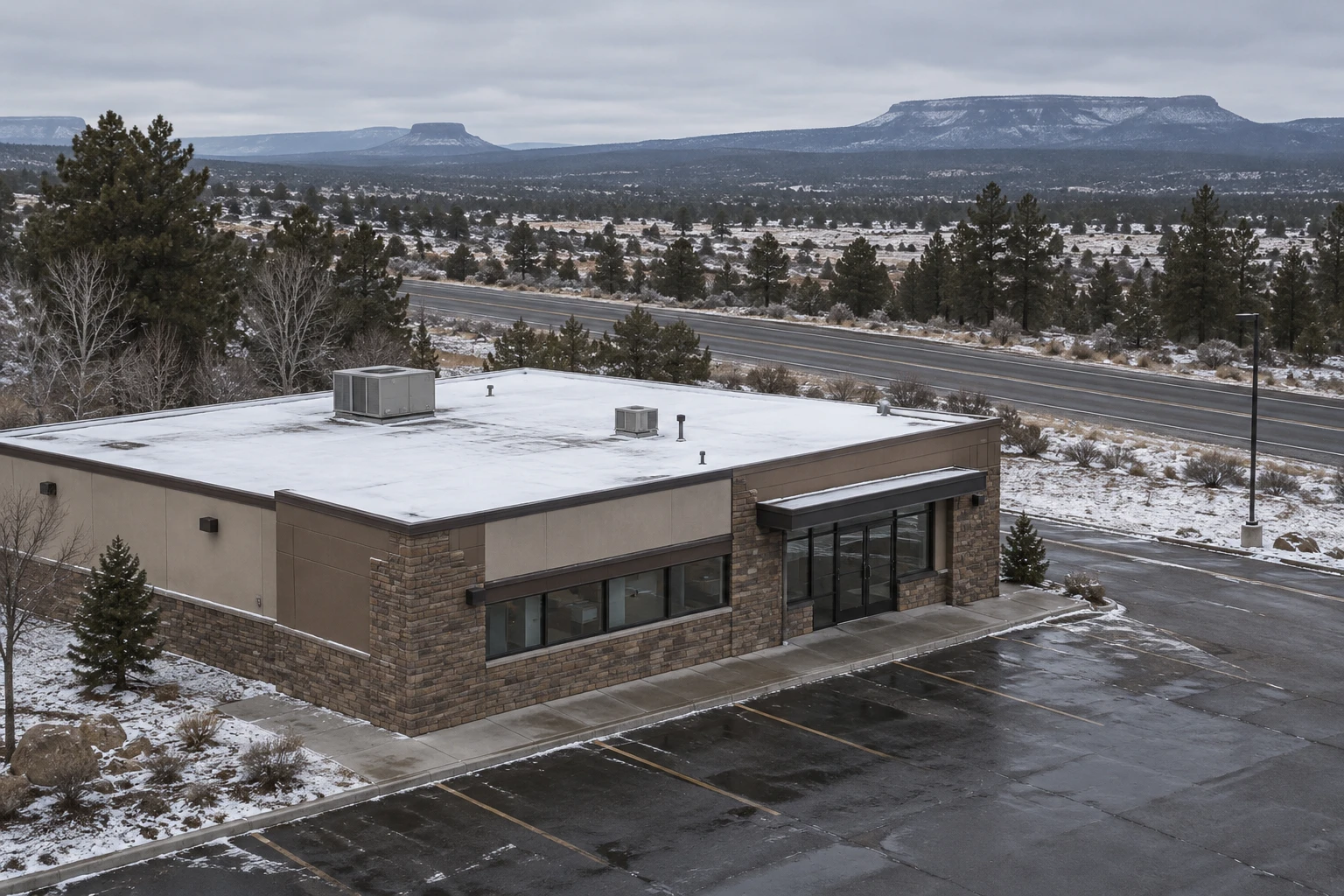
An empty building still has a roof, and the roof still has to work. Commercial Roofing Flagstaff covers commercial roofs in Gray Mountain, AZ, about 39 miles north-northeast of Flagstaff on US 89. The place once had motels, a trading post, gas stations and a state transportation maintenance yard, and most of those businesses have closed. A roof over a closed building goes unwatched, so nobody sees the first leak.
So the work here splits in two. Keep the roofs that still earn money sound, and keep the idle ones from becoming a larger bill.
Gray Mountain sits on a highway. A roadside building, whether lodging, fuel, retail or a maintenance yard, raises the same roof questions: long spans, rooftop equipment, canopies and edges open to wind. The first walk on each lot settles which of those apply.
What we look for does not depend on the business. Canopy roofs over fuel islands and entries carry their own drains and flashing. Low-slope roofs on retail and lodging need seams, drains and curbs checked. Metal buildings need fasteners and sealant looked at. Each type gets a ranked list with the cost drivers beside it.
Owners with a roof still in use can book a standard commercial roof inspection. Owners with a closed building can book a condition walk that records the state of the roof as it stands.
A maintenance yard or any shop building with large doors adds another check: the head of each door opening, where flashing and wall panels meet the roof edge. Doors that stick, ceilings that sag or panels that bow after a heavy snow are structural flags, and we mark them for an engineer before any roofing proceeds.
A closed building loses its early warning system. No one hears the drip, sees the stain or notices the door that no longer closes. Water finds a seam in spring, and by next winter the insulation is soaked and the deck is soft.
A basic care plan for an idle roof has four parts. Clear the drains and gutters so snowmelt leaves. Seal flashing, penetrations and open laps. Repair or secure any loose edge metal before wind peels it. Walk the roof twice a year and photograph it, so the file shows the condition on a date.
That plan costs far less than a replacement. It also protects the owner's choices: a building with a sound roof can be sold, leased or reopened, and one with a failed roof carries a large repair into every option. If the owner is deciding whether a roof is worth saving, a roof survey gives the answer with photographs and moisture results.
Security matters on a closed building. We record roof hatches and ladders, confirm they are locked and check that skylight domes are intact. A broken dome on an empty building lets weather in all winter, and a lock on the hatch keeps casual traffic off the membrane.
People have discussed wind farm proposals for the ridge west of town. A roof on open ground has no neighbor to block a gust either, so edges, corners and canopies get checked first.
Wind starts at the perimeter. A lifted corner of membrane, a coping cap that rattles or a fascia that has moved lets air under the roof, and a fluttering sheet tears its own seams. Our wind damage repair work resets edge metal on new cleats, re-bonds lifted membrane and adds fasteners at corners and perimeters.
On metal roofs, the check is fastener pull and panel laps. A screw that has backed out loses its hold, and a panel that moves wears the hole. We replace worn fasteners with larger ones and reseal laps with a sealant that stays flexible.
Canopies deserve their own pass. A fuel canopy often has a thin roof deck, narrow edge metal and a broad flat underside that wind pushes up against. We check the underside connections, the edge trim and the drain outlets, because a canopy that loses an edge puts debris on a driveway.
Our snow number comes from Flagstaff: 90 to 97 inches in a year, recorded near 7,000 feet. Gray Mountain is 39 miles from there. In the days after February 28, 2023, parts of the Flagstaff area collected 24.5 inches of snow, and city officials reported several roofs collapsing under it. The signs they listed apply to any building with a snow-loaded roof: sagging ceilings, bowing trusses and severe leaks.
In Flagstaff the monsoon delivers roughly a third of the year's moisture, mostly as July and August thunderstorms. A roof with a clogged drain, an open canopy edge or a cracked curb bead shows it fast in a downpour.
Flagstaff has logged minus 30 degrees F, and its freezing weather returns every late September. Any roof exposed to that cold cycles through freeze and thaw, so we schedule seam and flashing work for workable temperatures.
Thirty-nine miles is a real drive. We plan each visit to cover the roof: drains, flashing, edges, fasteners and a photo record, in one trip. Larger work is staged, with materials, a lift and a crew arriving together, in a dry window.
An active leak gets a temporary dry-in as soon as the roof can be walked, and the emergency line never closes. Permanent repairs follow when the weather allows. For owners along US 89, a visit can often be paired with calls in Timberline-Fernwood and Doney Park, which sit nearer to Flagstaff on the same highway.
A maintenance program is the cheapest way to cover distance, since two scheduled walks a year replace many unplanned trips.
Often, yes, if the owner expects to sell, lease or reopen. A sound roof keeps every option open. A failed roof adds a large cost to each one. A basic plan clears drains, seals open flashing, secures edge metal and records the roof twice a year, and it costs far less than replacement.
We walk the whole surface, probe seams, open suspect details and run a moisture check on any area with stains below. A core sample identifies the layers and insulation condition. Age and warranty stay unconfirmed until paperwork turns up. The result is a ranked list of repairs.
It needs its own look. Canopies have thin roof sections, drains close to traffic and edges that catch wind and snow slide. We check fasteners, seams, drains and the edge, and we confirm that water leaves away from pumps and walkways. Work near fueling areas follows the site's safety rules.
About 39 miles north-northeast on US 89. We combine tasks into one trip, stage larger jobs for a dry window and keep an emergency line running around the clock. The first response to a leak is a cover that stops the water until the weather allows a permanent fix.
Yes. One pass maps every roof on the lot, and it shows ponding, lifted edges and missing fasteners without a ladder on each building. We then walk the roofs the images flag and confirm what we saw. The result is a ranked list of repairs for the whole lot.
Browse the services, roof systems and building types we work with across Flagstaff and nearby Arizona communities.
A walk of the roof with photos, findings and a written scope.
Active leaks, storm damage and blocked drains get a fast response.
Roofing across Flagstaff and nearby Arizona communities.